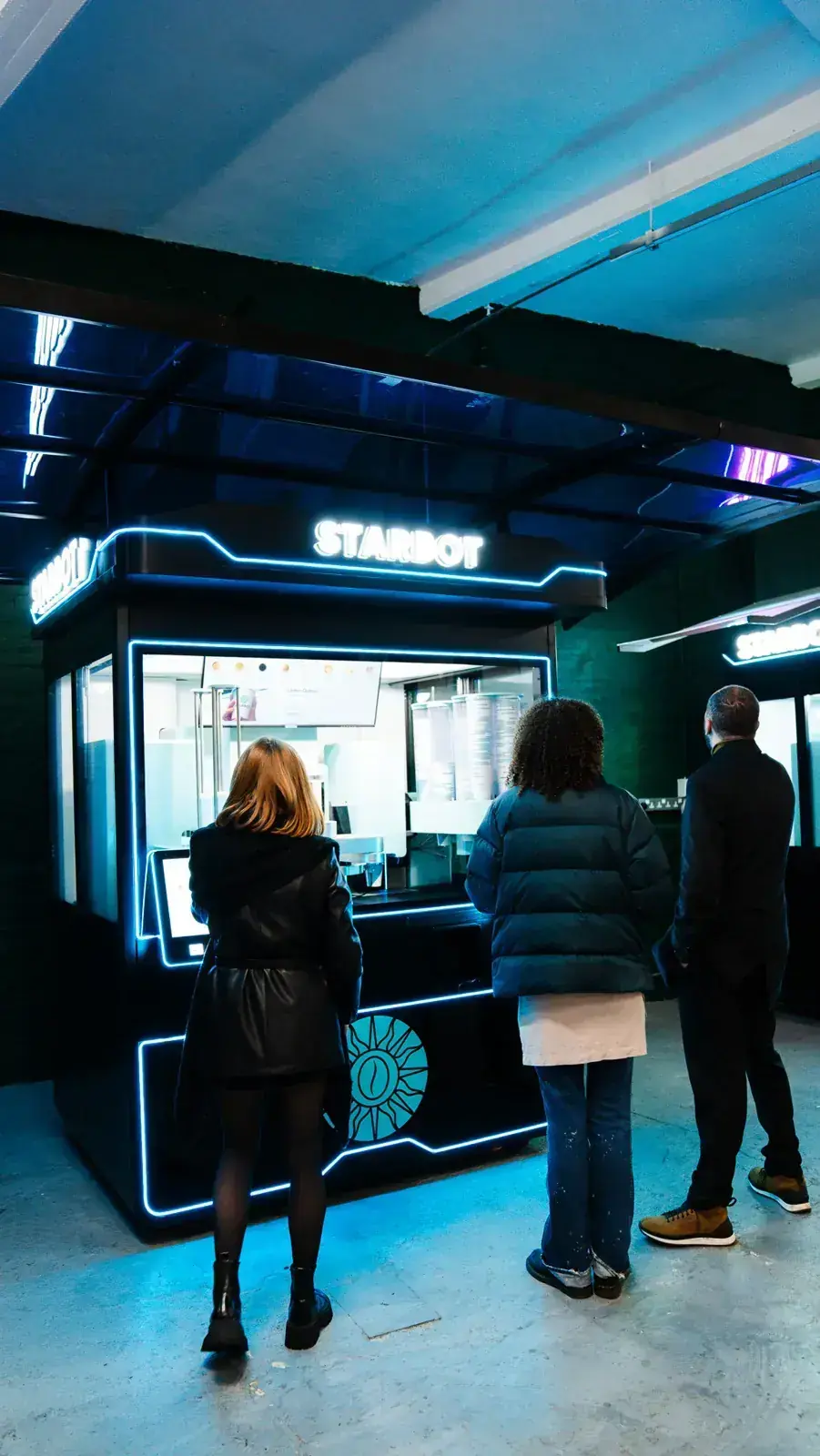
A coffee kiosk that pays rent on 2.5 m² of mall space and draws a crowd because people stop to watch it work. Free to host — we install, stock and service it; your
Weekend-weighted, with a long weekday afternoon lull that no staffed unit covers profitably.
A shopping centre does not buy a coffee machine. It fills a space, and the question the commercialisation team asks about any that footprint of mall is what that spot returns against what it costs to manage. The spots we want are the ones no letting agent has a tenant for — the head of an escalator, a lift lobby, the corridor from the multi-storey — and a kiosk earns from them without taking a single unit off the letting schedule.
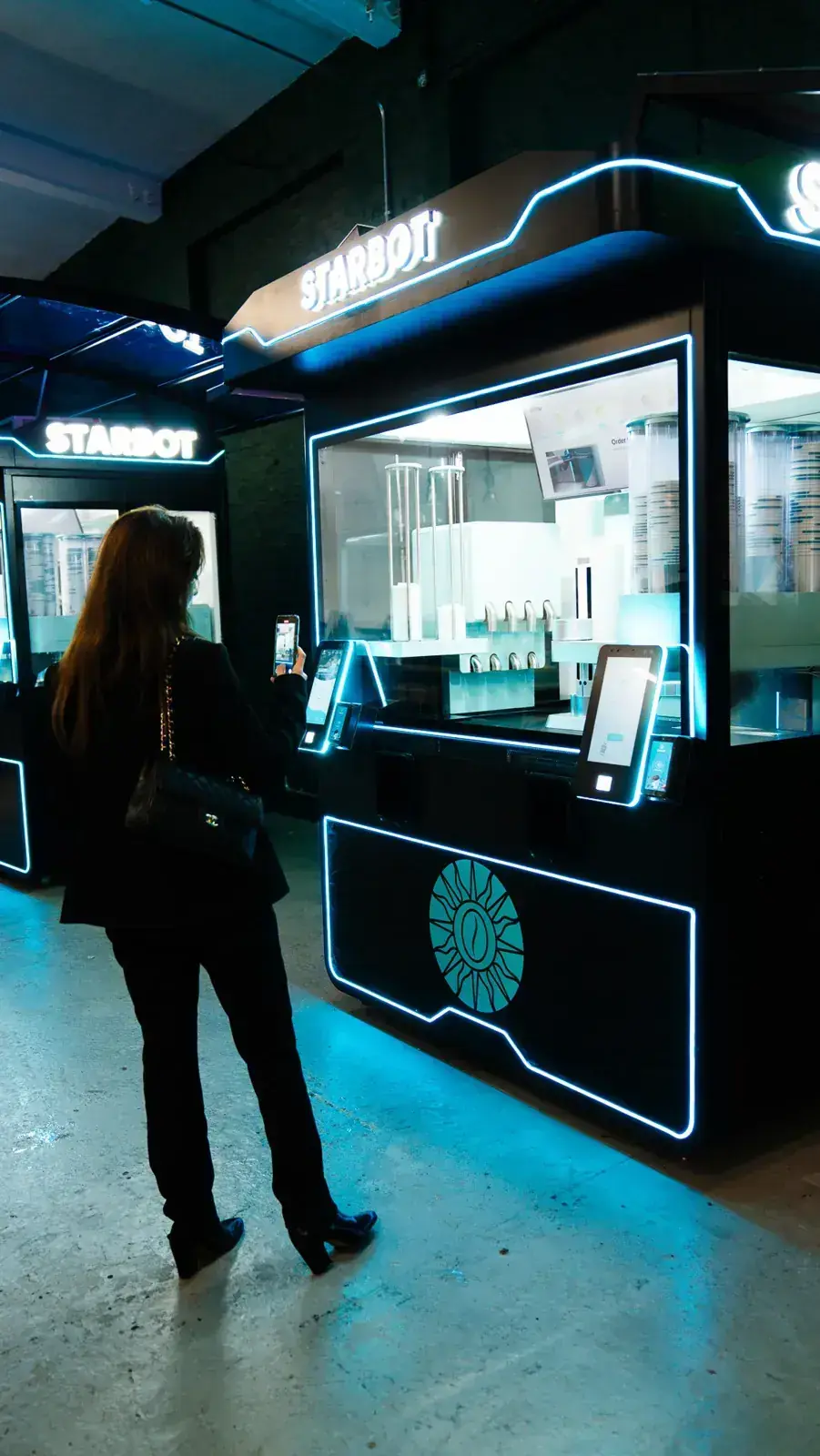
The second thing a centre gets is dwell, and dwell is the currency of a mall. An arm assembling a flat white in the open is the reason a shopper stops walking, and a shopper who has stopped is a shopper who is still in your building. The novelty does fade — we will not pretend a kiosk is a permanent attraction — but the position it occupies keeps trading long after people have stopped filming it.
The trading pattern is what decides it. A staffed retail merchandising unit is paid in full through the Tuesday afternoon lull in order to catch Saturday, which is why mall coffee kiosks have been failing on wage cost for twenty years. A machine has no wage attached to Tuesday afternoon, so the weekday trough stops being the thing that kills the site and becomes simply a quiet part of the week.
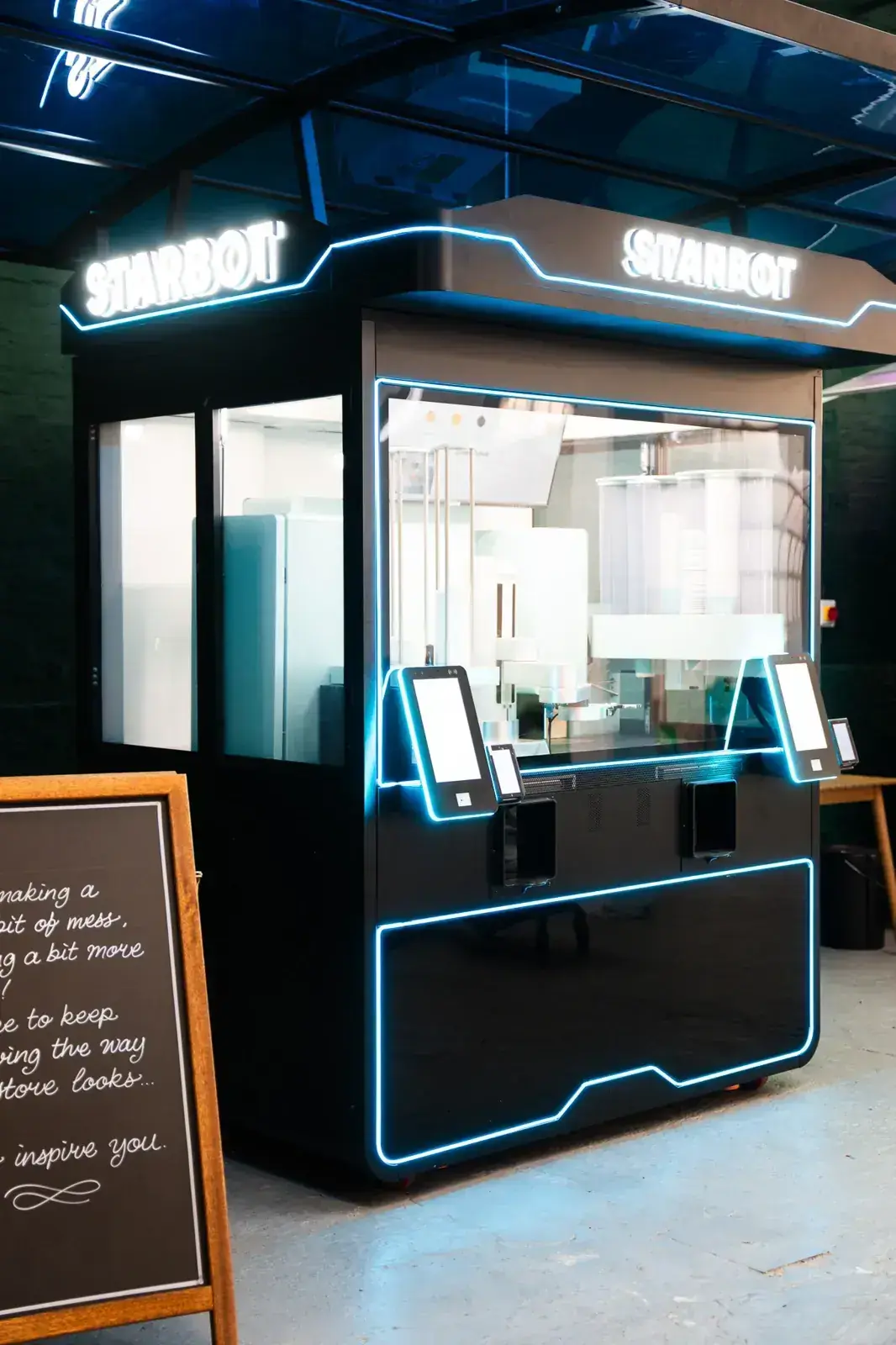
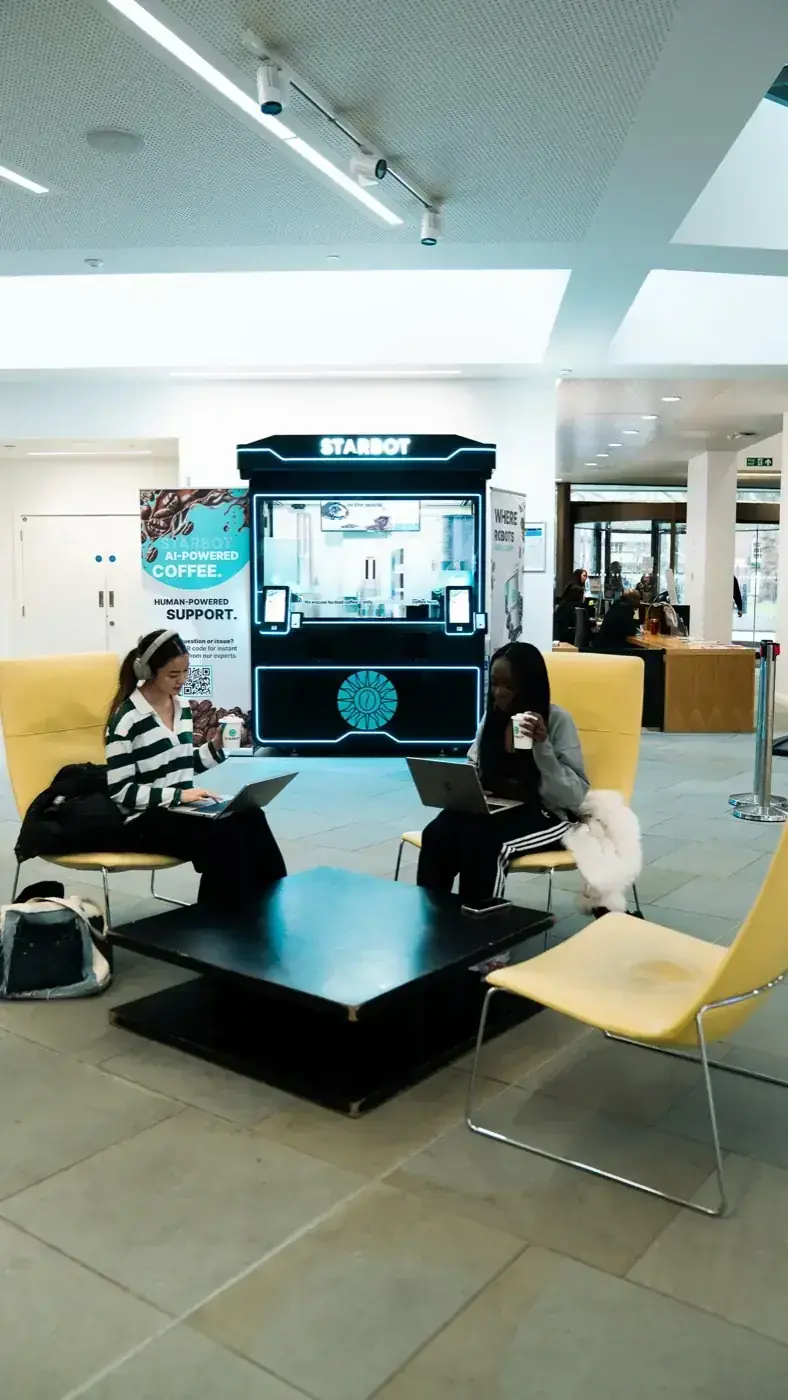
Photographed at City St George’s, University of London — our live site. Real photography, no renders.
Mall kiosks fail on staff cost during the weekday lull, which is most of the trading week.
This is the part nobody puts in the business case, because it is nobody’s job to write it down.
A branded unit needs a lettable footprint and a multi-year lease. This needs that footprint and earns on a licence — it goes in the spots a lease will never fill.
Same drink at 06:00 and at 22:00, in under 60 seconds, from a corner of floor.
Not a generic day. This is how the demand actually arrives in this kind of building — including the hours a staffed counter is paid for and nobody comes.
Before the doors. Cleaners, security, the centre team and retail staff arriving to open their own units — a small, absolutely reliable trade that no mall tenant is open for.
Openers, prams and older shoppers moving slowly. Low volume, long dwell, and the part of the day when a kiosk with visible theatre gets watched rather than passed.
The build. Traffic thickens toward the anchors and the food court, and the transitions between levels start doing the work of a queue-forming spot.
Lunch, and the one window where the food court genuinely competes. This is why we would rather be at a level transition than fifty metres from four coffee brands.
School pick-up and after-college traffic. Younger, faster-moving, and the audience most likely to buy a cold drink and film the arm making it.
The weekday collapse that empties staffed kiosks, extended on the centre's late-night trading day. The kiosk keeps trading through both without a second shift.
Saturday carries a disproportionate share of the week. Sunday is compressed by restricted trading hours for the larger stores, which concentrates the whole day into a few hours.
Two spots forty metres apart in the same building can differ by half the sales. These are the positions that work in shopping centres — and the one that does not.
People pause at a level transition whether they intend to or not, and a pause is what converts. It is also the part of the mall that letting agents cannot do anything with, so the space costs the centre nothing in foregone rent — which is the argument the asset manager actually wants to hear.
Everybody enters through it and nobody has ever let it. It works best in centres where the car park is the main arrival point rather than the street, because then it catches the shopper on the way in, before the food court has had a chance at them.
The anchor generates the reliable footfall of the mall and its doorway is where people stop to decide where to go next. The constraint is the anchor's own lease and the clear width in front of its entrance, so this position is agreed with the centre team rather than assumed.
The food court is where the mall's coffee already is, usually three or four brands of it, all with seating we do not have. A kiosk sited there is the fourth-best cup within fifty metres and it will trade like it.
In a shopping centre the space is controlled by the commercialisation or mall income team, operations are controlled by the centre manager, and the income line belongs to the asset manager or the owner's representative. That is a different chain from a lease, and a much shorter one, because a kiosk on a licence lands in the commercialisation budget rather than the rent roll and does not need a letting decision at all.
What actually holds these up is never the commercial terms. It is the fire strategy, which governs the clear width of every mall, and the existing leases, some of which restrict competing uses within a defined part of the centre. Both are answerable in a walk-round with the centre team, and asking about them in the first conversation rather than the fourth is the difference between a position agreed in one visit and a position argued about for a season.
It must not, and the position is agreed on the walk-round against your own fire strategy rather than argued about afterwards. In a space that size there is normally more than one workable spot at a level transition, which is why we ask to walk the mall before proposing one.
Neither. It is a site licence to place and operate equipment in an agreed position. It does not give us exclusive possession, does not create a tenancy, and the income sits in commercialisation rather than in rent — which is also why it does not need to go anywhere near your letting schedule.
That is a question only your leases can answer, and it is the first one we ask. Some centres have restrictive user clauses covering a defined part of the mall. If a position is caught by one, we move to a part of the centre that is not rather than test it.
Through the service yard and the goods lift, in the delivery window the centre already operates, which for most malls means before opening. The kiosk reports what it has sold, so a visit is scheduled against real stock rather than turning up weekly and hoping.
Yes, and the licence should name a fallback position for exactly that reason. Nothing is plumbed and nothing is fixed to the floor, so relocating it for a car display or a Christmas booking is a scheduled visit, not a project.
We do. It is our equipment, insured and maintained by us, and your centre team is not adopting an asset or adding a line to its planned maintenance schedule.
Nothing here needs plumbing, drainage or a fixing to the fabric of the building. The kiosk stands on the floor and plugs into a 16A socket.
A vending contract creates work for your facilities team. This one does not: restocking, cleaning, faults and reporting are ours.
Beans, milk, cups and syrups come in through the service yard on the centre's own delivery window, so nothing crosses the mall floor in trading hours. The visit is triggered by what the kiosk reports it has sold, which in a weekend-weighted building means the round follows Saturday rather than a calendar.
The mall team cleans the floor it stands on, as it already does. The drip tray, the milk path and the interior are ours, and there is no open jug, no hot plate and no grounds bin for centre housekeeping to inherit — which matters in a building where the cleaning specification is priced per square metre.
The kiosk reports its own fault state, so in most cases an engineer is already scheduled before anyone in the centre has noticed. Nobody in security has a supplier to ring at 19:00, and there is no maintenance number to put on the control room wall.
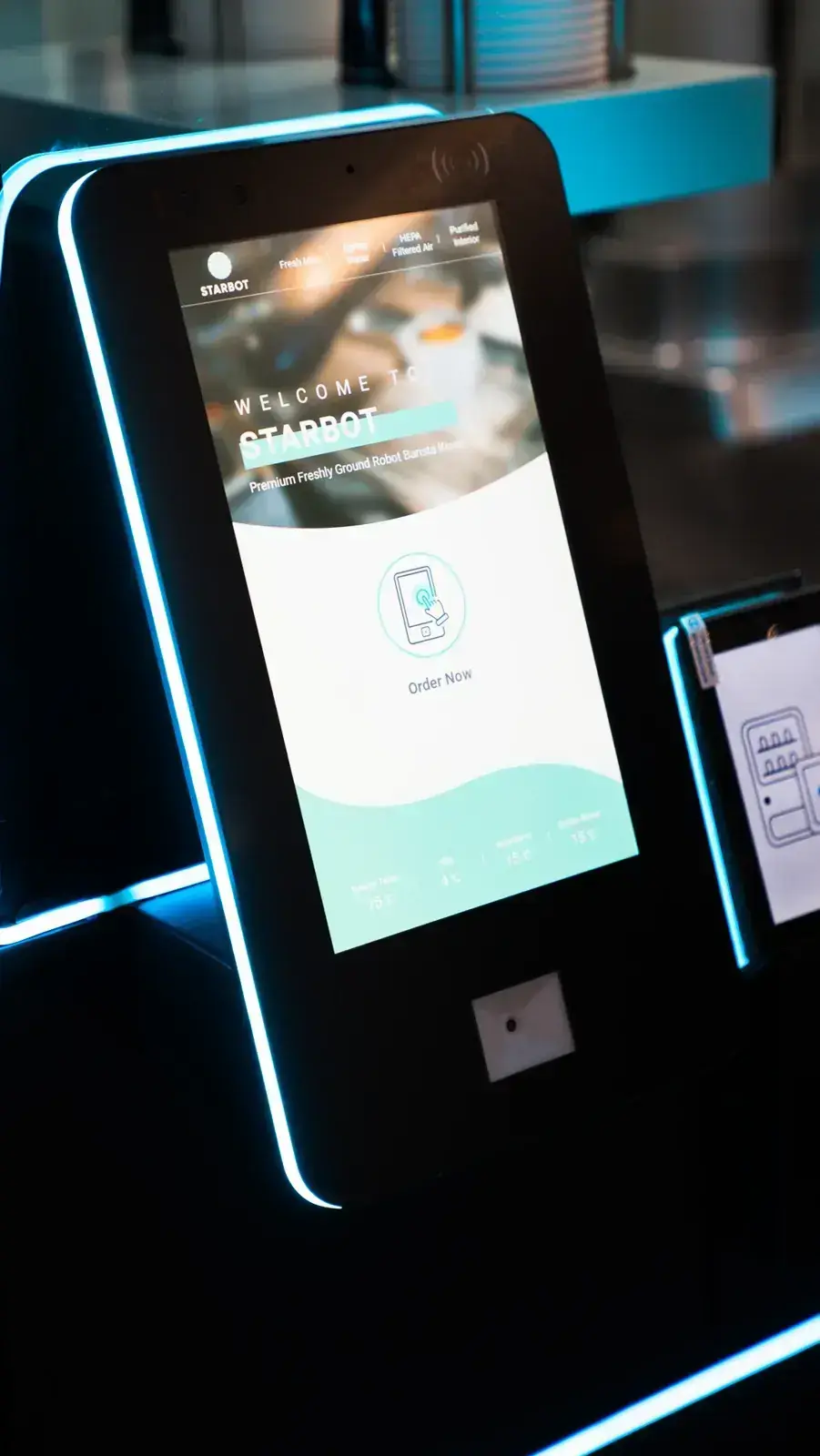
Payments are card and contactless only, so every cup is timestamped. For a centre that is the first honest read it has ever had on how a specific spot behaves by hour and by day — which is genuinely useful the next time that position is being valued for any other purpose.
Photographed at our live site in London. Real photography, no renders.
A centre signs a site licence rather than a lease. A licence is permission to place and operate equipment in a defined position; it does not confer exclusive possession of any part of the mall, it creates no tenancy, and it therefore raises none of the questions your letting team would need to answer about a unit. That is the whole reason a kiosk can go into a lift lobby that has been empty since the centre opened.
The commercial side is site commission: an agreed share of every cup sold, paid to the centre, with no capital cost and no fit-out contribution from you. The share is agreed per centre rather than published, because a regional centre with two anchors and a district mall with a Sunday market are not the same offer and quoting one figure for both would mean quoting one of them wrongly.
Because malls rebuild, re-let and sell space to promoters, the licence names a position and should name an alternative. Moving the kiosk is a visit rather than a negotiation, and centres that agree the fallback at the start never have the awkward conversation in the week before a Christmas booking.
Exit is notice on either side. We collect the kiosk, the floor is as it was, and there is nothing to reinstate because nothing was altered. If the centre would rather run the machine itself, the same kiosk is available on a five-year lease at £1,790 a month — a different arrangement entirely, but the same equipment.
The commercial shape — a share of every cup, or a fixed monthly fee for the space — is set out before anything is installed. See how hosting works.
If one of the rows above ours fits your building better, take it. We would rather not install a kiosk than install one into a position that cannot carry it.
A recognised brand, a licence fee that lands in the same budget line, and a tenant who fits out at their own cost.
It is still a staffed unit, so it carries a wage through the weekday lull, and franchisees fail on exactly that. It also needs considerably more than that footprint, which rules out every position we are actually interested in.
Real rent, real term, and income the valuation recognises. In a strong centre this is unquestionably the better deal.
It needs a unit, and units are the thing you are short of in the parts of the mall that are struggling. A lift lobby, an escalator head and a car park link cannot be let to anybody at any price, which is where this conversation started.
Cheap, reliable, no staff, and it has been the default answer for these positions for decades.
It sells the drink people settle for. Nobody has ever stopped to watch a vending machine, nobody photographs one, and a centre trying to argue it is a destination has just installed the visual proof that it is not.
Zero cost, zero management, and no risk of a failed operator making the mall look worse.
An empty transition is a dead transition, and there is no version of an empty escalator head that helps a centre. It also removes the only reason a shopper had to stop between two levels.
Barista-grade drinks without a wait from a corner of floor, no capital cost on revenue share, trading every hour the centre is open including the lull and the weekend.
It is not a brand anybody came to your centre for, and it does not sell food, so it will never anchor a dwell zone the way a café with seating does. On a licence it adds nothing to the capital value the way a leased unit does. And in a centre that already has four coffee tenants at that end, we would be the fifth cup within a hundred metres, which is a site we would rather not take than take and defend.
The last row is ours, with its real downside written in. Revenue share and unit pricing are agreed per site and are not published.
Four cases in this venue type where we would tell you not to bother. They cost us installs; printing them costs less than a kiosk that never earns.
Each of these has happened somewhere, and each shows up as the same thing on the report: a position that takes half of what the footfall said it would.
It becomes the cheapest option in a row of brands with seating, judged against them on a like-for-like basis that ignores everything it is good at. The same kiosk at an escalator head two hundred metres away trades against nobody and catches every person changing level.
Centres often want the kiosk exactly where the mall has gone quiet, in the hope it pulls people down there. It does not. Coffee follows footfall; it does not create it, and a kiosk in a dead limb of the mall simply becomes another closed-looking thing at the end of a corridor.
It gets pulled at the first fire inspection, and the removal is remembered far longer than the trial. Agreeing the position against the centre's own fire strategy on the walk-round costs ten minutes and avoids all of it.
The arm is the reason people stop, so a position where the glass faces away from the direction of travel throws away the one advantage the kiosk has over a vending bank. Orientation matters more here than in any other venue we place.
Density matters to us as much as footfall: several sites inside one servicing round is what keeps a kiosk free to host.
The Bullring and Grand Central sit on top of a station and a shopping centre at once, which produces exactly the level transitions a kiosk this size is designed for.
Liverpool ONE is an open-air scheme where the covered link corridors and car park routes are the positions that have never been lettable.
The Victoria Centre carries city-centre retail traffic on top of a bus station, so the weekday afternoon is far less dead than in a purely retail scheme.
Retail in the centre of Cardiff runs an ordinary week punctuated by stadium event days, which is precisely the pattern a staffed kiosk cannot roster for.
Because in almost every case you cannot. A branded unit wants a lettable unit, a fit-out and a multi-year lease, and the positions we ask for — an escalator head, a lift lobby, the car park link — are a corner of space no letting agent has ever had a tenant for. The kiosk is not competing with a lettable unit; it is trading in the part of the mall that has never been lettable.
It is a site licence, not a lease. There is no exclusive possession, no tenancy and no security of tenure, and the income sits in commercialisation rather than rent. That is deliberately unglamorous: it means your letting team never has to be consulted, and it means the position can move if the centre needs it to.
Yes, and it is worth naming the fallback position when the licence is signed. Nothing is plumbed and nothing is fixed to the floor, so moving it for a car display or a Christmas grotto is a scheduled visit. Centres that agree this at the start never have the argument in the week before the booking.
Quietly, which is exactly the point. The reason staffed mall kiosks fail is that Tuesday at 15:00 has to pay a wage and cannot. The kiosk has no wage attached to that hour, so a slow afternoon costs neither of us anything and the weekend is not being asked to subsidise it.
A clear corner outside the mall clear width, a standard socket the position can reach, and access through the service yard and goods lift in your existing delivery window. There is no plumbing, no drainage and no fixing to the fabric, so there is nothing for your projects team to schedule.
That is how we would prefer to do it anyway. Restocking runs through the service yard before the shutters go up, so nothing crosses the mall floor in trading hours, and the visit is triggered by what the kiosk reports it has sold rather than by a fixed weekly round.
Then we site elsewhere in the centre or we do not proceed. It is the first question we ask, because a position that is caught by an existing lease is a position that gets removed later at everybody's expense, and no amount of commercial enthusiasm survives a tenant's solicitor.
An agreed share of every cup sold, with no capital cost, no fit-out contribution and no staffing. What that comes to depends entirely on how many people stop at the position rather than how many walk past it, which is why we survey the spot instead of quoting from a centre-wide footfall figure. Drinks run from £2.00 for an espresso to £3.80 for a matcha latte, and the price list is public.
No. We restock it, clean it, service it and insure it, and it reports its own faults so an engineer is usually on the way before your control room hears anything. The only thing we ask for is a named contact so the service yard barrier is not the end of the visit.

Not what you were after? All sixteen venue types · Host a kiosk at your site · Own a STARBOT franchise · Lease a unit · Own one · £1,790/mo
Postcode, venue type and rough daily footfall is enough to start. We come back with a footfall-based model for your site — usually within a day.
No obligation, no credit search, no spam — one reply from the team with the exact numbers for your venue.
Prefer to talk? WhatsApp us — or ask Richard, bottom right.
Ask me anything on this page — the kiosk, the numbers, your site. Voice or chat, any hour.