Live · City St George's, University of London

A free coffee kiosk in your building. We run all of it.

A free coffee machine for your business — if "coffee machine" covers a robotic arm pouring Specialty Grade 1. Give us a spare corner and a socket; we install it, stock it, clean it and service it, and your site takes an agreed share of every cup. No capital, no staff, no fit-out.

150cups a day, first London site
£0to install and to run
24/7no barista, no rota
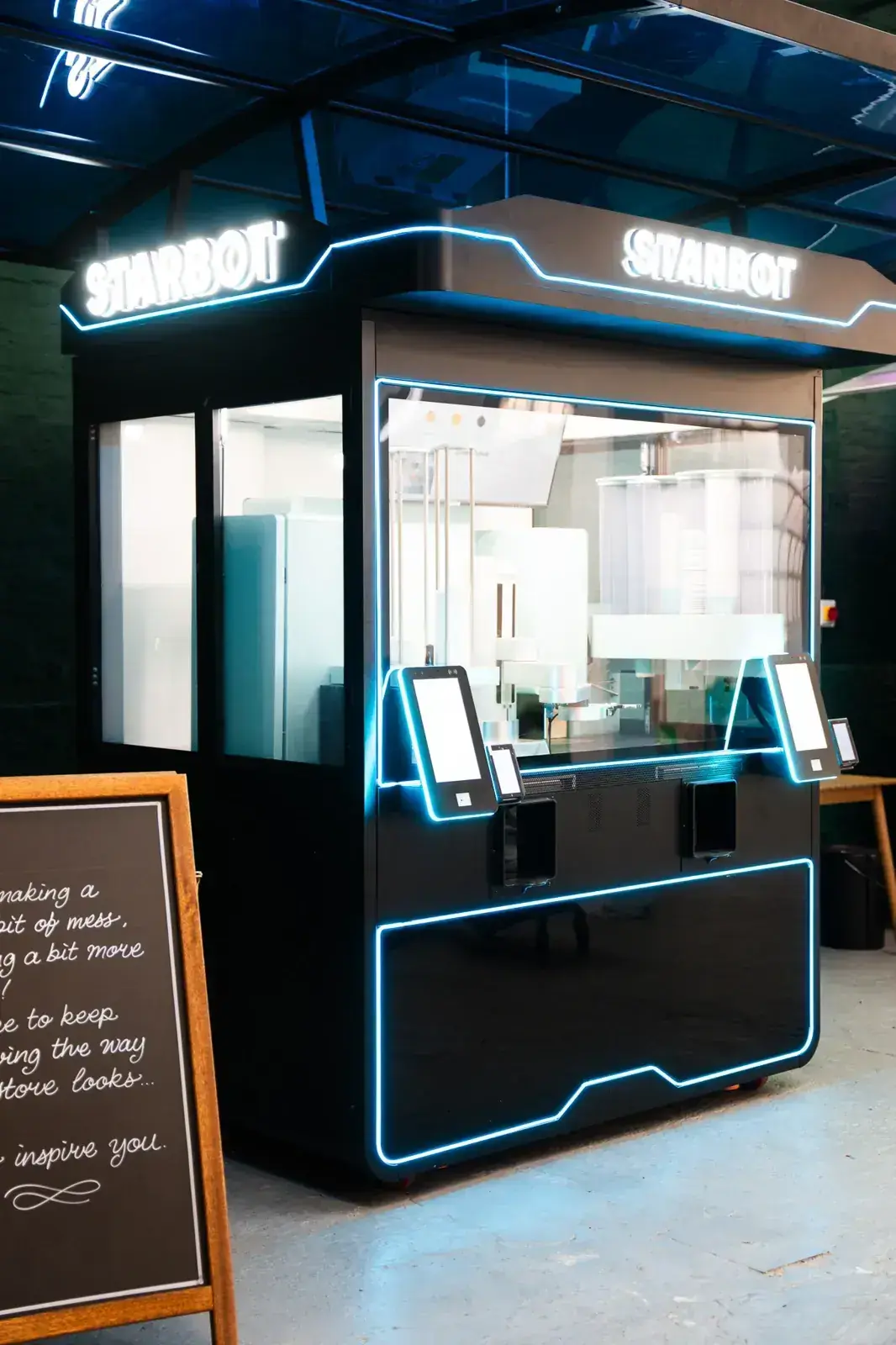
A STARBOT robot barista kiosk installed inside a London venue
Three ways inHost · free, for venuesFranchise · own & operateLease · £1,790 a month
The short answer
What it costs you

Nothing, ever. We fund the kiosk, deliver it, install it, stock it, clean it and repair it. No capital, no service charge, no invoice at any point.

What you give

A corner of indoor floor at ground level, a socket within reach, internet, and a way in for restocking. That is the entire ask.

What you get

An agreed share of every cup — or a fixed monthly fee for the space, if your finance team prefers a number that never moves.

It is a site licence, not a lease: a short document, an agreed spot, an agreed term. Nobody is taking a tenancy on your building. Check if my site qualifies
Already live

Where you can drink one today.

Looking for a STARBOT rather than looking to host one? Here is the whole list — it is short, and it is growing.

Open now City St George's, University of London Clerkenwell campus · London

Open to anyone on the Clerkenwell campus, all day and all night, with a robot arm doing the pouring. Hot or iced, tap to pay, no queue to speak of — the full menu and prices are on the front page.

Next up More UK sites Announced soon

Rail, campus and hospital locations are being signed now. Want the next one to be your building? That is the rest of this page.

Everything below is for building owners and estates teams: what it costs to host a kiosk (nothing), what we need from your site, and how your floor gets paid. Skip straight to the enquiry →

The deal

You give the corner.
We give you a coffee shop.

No invoice is coming your way, now or later. We fund the kiosk and we operate it — your building supplies the spot it stands in, and that is the whole of your side.

Your side

Four things, and none of them cost money

  • 2.5 m² of floor — Indoor, ground level, against a wall. A lobby corner, an atrium edge, a concourse.
  • One 16A socket — Single-phase, within reach of the spot. No three-phase, no plumbing, no drainage.
  • Stable internet — Wi-Fi or a network point — it needs to talk to our monitoring platform.
  • Access for restocking — A route in through standard doors, and whatever your building rules require.

No planning application, no fit-out, no shopfitters, and no corridor closed off while it goes in. It arrives on a pallet truck and it is trading the same day.

Our side

Everything else

  • The kiosk itself — We fund it, deliver it and install it. No capital cost and no fit-out on your side.
  • The coffee — Specialty Grade 1 beans, fresh milk and oat, cups and lids — all on our restocking route.
  • The daily visit — Our operator, not your cleaners: stock in, surfaces down, standards checked. Nobody on your team picks up a cloth.
  • Maintenance & support — Engineers, spares and repairs. Telemetry reports faults to us — usually before your front desk notices.
  • The payments — Card and phone only. No cash on site, no float, no takings for anyone to bank.
  • The removal, if it comes to that — The unit is ours. If a spot underperforms, moving it is our cost and our lorry — you are not left with kit to dispose of.

Installed, supplied, cleaned, monitored and repaired by STARBOT. Your facilities team's workload goes up by nothing.

And you get paid

Two ways, your choice.

Option 01 · most common
A share of every cup

An agreed share of sales at your site, paid on what the kiosk actually takes. The busier the building, the more the floor earns — and it costs you nothing on a quiet week.

Income scales with your footfall ↑
Option 02
A fixed monthly fee

You charge us a flat monthly fee for the corner, like any other licensee. Predictable, budgetable, and completely independent of how many coffees we sell.

Same figure every month ↑
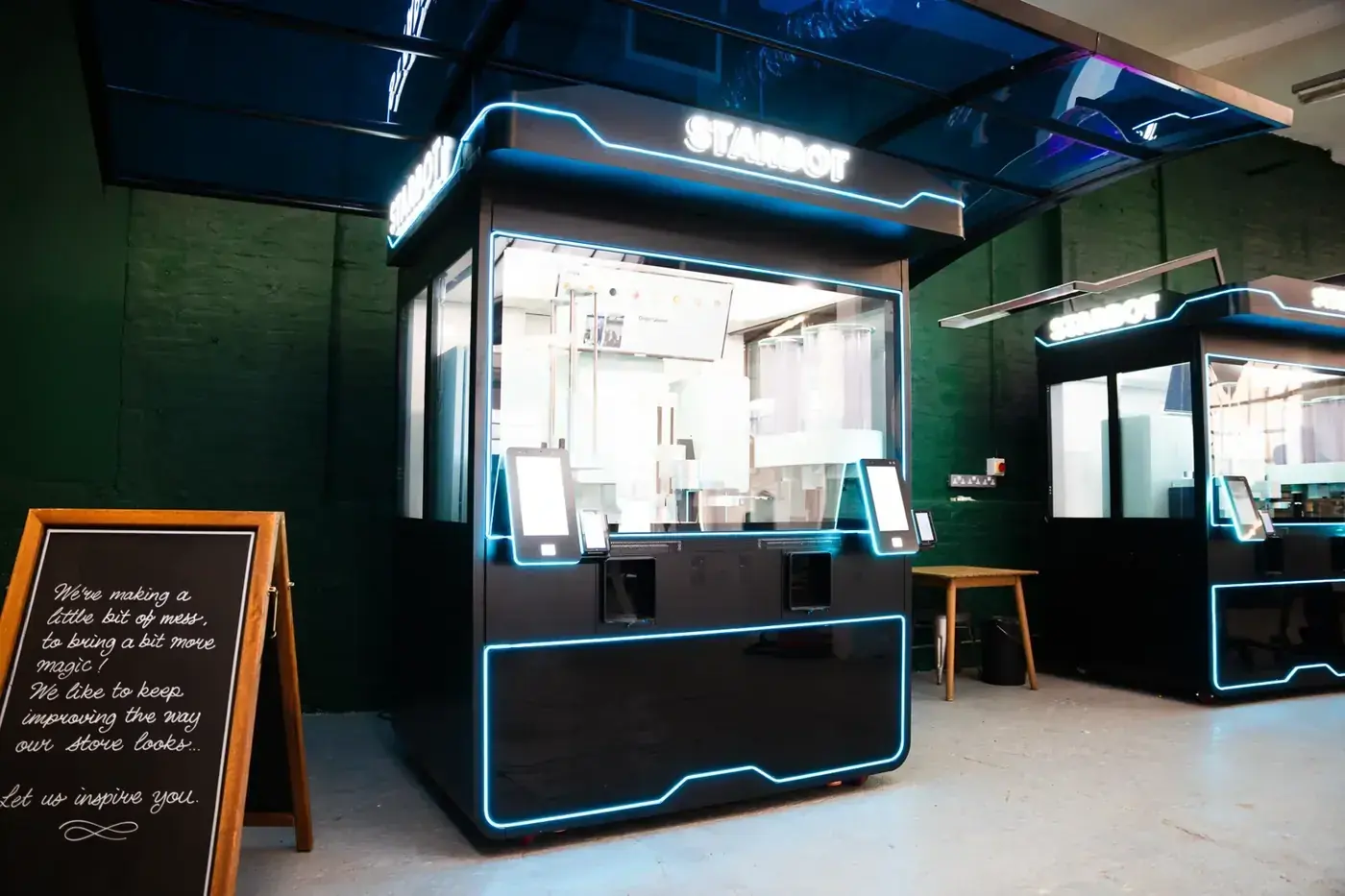
The STARBOT kiosk from the side, showing its compact footprint against a wall
The unit · a corner, against a wall
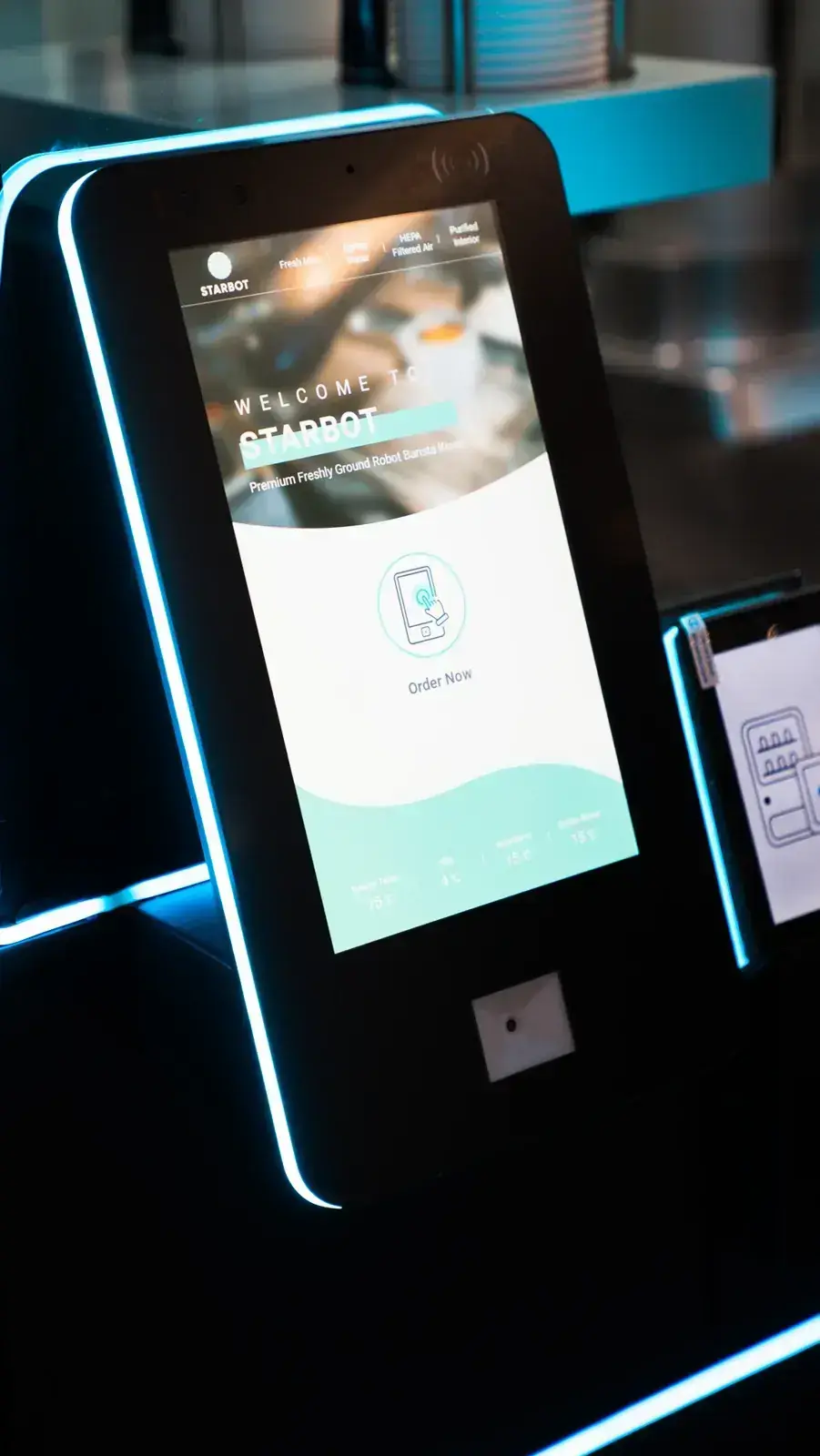
The STARBOT ordering touchscreen with contactless card payment
Tap, choose, pay · the whole till
Where it works

Buildings where people wait, pass or stay.

The kiosk earns wherever there is a steady flow of people and nowhere decent to get a coffee. That is most large buildings in the UK at eight in the morning — and nearly all of them at ten at night.

EducationUniversities & colleges

Long dwell time, late library hours and a term-time crowd that has nowhere else to go at nine at night. Our first London site is a campus, which is why we know this one properly.

HealthcareHospitals & clinics

Staff on shift at three in the morning, visitors with hours to fill, and a canteen that shuts at six. Demand here never really stops.

TransportStations & travel hubs

High volume, no patience. The queue keeps moving rather than walking past — nobody misses a train waiting for a flat white.

WorkplaceOffices & business parks

A café-grade amenity for the lobby without signing a café tenant or staffing a pantry — and something to show on a building tour.

RetailShopping centres & retail parks

A robotic arm behind glass is a dwell anchor. People stop to watch it, film it, and then buy from it.

LeisureGyms, hotels & leisure centres

Post-workout and pre-checkout, at the hours when nothing else on site is open. Small footprint, no back of house.

What makes a strong spot
IndoorGround floorA clear cornerA socket nearbyInternetSteady daily footfallRestocking access

We validate the exact position against real footfall data before anything is agreed — where people actually walk, not where there happens to be a spare corner.

Watch it work

Before you give up the floor, see the thing.

Real footage from the live site — the unit behind the glass, a queue at the screens, a cup leaving the shelf and the people who came back for it. No renders, no animation.

THE UNIT
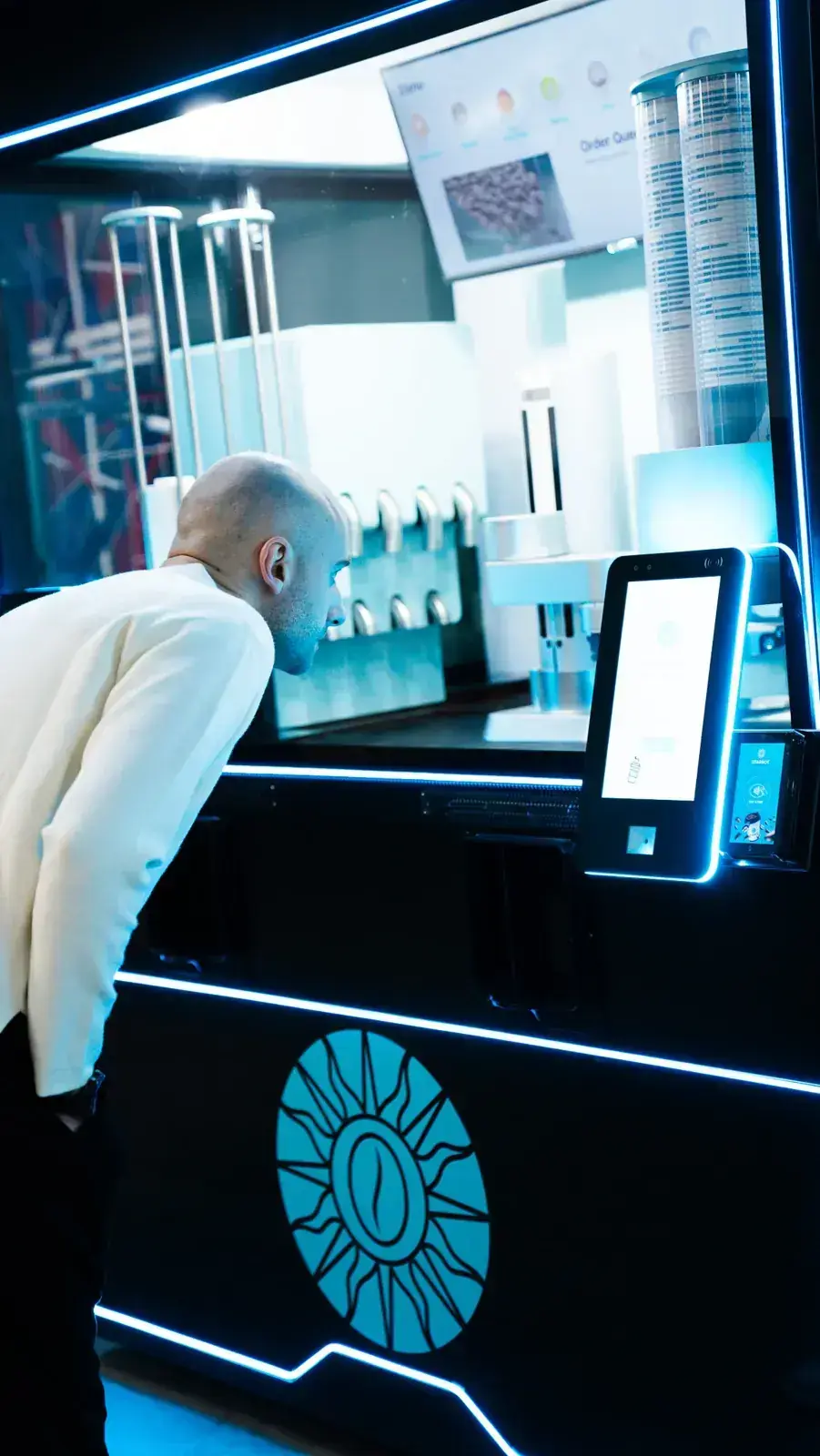
The kiosk itselfWhat actually lands in your lobby
THE QUEUE
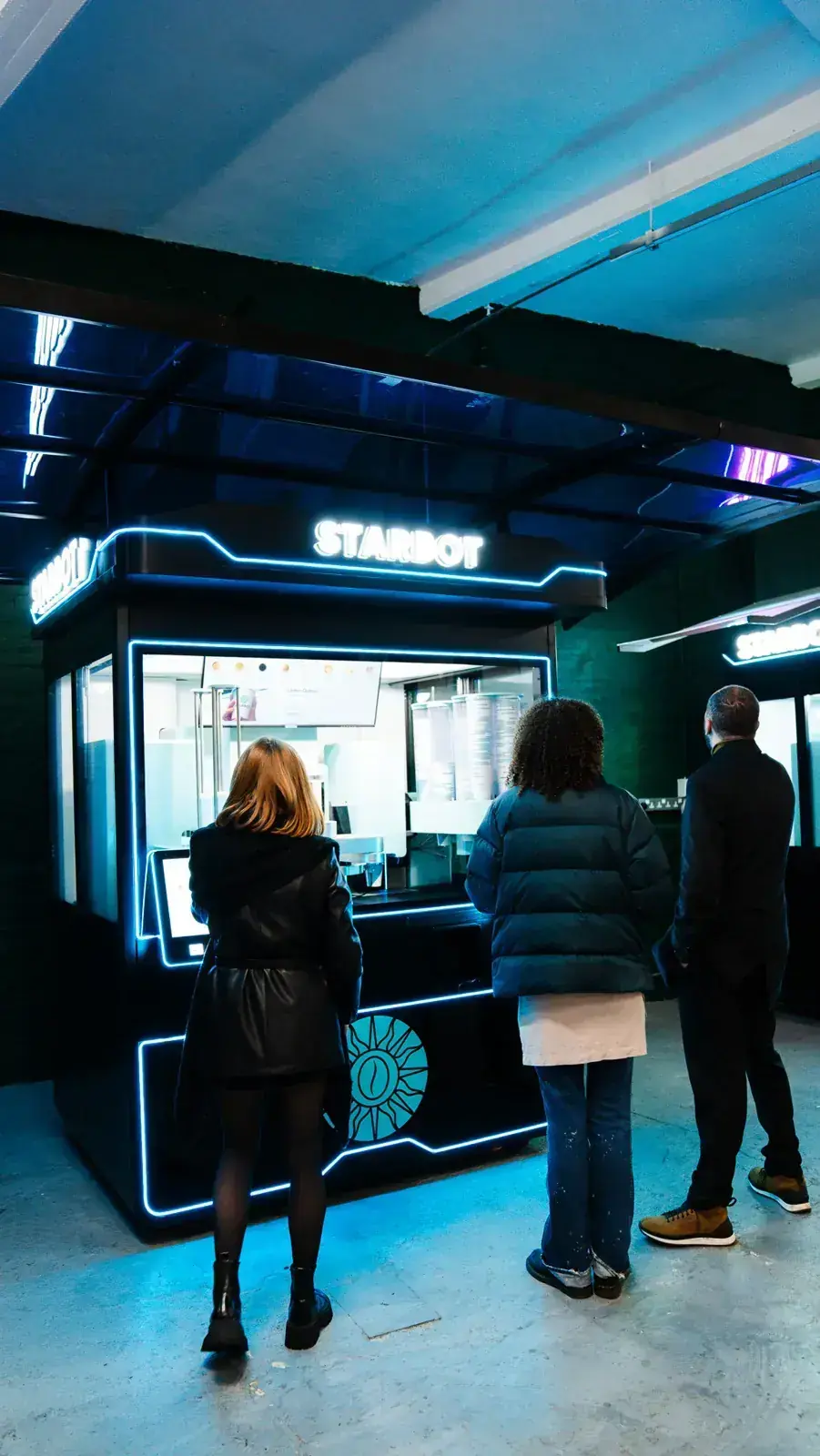
A queue that clearsThree at the screens, on a normal weekday
THE HANDOVER
Cup on the shelf, then goneNo counter, nobody to ask
THE REGULARS
They come backThe same faces, most mornings

Filmed on site, on an ordinary weekday — not a launch day. Want to stand in front of one? Ask for a site visit.

A day on site

What it adds to your team's workload.

A vending contract creates jobs for your facilities team: refills, jams, complaints, cash. This one does not. Here is a normal twenty-four hours.

Operations log · a typical day
Still trading

No opening rota and no closing time. Overnight staff and late finishers get the same cup as the morning rush.

The rush moves

Under sixty seconds an order, so the queue clears instead of building — and nothing about it lands on your front desk.

It cleans itself

The machine rinses and purges between drinks, on its own schedule. Your cleaning contract is unchanged and your contractor is not asked to learn a new bit of kit.

Our operator visits

Beans, milk, cups, a wipe-down and a stock check — an hour or two, on our rounds. Our person, not yours, and never through your stores.

Telemetry flags it first

Live sales and fault data stream to our monitoring platform. We usually know about a problem before your front desk does.

Night shift served

The security team, the cleaners, the ward staff. The floor is still earning while the building sleeps.

Your facilities teamNothing. No refills, no keys, no call-outs to log.
Your cleanersNothing. Their round is exactly what it was yesterday.
Your finance teamNothing to bank, nothing to reconcile — the statement arrives already done.
Your front deskNothing to explain. Telemetry tells us about a fault first.
The numbers

Model your building in ten seconds.

Every assumption here is yours to change — capture rate, cup price and how many days a month the building actually trades. One kiosk tops out at ~500 cups a day. This is gross sales at the kiosk; your share is agreed before install.

Venue type
8,000people / day
Our planning rate for campuses · yours to change
30 = open every day. Term-time site? Drop it.
Average cup

These are the planning rates we use ourselves before committing a kiosk to a building — annualised, not lifted from a good week. They are deliberately careful: our own campus site trades above its rate in term time and well below it in August, and the rate is the average of both. An office is the exception — a closed crowd comes back to the same machine, so it is counted as cups per person on site rather than a share of passers-by. Every field here is yours to change. Output is capped at 500 cups a day — one kiosk's realistic ceiling — and a 12-month ramp-up is applied to year one.

Estimated monthly sales at the kiosk
£0
0cups / day
£0per trading day
£0year one (ramped)
Month 1Month 12

Seasonality is real and we would rather say it here than surprise you later: a campus empties over the holidays and our own university site trades at a fraction of its term-time rate through those weeks. That is what the trading-days field is for — model the year your building actually has, not twelve identical months.

Proof, not a pitch

150 cups a day. On a campus. In two months.

One kiosk × one campus lobby × nobody on the rota
150 cups a day
City St George's, University of London — counted, in the first two months

That is a measurement, not a model: a till figure from a real building in London. It is also term time, which is the honest half of the sentence — the planning rate in the estimator above is the annual average, holidays and all, and it is the number we would put in front of you.

Customers queueing at the STARBOT kiosk on campus
i. The queue, on a normal day
A customer ordering coffee at the STARBOT touchscreen
ii. Ordering, mid-morning
Guests with STARBOT coffee at the London launch
iii. Launch night
Questions estates teams ask

The awkward ones, answered.

What does it cost us to host one?

Nothing to install and nothing to run. We fund the kiosk, deliver it, stock it, clean it and service it. Your side is the corner, the socket and internet — the deal panel above lists it exactly. How your site is paid — an agreed share of sales, or a fixed monthly fee for the space — is set out in the site licence before anything is installed.

Our socket is nowhere near the spot we have in mind — is that a problem?

Usually not. The requirements panel above is the whole ask, and a spur to a sensible position is a morning's work for the electrician you already use. What we will not do is design around a compromise: if the only powered corner is the one nobody walks past, the site is worth less to both of us than a slightly longer cable run.

Is this a lease? Are we taking on a tenant?

No. We occupy an agreed spot of a couple of square metres under a site licence for an agreed term — not a lease and not a retail unit. It is a far shorter document than a tenancy, and it is the reason a kiosk can go in where a café never could.

Who cleans it, restocks it and fixes it?

We do, all three — the day log above is the whole of it. What matters for your contracts is what it does not touch: your cleaning specification, your stores, your waste route and your out-of-hours call-out list all stay as they are.

How many cups would it sell at our site?

Honestly? Nobody knows until we look at your building — but we will not pretend otherwise to get a signature. The estimator on this page runs on our own planning rates, the ones we use internally to decide whether a site is worth a kiosk: 2% of campus flow, 5% in a hospital, 7% in a hotel or gym, 1.5% in a transport hub, 0.6% in a shopping centre, and an office counted as cups per person on site rather than a percentage. They are annual averages, so a good week beats them and August does not. Every field is yours to change, and before anything is installed we check your specific spot against real footfall so the numbers are agreed in advance.

What does this add to our security and audit position?

Less than the vending machine it usually replaces. There is no cash anywhere in it, so there is no float to hold, no till to empty, no collection to escort and no reason for anyone to be at the kiosk out of hours. Sales reconcile to us and your share arrives as one figure, with the transaction detail behind it if your auditors ever want it.

What does it sell, and at what price?

Espresso from £2.00, flat white, cappuccino and latte at £3.30, chai and matcha at £3.80 — hot or iced, every drink adjustable for strength, milk and sweetness. That undercuts the high-street chains your visitors are walking out to, which is the point. Bubble tea and frozen desserts run on the same platform and the same corner, so the offer can grow without a second footprint.

What if it does not work at our site?

The unit belongs to us, so the risk sits with us. If a spot underperforms against the model we agreed, relocating the kiosk is our cost and our logistics — your site is not left with a piece of hardware to dispose of.
Not a venue owner? Own a STARBOT franchise · Lease a unit · Own one · £1,790/mo

Tell us about your building.

Postcode, venue type and rough daily footfall is enough to start. We come back with a footfall-based model for your site — usually within a day.

Location postcodeFootfall checkSite visitLicenceFirst cup
Or go direct — WhatsApp hello@starbot.co.uk

Tell us about your site.
We reply the same day.

No obligation, no credit search, no spam — one reply from the team with the exact numbers for your venue.

Prefer to talk? WhatsApp us — or ask Richard, bottom right.