Lobby coffee at 05:00 for the early check-out, without opening the restaurant or staffing a bar. Free to host — we install, stock and service it; your site takes a
Early check-outs before breakfast service, then a quiet day, then evening arrivals — three windows, none worth a shift.
A hotel already knows how to make coffee. What it cannot do is make coffee at 05:00 without opening a kitchen, and that is the entire proposition here. The guest leaving for a 07:00 flight, the contractor on a site start, the crew checking out before the breakfast team has arrived — all of them meet a dark restaurant and a night porter who cannot leave the desk, and all of them remember it in the review.
The second window is the one after the bar closes. From last orders to the first breakfast cover, a hotel with a hundred rooms full of people has nothing available that anybody would describe as a drink. A kiosk in the lobby covers both ends of that night without adding an hour to anyone's rota, and it does it in 2.5 m² of a floor that is already carpeted and already lit.
The third thing, and the one general managers raise first, is that a robot arm in a lobby is not a vending machine in a corridor. Guests film it. It appears in reviews as a feature rather than as a complaint about the machine being out of order, which is the only category hotel coffee equipment has occupied for the last twenty years.
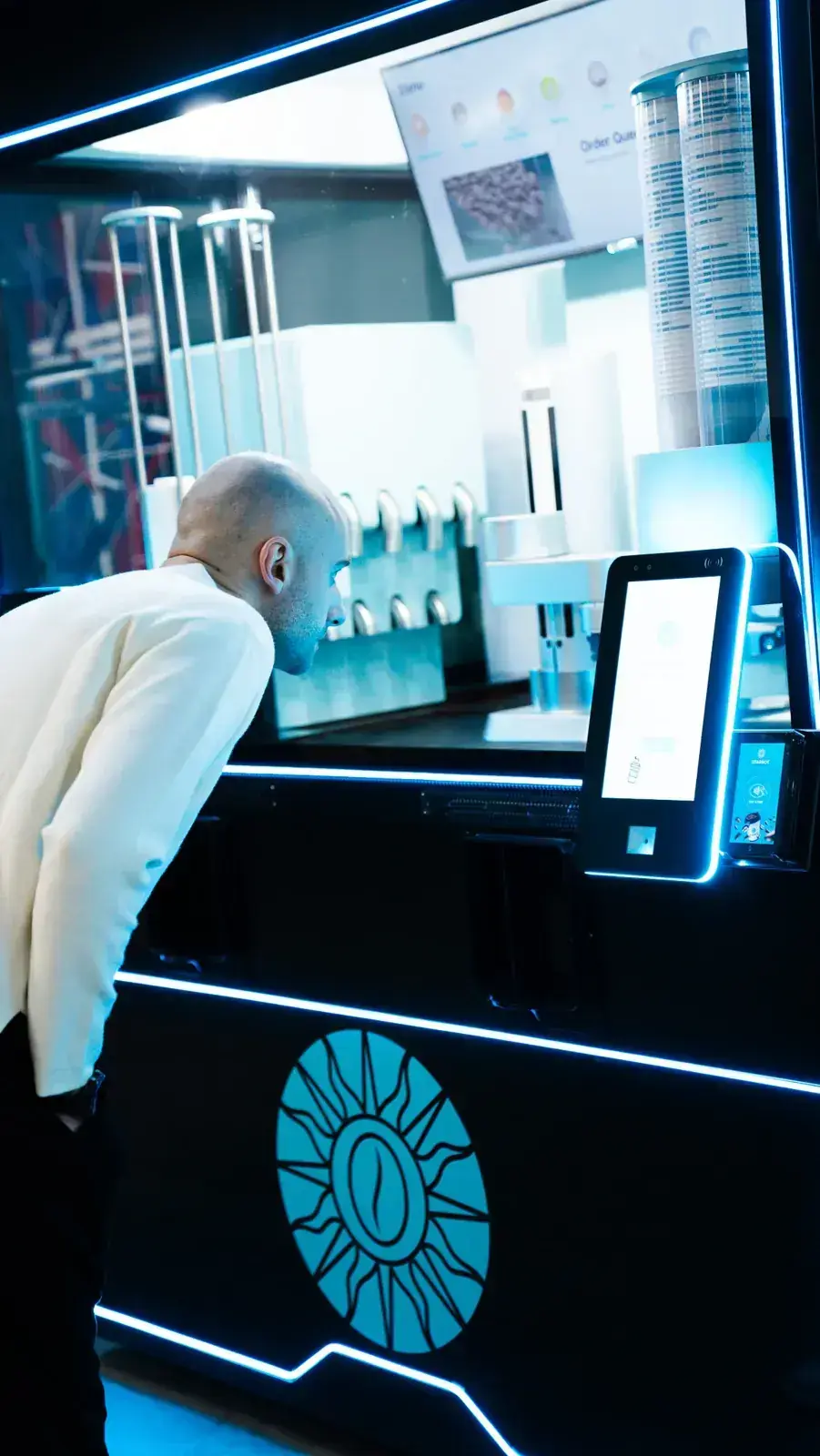
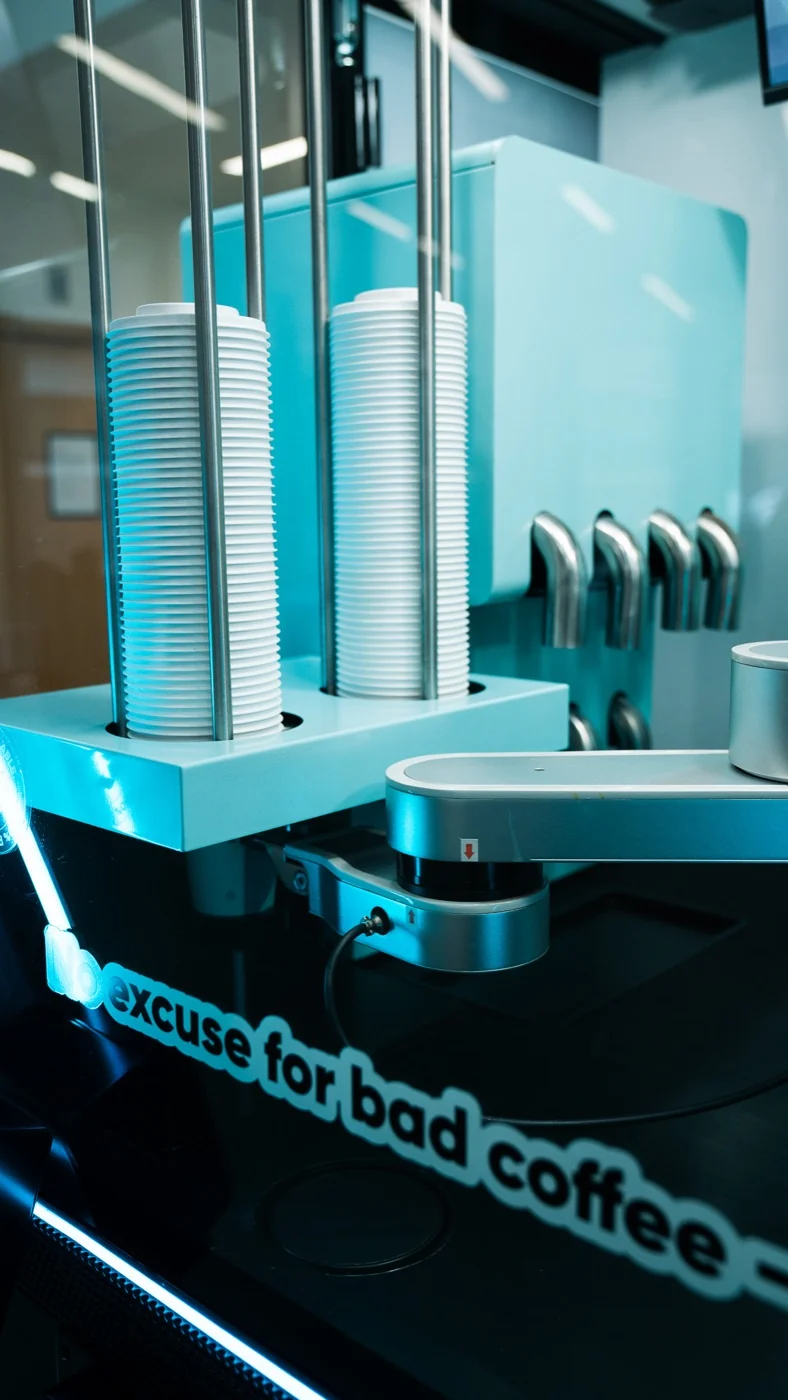
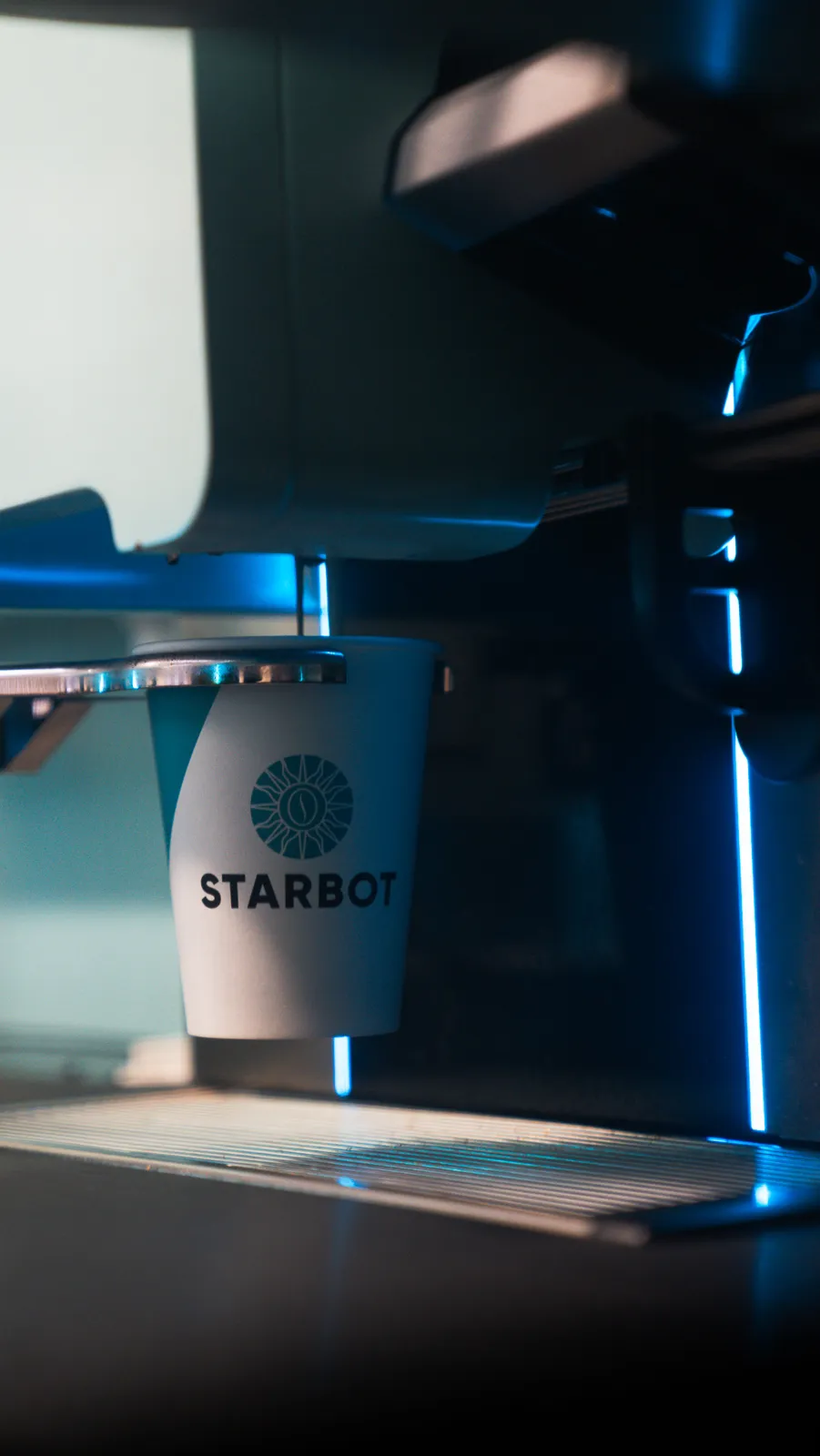
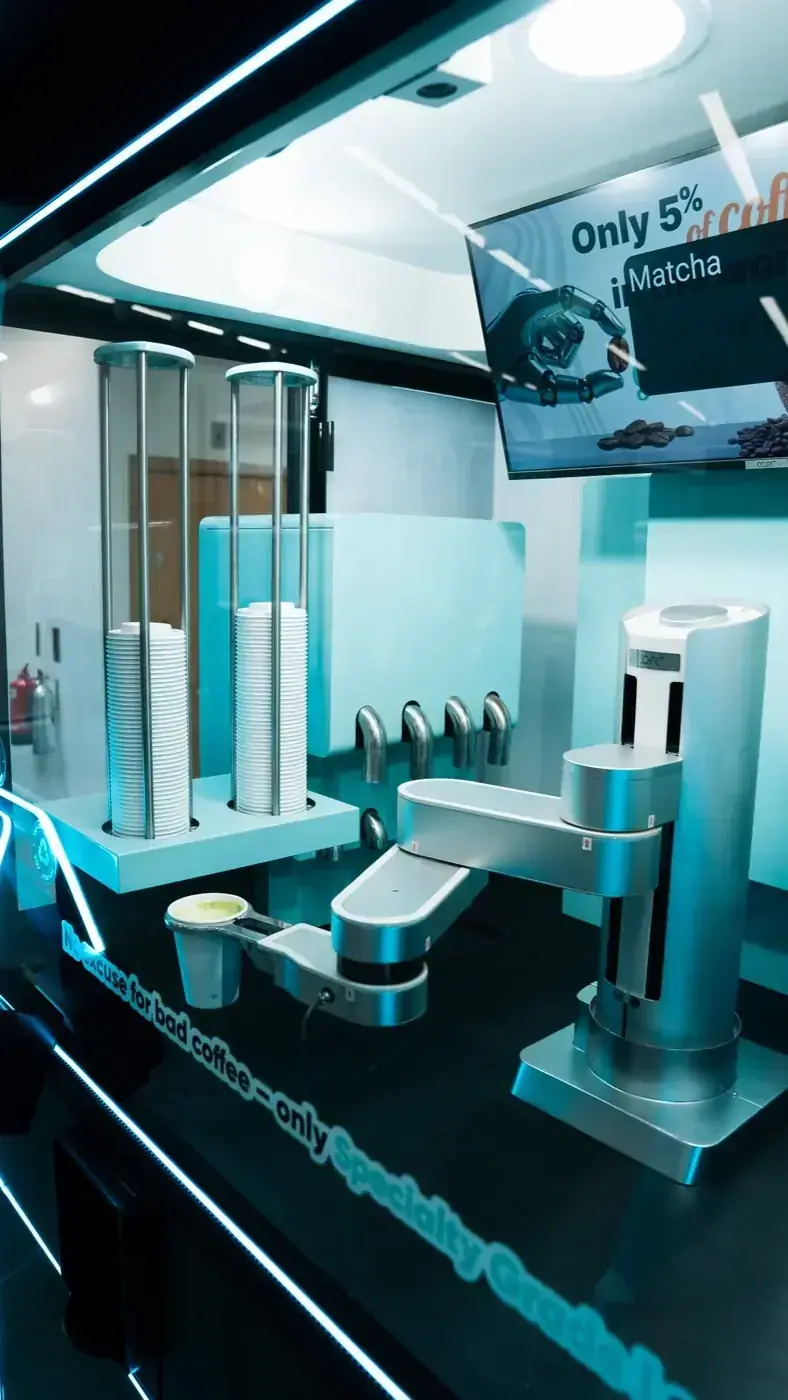
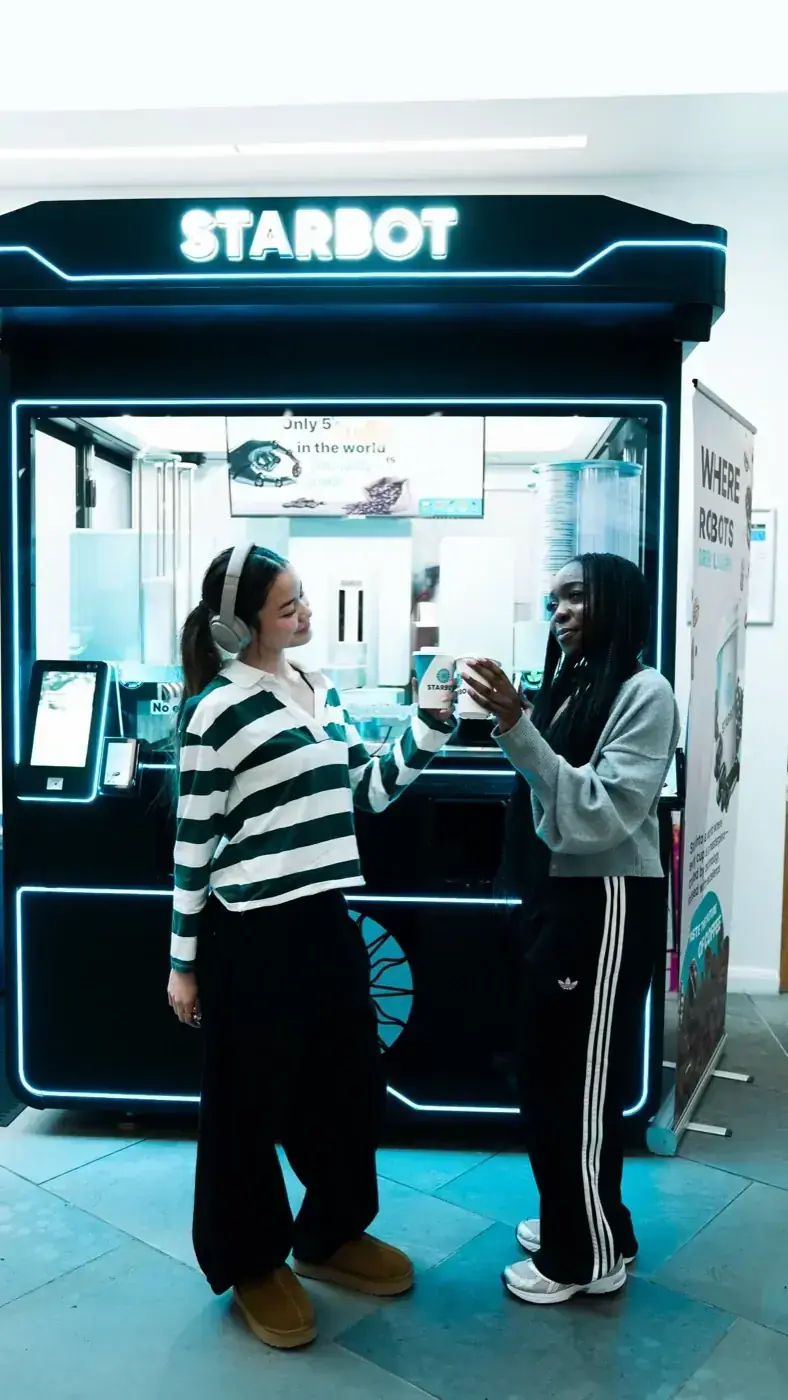
Photographed at City St George’s, University of London — our live site. Real photography, no renders.
Breakfast service starts at 06:30 and the bar closes at 23:00 — the airport-run guest is served by neither.
This is the part nobody puts in the business case, because it is nobody’s job to write it down.
At 05:00 they expect coffee to exist. The robot is also the thing they photograph and put in a review.
Same drink at 06:00 and at 22:00, in under 60 seconds, from a corner of floor.
Not a generic day. This is how the demand actually arrives in this kind of building — including the hours a staffed counter is paid for and nobody comes.
Airport runs, crew departures and early site starts. The restaurant is dark, the night porter is alone at the desk, and this is the single most reliable unserved window in the building.
Breakfast service. The kiosk takes the overflow and the guest who does not want to sit down for a cooked breakfast to get a flat white on the way out.
Check-out, plus the mid-morning break if the hotel runs meeting rooms. Delegate coffee at 11:00 is a staffed job that a kiosk in the meeting corridor absorbs entirely.
The flat middle. Business arrivals trickle in, the bar is not open, and there is no service in the building a guest can get a coffee from without asking someone to make an exception.
The check-in wave, when the lobby is busier than it has been since breakfast and the front desk is doing three things at once.
Pre-dinner, the second meeting break, and the hour when the restaurant is setting up rather than serving.
After the bar closes. A full hotel, no service, one member of staff, and every request routed through a night porter who has a desk to man.
Two spots forty metres apart in the same building can differ by half the sales. These are the positions that work in hotels — and the one that does not.
This is the position that works in almost every hotel. The night porter can see it without leaving the desk, a guest can find it at 03:00 without knowing the building, and it is the one part of the hotel where a machine doing something visually interesting is an asset rather than clutter.
Every guest passes the lifts several times a day and no guest walks into a dark restaurant to look for coffee. The lift core also keeps the kiosk trading during the hours the food and beverage space is closed or laid up for the next service.
If the hotel runs day meetings, the corridor outside the rooms is a genuine second position: delegate breaks are two fixed spikes a day that currently require someone to lay up and man a table, and the kiosk absorbs both without a banqueting porter.
Anything inside the bar is unavailable exactly when the coffee gap opens. It is the most common suggestion a hotel makes and the one that guarantees the kiosk cannot serve the two windows it was brought in for.
Who signs in a hotel depends on how the hotel is owned. In an independent, the general manager decides and it is a short conversation. In a managed hotel the operator runs the building but the owner or asset manager holds the space, so the licence is signed by the owning entity even though the GM is the person who wants it. Getting that the wrong way round is the most common reason a hotel deal stalls after everybody has already agreed.
In a franchised hotel there is a third party: brand standards. What may stand in a branded lobby is governed by the franchise agreement, and no GM can wave that through locally. It is answerable — the kiosk is not plumbed, not fixed and can be positioned out of the primary sightline — but it needs to go to the brand early rather than after the survey, because it is the one part of the chain nobody can accelerate.
It trades hardest in the hours neither is open, which is why we push for the lobby rather than the restaurant. Where a hotel is worried, the honest test is the timestamped sales data after a month — it shows exactly which hours the cups came from, and in most hotels the answer is the ones nobody was serving.
That is a question for your brand, and one worth asking before the survey rather than after. What helps is that nothing is fixed to the building and the footprint is that footprint, so a position that satisfies the standard is usually findable even in a tightly specified lobby.
The kiosk reports its own fault state, so an engineer is normally already scheduled before the night porter knows there is a problem. For the guest in front of the desk at 03:00, the night team has a contact and does not have to diagnose anything — there is nothing on the machine for a member of your staff to open.
No. It runs from a refillable water supply and a standard 16A socket, which is why it can stand on a carpeted lobby floor rather than only where there is a drain. That is normally the answer your maintenance lead is looking for, because a lobby drain does not exist in most hotels.
We move it or we take it out for the duration, both by arrangement. It is not fixed and not plumbed, so it is not part of a strip-out, and hotels refurbish on a cycle frequently enough that we would rather write the arrangement into the licence than discover it at the first programme meeting.
The cup path is sealed, there is no open milk jug, no hot plate and no exposed grounds, and the interior is serviced by us on a logged schedule rather than by your team between covers. Your F and B manager keeps no responsibility for it and adds nothing to their own hygiene procedures.
Nothing here needs plumbing, drainage or a fixing to the fabric of the building. The kiosk stands on the floor and plugs into a standard socket.
A vending contract creates work for your facilities team. This one does not: restocking, cleaning, faults and reporting are ours.
Deliveries route through the goods entrance on the hotel's own schedule, so nothing is wheeled past a check-in queue at 15:00. Because the kiosk reports what it has sold, the visit follows real consumption — which in a hotel swings with occupancy far more violently than in any office.
The drip tray, the milk path and the interior are ours. Your housekeeping team keeps cleaning the lobby floor it stands on, which was already in their specification, and there is no open jug or grounds bin for a room attendant to inherit at the end of a shift.
This is the point most GMs care about. A lone night porter cannot leave the desk to make a coffee, and with a kiosk in the lobby they no longer have to say no. Payment is card and contactless, so there is no float, no till and nothing to cash up before handover.
Every cup is timestamped, so after a month the hotel can see whether the trade came from 05:00 and 23:30 or from 08:00. In practice that is the number that decides whether a second position — usually the meeting corridor — is worth having.
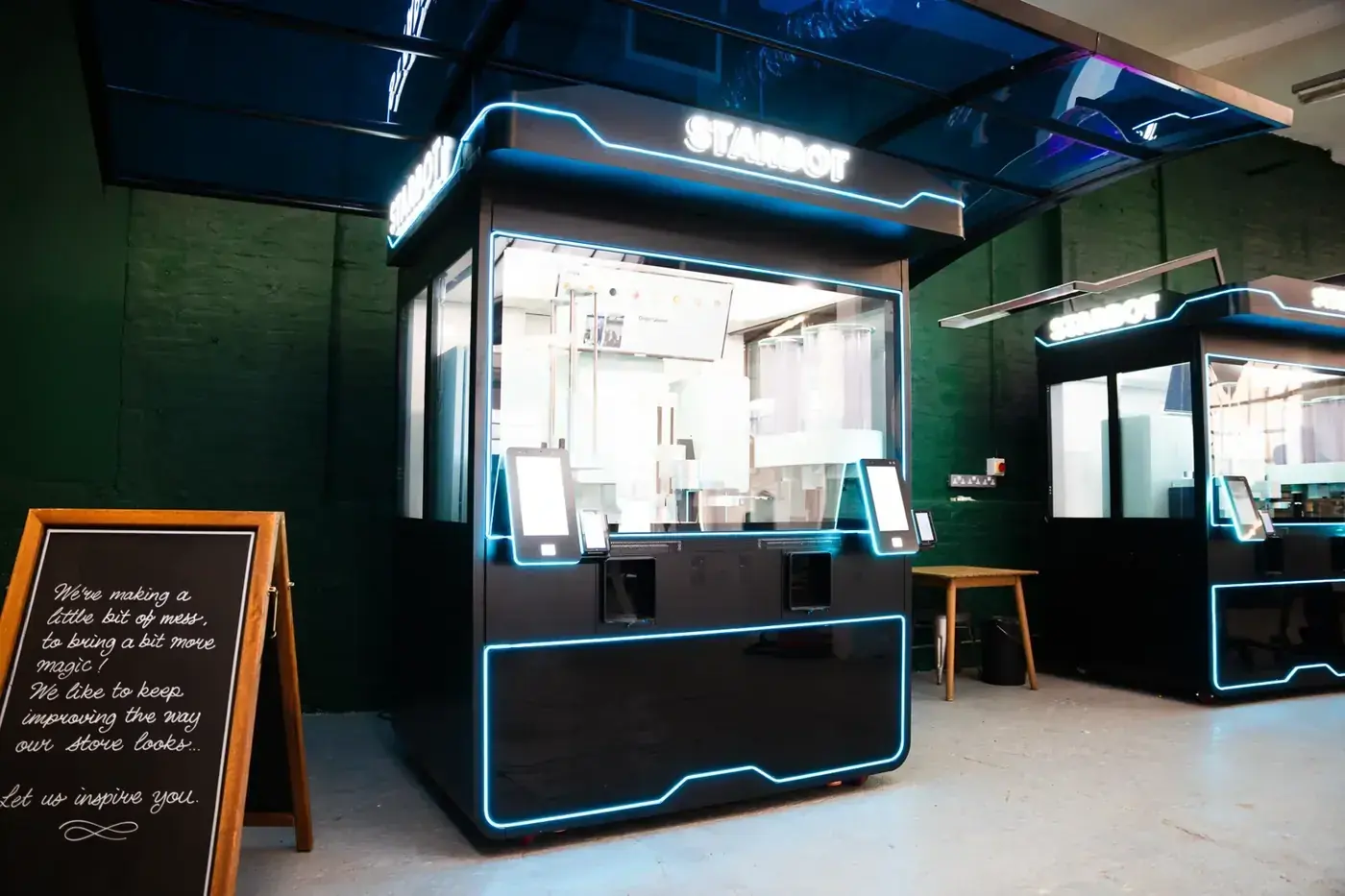
Photographed at our live site in London. Real photography, no renders.
The hotel signs a site licence: permission for us to place and operate the kiosk in an agreed position, with no exclusive possession and no tenancy created. In a hotel this matters more than it sounds, because the building is frequently owned by one party and run by another, and a licence signed by the operator over space controlled by the owner is worth very little to either of them.
Commercially there are two shapes and hotels split roughly evenly between them. On revenue share the guest pays by card, drinks start at £2.00, and the hotel takes an agreed share of every cup with no capital cost. In host mode the hotel covers the cups and the coffee is free at the point of use — the common choice where a brand includes coffee for loyalty members or where the GM simply wants it as part of the welcome.
Because hotels refurbish, rebrand and change operator, the licence names a position and provides for moving it. Nothing is fixed or plumbed, so relocation is a visit; a change of operator is a conversation about who now holds the space rather than a fresh negotiation about the machine.
Exit is notice on either side, we collect the kiosk and there is nothing to reinstate. If the hotel would rather run the equipment itself — which is more common in independents than in branded houses — the same kiosk is available on a five-year lease at £1,790 a month.
The commercial shape — a share of every cup, or a fixed monthly fee for the space — is set out before anything is installed. See how hosting works.
If one of the rows above ours fits your building better, take it. We would rather not install a kiosk than install one into a position that cannot carry it.
Real service, real cups, and the guest gets exactly what a hotel is supposed to provide.
It is a shift. Opening at 05:00 for the airport-run guest means paying a member of staff for the two hours before breakfast, every day, whether four guests check out early or none do. No hotel below a certain size has ever made that arithmetic work.
Universal, expected, and effectively free once the tray is stocked.
It is instant coffee in a paper sachet. It answers the question of whether a hot drink exists and no part of the question of whether the hotel is any good, and it is precisely what guests are describing when a review says the coffee was disappointing.
Cheap, requires nobody, and covers the post-bar window in a technical sense.
Coffee that has sat on a hot plate for four hours is worse than no coffee, and an unattended urn in a lobby is its own health and safety conversation. It also looks like exactly what it is: a compromise, in the part of the hotel where impressions are formed.
A recognised name, proper seating, and in a large city-centre hotel it can be a genuine profit centre and a draw for non-residents.
It needs floor area you probably want for something else, a lease or a concession agreement, and it keeps café hours — which means it is shut for both of the windows this page is about. It is a good answer to a different question.
Barista-grade drinks without a wait, in the lobby, at 05:00 and at midnight, with no rota and no capital cost on revenue share.
It is not service. A guest who wants to be looked after by a person at 05:00 is still not being looked after by a person, and in a hotel that competes on hospitality that is a real objection rather than a rhetorical one. Where breakfast is included for nearly every guest, the paid trade is confined to the early and late windows unless the hotel runs host mode. And a small hotel with a modest occupancy does not have the volume to justify a machine standing in its lobby — we would rather say so than install one.
The last row is ours, with its real downside written in. Revenue share and unit pricing are agreed per site and are not published.
Four cases in this venue type where we would tell you not to bother. They cost us installs; printing them costs less than a kiosk that never earns.
Each of these has happened somewhere, and each shows up as the same thing on the report: a position that takes half of what the footfall said it would.
The room is locked or laid up for most of the twenty-four hours, which means the kiosk is unavailable in both windows it was installed for. It also gets judged as part of the breakfast offer, which is a comparison it does not need and does not win.
A machine in a side corridor with nobody watching it at 02:00 is a different proposition from one in the porter's line of sight. Hotels that site it out of view have a security conversation within the first month, and it is entirely avoidable by moving it ten metres.
Standing it in the primary sightline of a lobby that has a specified look is the fastest way to have it removed by somebody who never saw the business case. A position that serves the same guests from the lift core survives the brand audit and trades identically.
Hotel corridors serving function rooms are escape routes with defined widths, and a kiosk that narrows one gets moved after the first inspection. Agreeing the spot against the fire strategy at survey stage costs nothing and settles it permanently.
Density matters to us as much as footfall: several sites inside one servicing round is what keeps a kiosk free to host.
August multiplies hotel occupancy across the city in the one month when nobody can hire the staff to serve it, and the festival crowd keeps hotel lobbies busy well past when the bar closes.
The capital has the densest hotel estate in the country and the earliest departures, with airport runs starting long before any breakfast team is on shift.
A city-centre hotel market feeding an airport and a heavy events calendar, which produces the 04:30 check-out pattern several days a week rather than occasionally.
Hotels here run ordinary weeks punctuated by stadium event days, when the building is full, the bar is overrun and the lobby needs a second serving point that does not need a second team.
At 15:00 in a staffed lobby, a person is better and we would not argue otherwise. At 05:00 the choice is not between a machine and a person, it is between a machine and nothing, because the restaurant is dark and the night porter cannot leave the desk. What guests actually write about is the robot arm — it reads as a feature, which is not a sentence anybody has ever written about a hotel vending machine.
The windows barely overlap: the trade concentrates before breakfast service starts and after the bar has closed. Every cup is timestamped, so a month of data settles the question factually rather than by argument, and if the data showed it displacing covers we would move it out of the restaurant sightline.
It depends on the brand and it is worth asking them in parallel with talking to us rather than afterwards. The kiosk is not fixed, not plumbed and occupies that footprint, so a position that satisfies a lobby standard is normally findable — but the brand decides, not the general manager, and that part cannot be shortcut.
The kiosk takes card and contactless, which is what the great majority of hotels use. If you would rather guests were not paying at all — a club floor, a loyalty inclusion, or simply a welcome — it runs in host mode with the hotel covering the cups, and that is the cleanest way to make coffee feel included without a posting arrangement.
That is often the strongest secondary position in the building. Delegate breaks are two fixed spikes a day that currently need a table laid up and someone to man it; a kiosk in the meeting corridor absorbs both, serves each drink without a wait, and keeps trading when the meeting rooms are empty.
Nobody on your side. It reports its own faults, so an engineer is usually already on the way, and there is no float, no till and nothing to cash up, because there is no cash in it to begin with. The night porter gains a thing they can point at instead of a request they have to refuse.
No plumbing, no drainage, no fixing to the building. It stands on the floor and plugs into a standard socket, which is why a carpeted lobby is a perfectly good position. The only physical constraint we have ever hit is the route in — it needs a lift or a level entrance, not a half-landing stair.
Whoever controls the space, which in a managed or leased hotel is normally the owner rather than the operator, even though the general manager is the person who wants it. It is worth establishing that in the first conversation — it is the single most common reason a hotel agreement sits unsigned after everyone has said yes.
On revenue share, an agreed share of every cup with no capital cost, no fit-out and no staffing. What it comes to depends on occupancy and on how many guests pass the position, which is why we survey the lobby rather than quote an average. Drinks run from an espresso up to a chai or matcha latte, and the full list is published.
Not what you were after? All sixteen venue types · Host a kiosk at your site · Own a STARBOT franchise · Lease a unit · Own one · £1,790/mo
Postcode, venue type and rough daily footfall is enough to start. We come back with a footfall-based model for your site — usually within a day.
No obligation, no credit search, no spam — one reply from the team with the exact numbers for your venue.
Prefer to talk? WhatsApp us — or ask Richard, bottom right.
Ask me anything on this page — the kiosk, the numbers, your site. Voice or chat, any hour.