Live · City St George’s, University of London

Coffee machines for offices

A barista-grade coffee kiosk for your office reception. No staff, no rota, no queue — specialty coffee in under 60 seconds, in 2.5 m².

150cups a day, first London site
2.5 m²and one 16A socket
£0to install and to run
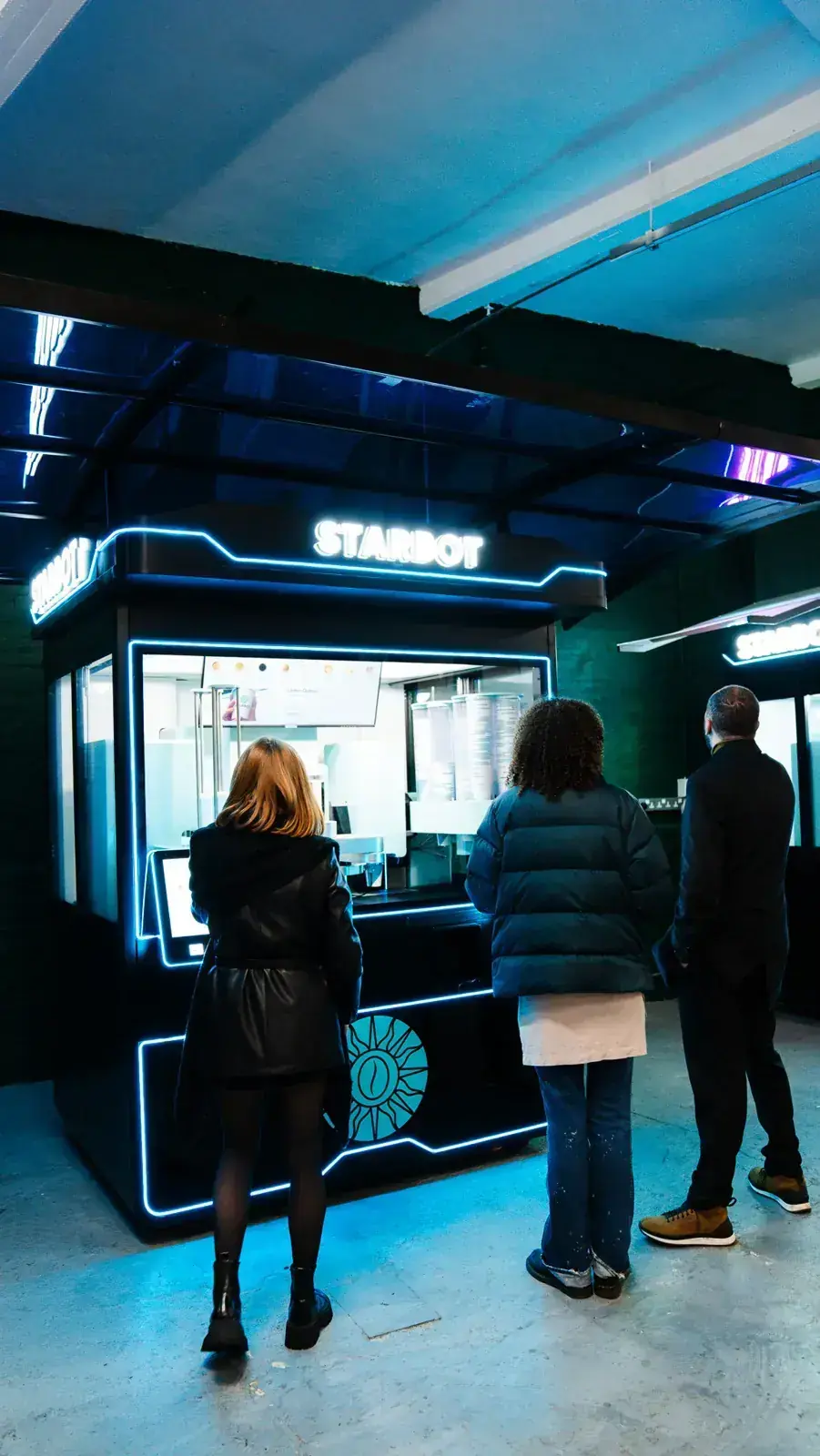
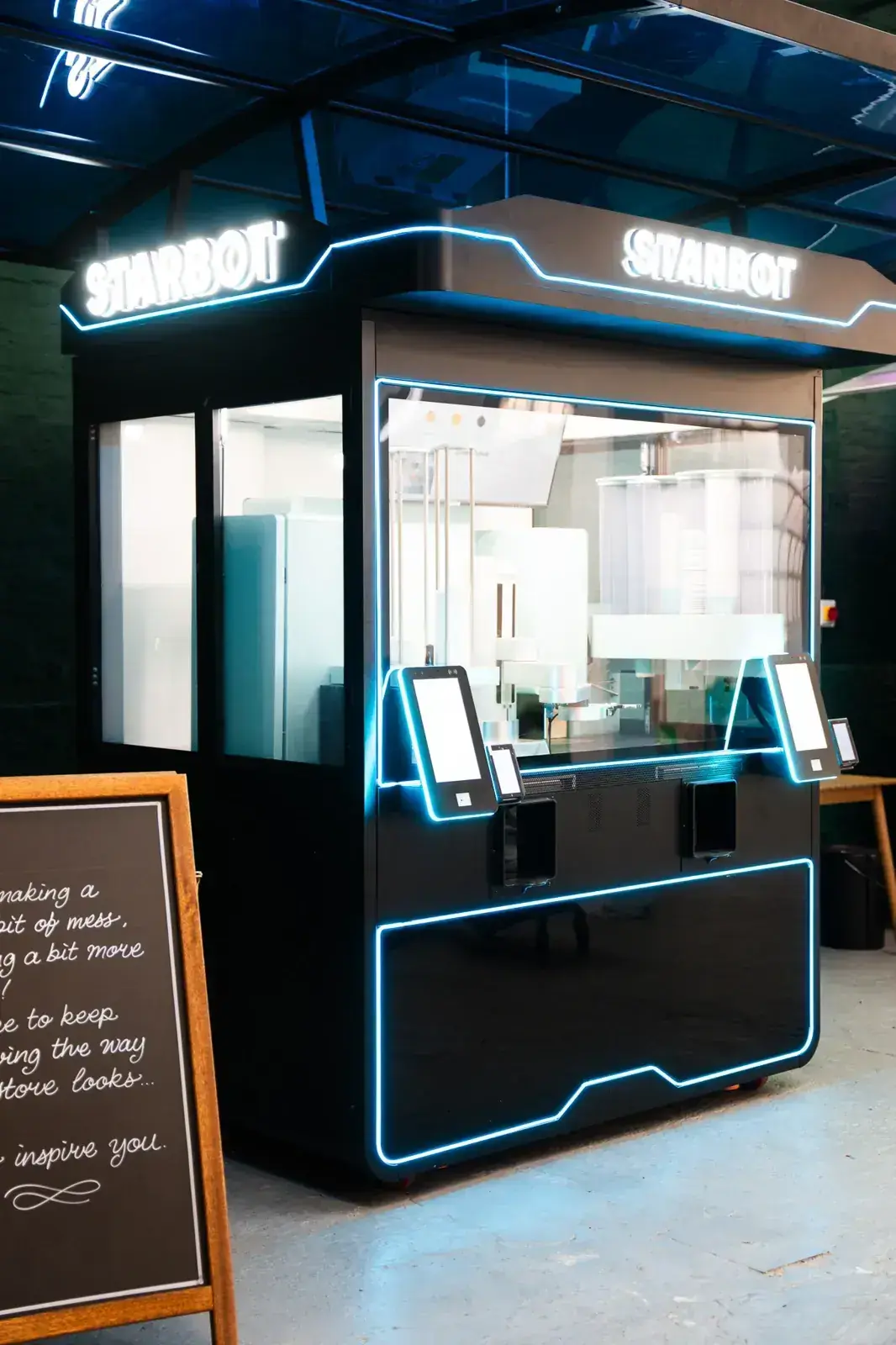
A STARBOT robot barista kiosk installed and trading inside a London venue
The case

Why a kiosk, in this kind of building.

Two hard peaks — 08:30 to 10:00 and again after lunch — then near silence. A staffed counter is paid for the silence.

An office coffee machine is judged on about ninety minutes of the day. Between 08:30 and 10:00 a floor wants a drink in the time it takes to walk from the lift to a desk, and everything the machine does for the rest of the day is spent justifying the space it stands on. That is the case for a kiosk rather than a counter: it pours the same flat white without a wait at 09:04 and at 15:40, and it costs nothing to stand idle in between.

The second thing an office is buying is the visitor moment. A client who arrives at 10:30 for a meeting is handed either a proper coffee or an apology about the kitchen machine, and the reception desk is where that is decided. A kiosk in the lobby serves both audiences off one that footprint footprint — staff on their own cards, visitors on the host's, with no one leaving the desk to make it.

The money question is also different in an office than anywhere else we place. Most venues want the revenue share. Offices frequently do not: they want the drink subsidised or free at the point of use because it is a retention argument, not a profit line. Both work on the same kiosk — the tariff is a setting, and an office can change its mind about it later without changing the machine.

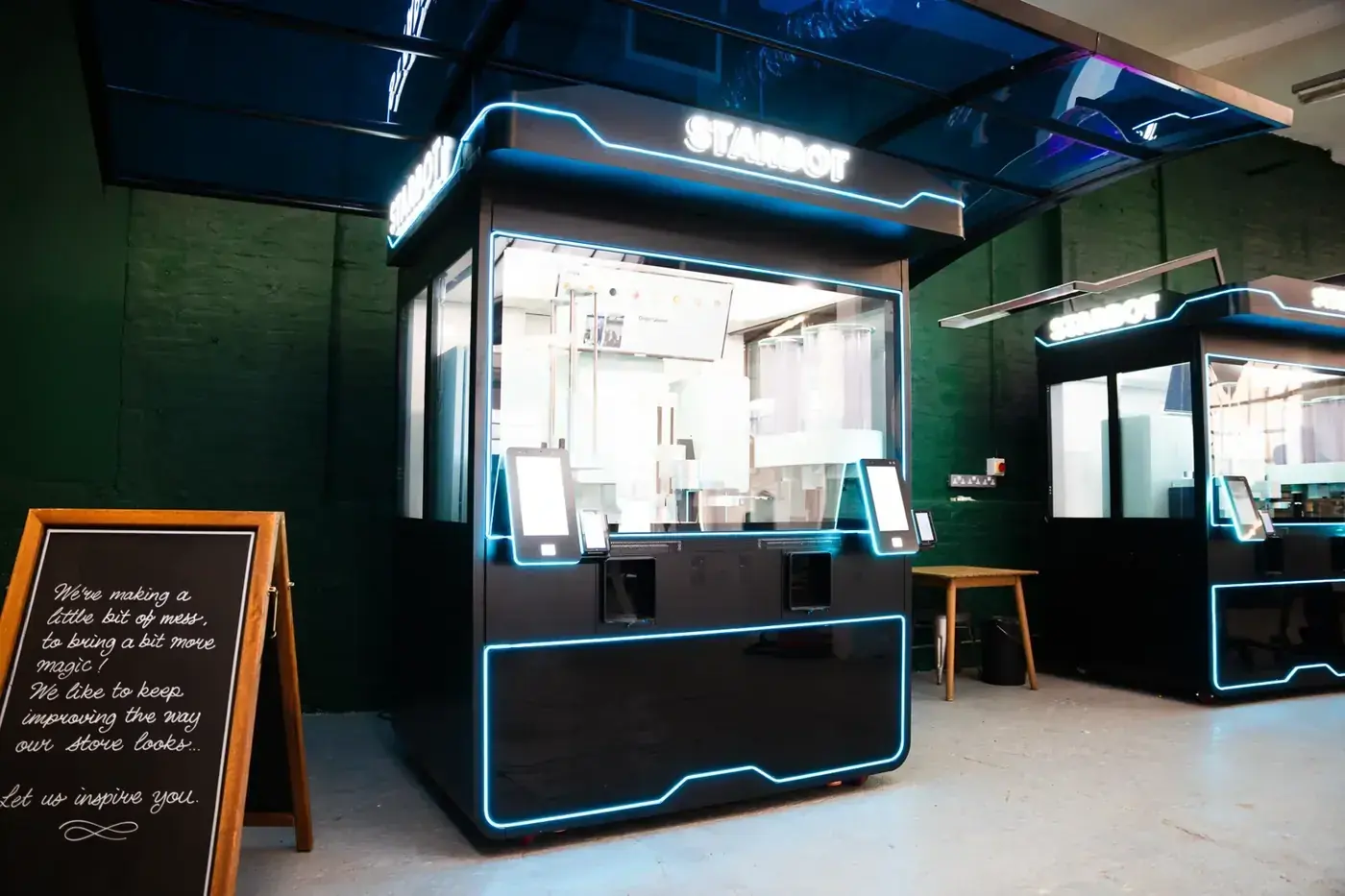
The STARBOT kiosk from the side, showing its footprint against a wall
The unit, side on
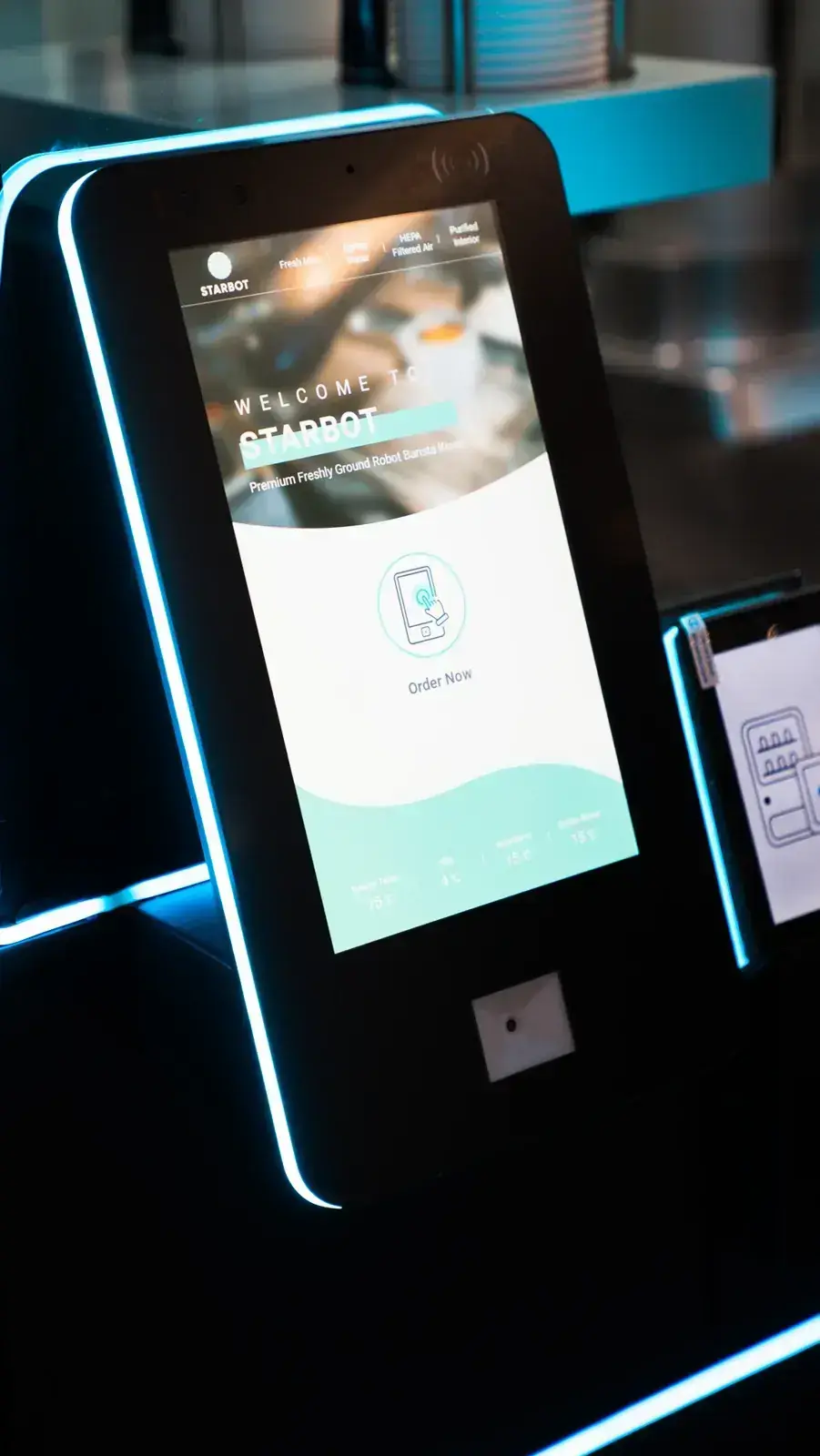
The STARBOT ordering touchscreen taking a contactless card payment
Tap, choose, pay
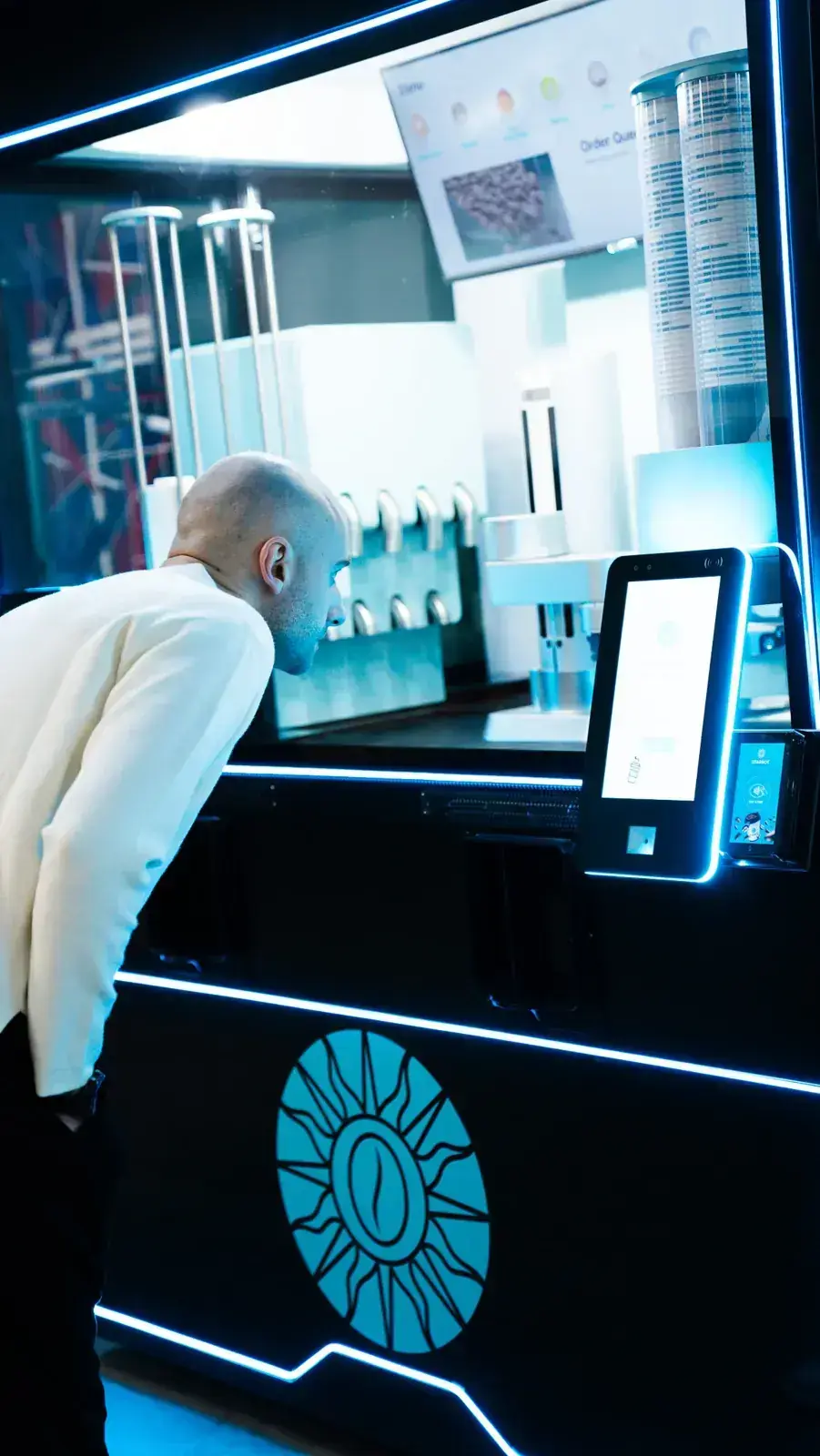
A customer ordering coffee at the STARBOT touchscreen
Ordering, mid-morning

Photographed at City St George’s, University of London — our live site. Real photography, no renders.

The first objection

“We already have a bean-to-cup machine in the kitchen.”

What actually happens

Where the incumbent gives up

Office kitchen machines get descaled by whoever remembers, and the queue at 09:00 is six people deep with one person cleaning the drip tray.

This is the part nobody puts in the business case, because it is nobody’s job to write it down.

Our answer

What the kiosk does instead

Bean-to-cup makes a drink; it does not make a flat white anyone would pay for. The difference is the milk — ours is textured to temperature, per cup, by an arm that repeats the same motion every time.

Same drink at 06:00 and at 22:00, without a wait, from a corner of floor.

The trading day

A day in offices, hour by hour.

Not a generic day. This is how the demand actually arrives in this kind of building — including the hours a staffed counter is paid for and nobody comes.

Trading pattern · offices

Early starters and the finance floor at quarter end. Nobody has unlocked the kitchen yet and the first person in does not want to be the one descaling anything.

The wave. Ten to fifteen people can arrive at the machine inside two minutes, and the only question that matters is whether the queue clears before the 09:30 calls start.

Visitor coffee. Low volume, highest stakes — this is the cup a client remembers, and it is the reason the kiosk sits in reception rather than behind the pass.

The second peak, flatter and longer than the morning one. It is mostly people who went out for lunch and came back wanting something before the afternoon block.

The dead middle. A staffed counter is paid in full for these hours; the kiosk is not paid at all, which is the whole economic argument.

Late meetings, deal teams and anyone on a US call. Thin but reliable, and entirely uncovered if coffee depends on someone being in the kitchen.

In a hybrid office Friday is a half-strength day and the weekend is close to zero. This is priced in — an idle kiosk has no wage bill — but it is also why headcount alone never decides a site.

Why it holds up here
Runs unattended through the whole working day, including the dead hours
Fits in a reception corner or a lift lobby — that footprint, a standard socket
Card and contactless only, so no float, no cash handling, no reconciliation
Where it stands

The position decides the numbers.

Two spots forty metres apart in the same building can differ by half the sales. These are the positions that work in offices — and the one that does not.

Reception or the lobby side of the barrier

The best office spot is the one both audiences reach. Staff pass it on the way in, visitors reach it without being badged through, and the machine is doing brand work while it is not pouring. It needs a wall run for the socket and enough clear floor that a queue of four does not block the barrier.

The lift lobby of the busiest floor

In a multi-floor tenancy the lift lobby beats the kitchen because it catches people at the moment they arrive rather than the moment they remember they are thirsty. It also stops the machine being judged against the free instant sitting a metre away.

Next to the kitchen, not inside it

Inside a tea point the kiosk competes with a kettle, blocks the microwave queue and disappears from view of anyone who does not already know it is there. Immediately outside — in the corridor or the breakout area — it keeps the association with break time and loses the congestion.

Not the far end of a deep floor plate

Office coffee is an impulse. Past roughly the distance people will walk without deciding to, the kiosk stops being a habit and becomes a trip, and trips are what people replace with the shop downstairs.

Getting it approved

How a yes actually happens here.

In an office the person who wants the kiosk is rarely the person who can say yes to it. The office manager or workplace lead sponsors it, facilities checks the practicalities, and if the space is common parts or the building is managed, the landlord's agent has the final word. Nothing about that chain is difficult, but it is sequential, and skipping to the end is how these stall.

What shortens it is answering the estates questions before they are asked. There is no plumbing, no drainage, no fixing to the fabric of the building and no alteration to the demise — the kiosk stands on the floor and plugs into a 16A socket. That takes the request out of the category that needs a licence for alterations and puts it in the category that needs a decision.

Who has to say yes

What estates and compliance ask · answered

Does it need any alteration to the building?

No. It stands on the floor, plugs into a standard socket and takes a refillable water supply, so there is no drainage, no fixed pipework and nothing screwed to the fabric. When it leaves, the floor is as it was.

Who is responsible for the electrical safety of it?

We are. It is our equipment, it is inspected and tested as our equipment, and it is insured by us. Your facilities team is not adopting an asset.

Does it obstruct a means of escape?

It must not, and that is a siting decision made on the walk-round rather than argued about afterwards. In a space that size there is usually more than one spot that clears the escape route, which is why we ask to see the floor before quoting a position.

What does it do to our cleaning specification?

Nothing. Servicing, refills and the inside of the machine are ours. Your contractor keeps cleaning the floor it stands on, which they were cleaning anyway.

Who pays for the electricity and the water?

The site does — it is a standard socket load and a refillable supply, which is why it never appears as a separate line in the agreement. Everything else that goes into a cup is ours.

What happens if we need it moved for a fit-out?

We move it. It is not plumbed and not fixed, so a move is a scheduled visit rather than a project, and a fit-out is the single most common reason an office asks for one.

Nothing here needs plumbing, drainage or a fixing to the fabric of the building. The kiosk stands on the floor and plugs into a standard socket.

What the site has to be able to offer
2.5 m² of clear floor that is not on an escape routeA standard 16A socket within reach of the positionA route in for the kiosk itself — a lift or a level entrance, not a stairwellAccess for restocking during the working day, or a pass arrangement for out of hoursA named contact for the building, so an engineer is not stopped at reception
Operations

Who does what, once it is in.

A vending contract creates work for your facilities team. This one does not: restocking, cleaning, faults and reporting are ours.

Restocking runs off the machine, not a calendar

The kiosk reports what it has left. Beans, milk, cups and syrups are replenished on that signal rather than on a fixed weekly round, which in an office matters because consumption is spiky — a week with three all-hands empties it faster than a fortnight of hybrid Fridays.

Cleaning is ours and the surface is yours

The drip tray, the milk path and the inside of the machine are on our schedule. What your team sees is a wipe-down exterior with no open jug, no hot plate and no grounds bin to empty, which is the difference between the kiosk and the machine currently in the kitchen.

Faults come to us before they come to you

The kiosk reports its own fault state, so in most cases the first person who knows is our engineer, not the office manager with a queue behind them. There is no number for your staff to ring and no maintenance line in your facilities budget.

Sales reporting the office can actually use

Every sale is a card sale, so the record is per cup, per hour, per day. In an office that is genuinely useful the first time someone asks whether the Tuesday-to-Thursday pattern is real: the answer stops being a survey and starts being a chart.

People queueing at the STARBOT kiosk during a busy period
A queue that clears
Someone working on a laptop with a STARBOT coffee beside them
Dwell time, on site
Specialty Grade 1 coffee beans held in a hand before loading the hopper
Specialty Grade 1 beans

Photographed at our live site in London. Real photography, no renders.

What gets signed

A site licence, not a lease.

What an office signs is a site licence, not a lease. A licence is permission for us to place and operate equipment in a defined spot; it does not give us exclusive possession of any part of your floor, and it does not create a tenancy. That distinction matters more in an office than anywhere else, because the office is itself usually a tenant and its own lease has something to say about who else it lets occupy space.

The commercial terms sit on top of that: an agreed share of every cup sold on revenue share, or a fixed arrangement if the employer would rather subsidise drinks and hand them out free. The share is agreed per site rather than published, because a reception in a building of two thousand people and a single-floor tenancy are not the same offer, and pretending otherwise would mean quoting one of them wrongly.

Getting out is deliberately unceremonious. Notice on either side, we collect the kiosk, and there is no dilapidation to argue over because nothing was altered. Offices move, merge and refit more often than any other venue on this site, so an agreement that punishes them for it would be an agreement we spend our time enforcing instead of selling coffee.

If you would rather run the machine yourself, the same kiosk is available on a five-year lease at £1,790 a month — that is a different page and a different conversation, but it is the same equipment and the same servicing.

The commercial shape — a share of every cup, or a fixed monthly fee for the space — is set out before anything is installed. See how hosting works.

Versus the alternatives

Every other option, including where we lose.

If one of the rows above ours fits your building better, take it. We would rather not install a kiosk than install one into a position that cannot carry it.

The optionHow it plays out hereWhere it falls down
The bean-to-cup in the kitchen

Already installed, already paid for, free at the point of use, and everybody has an opinion about it.

It is nobody's job. Descaling happens when someone remembers, the milk fridge is a shared responsibility, and at 09:00 the queue is six deep behind a person cleaning the drip tray. It also never serves a visitor a drink worth the walk to reception.

Pod machines on each floor

Cheap to install, tidy, no queue because there are four of them.

Cost per cup is the highest of any option once someone is buying pods monthly, the waste is visible, and the drink is not one anybody would choose to pay for. It solves the queue by making the coffee not worth queueing for.

A staffed coffee bar in reception

The best cup and the best impression, and in a building of real scale it genuinely works.

You are paying a wage through the dead middle of the day to catch two peaks, plus cover for holidays and sickness. Below a headcount that keeps a barista busy, the cost per cup is several times ours, and the counter closes at 15:00 exactly when the second shift wants it.

Nothing — people go out for it

Zero cost, zero admin, and there is a coffee shop within five minutes of most offices.

It is twenty minutes a person a day and it happens in the peak, not the lull. It also moves the visitor moment off your premises, which is the part offices notice last and mind most.

A STARBOT kiosk

Barista-grade drinks without a wait, no staff, no rota, that footprint, no capital cost on revenue share.

It is a machine, and it will not learn your order or ask about your weekend. The menu is fixed — there is no off-menu drink for the person who wants a half-shot in a specific cup. On a floor with only a handful of people in on a given day it will not earn its space, and we would rather say that at the survey than install and remove three months later.

The last row is ours, with its real downside written in. Revenue share and unit pricing are agreed per site and are not published.

When to say no

Where this is the wrong answer.

Four cases in this venue type where we would tell you not to bother. They cost us installs; printing them costs less than a kiosk that never earns.

Siting mistakes

Four ways to put it in the wrong place.

Each of these has happened somewhere, and each shows up as the same thing on the report: a position that takes half of what the footfall said it would.

Putting it in the tea point

It ends up competing with a kettle and free instant standing a metre away, hidden from every visitor, in the one part of the floor where a queue also blocks the microwave. The same kiosk in the corridor outside does two things the kitchen position never does: it gets seen, and it gets used by people who did not come specifically for it.

Siting it behind the security barrier in a visitor-heavy building

Half the audience — clients, contractors, candidates, couriers — can no longer reach it, and reception is back to apologising. In a building where visitors matter, the barrier is the line that decides how much the kiosk is worth.

Next to the quiet room or the phone booths

The grinder is audible. It is not loud in a lobby and it is very loud outside a room someone is being interviewed in, and the complaint that follows is not about coffee, it is about noise, which is much harder to argue with.

The far corner of a deep floor plate

Coffee is bought on impulse and impulse has a radius. Put it past that radius and consumption falls off a cliff, the site looks like a failure, and the actual problem was thirty metres of carpet.

Where these cluster

The cities this venue type is thickest in.

Density matters to us as much as footfall: several sites inside one servicing round is what keeps a kiosk free to host.

London

The City and Canary Wharf run the deepest concentration of multi-tenant office towers in the country, and most of them have a lift lobby doing nothing.

Leeds

The legal and financial district has long dwell times and a professional office population that buys coffee at a rate hybrid working has barely dented.

Manchester

Spinningfields and the surrounding office estate are dense enough that one engineer covers several buildings in a morning.

Birmingham

The M42 corridor is office space where the nearest coffee shop is a drive rather than a walk, which is exactly when an in-building kiosk stops being a nicety.

Questions from this kind of building

The ones worth asking before you sign.

We already have a bean-to-cup machine in the kitchen. Why would we add this?

Because they are not the same drink and they do not serve the same person. Bean-to-cup makes a hot drink; the kiosk textures milk to temperature per cup, with the same motion every time, which is what a flat white actually is. The kitchen machine also cannot serve a client in reception, and it is nobody's job to keep it clean at 09:00.

Who pays for the coffee — the company or the staff?

Either. On revenue share the staff pay by card, drinks start at £2.00, and you take an agreed share of every cup. If you would rather the coffee were free at the point of use, the kiosk runs in host mode and the employer covers it. It is a tariff setting, not a different machine, and offices change their minds about it more often than any other venue.

Does it need plumbing, drainage or any building work?

No. It runs from a refillable water supply and a standard socket, which is why it can stand in a lobby or a lift landing rather than only where there is a drain. Nothing is fixed to the building and there is no alteration to your demise, which is usually what your landlord's agent is actually asking about.

Our office is hybrid — busy Tuesday to Thursday, quiet the rest. Does that kill it?

It changes the arithmetic rather than ending it, because an idle kiosk has no wage bill to cover on a quiet Friday. What decides it is how many people pass the spot on a normal Wednesday, not how many desks you have. We would rather look at that before installing than discover it after.

What does our landlord or managing agent have to agree to?

That we may place equipment in the position agreed. Because there is no fixing, nothing to plumb in and no alteration, this is normally a permission rather than a licence for alterations. If the spot is in common parts rather than inside your demise, the agent decides, so it is worth asking them in parallel with us rather than afterwards.

What happens when fifteen people arrive at 09:00 at once?

Each drink is served without a wait and nobody is discussing their weekend with a barista, so the queue moves at machine pace. The honest limit is that it is one machine: a genuine two-hundred-person simultaneous rush wants a second position, and in a tower that usually means one kiosk per busy floor rather than one heroic kiosk in the lobby.

Who cleans it, refills it and deals with it when it breaks?

We do, all three. The kiosk reports its stock and its fault state, so refills are scheduled from what it has actually sold and an engineer is usually on the way before your office manager has noticed. There is no maintenance line for your facilities team and no consumables to order.

We are moving office in eighteen months. Are we stuck with it?

No. It is a site licence with notice on both sides, and because nothing is plumbed or fixed, taking it out is a visit rather than a reinstatement job. If you are moving rather than stopping, the usual answer is that it comes with you and we re-survey the new floor.

How much would our office actually make from it?

It depends entirely on how many people pass the position and stop, which is why we will not publish an office average — the calculator works it out from your own footfall instead. As a reference point, the kiosk at our first London site served 150 cups a day in its first two months, in a building with far more passing traffic than a single-floor tenancy.
Not what you were after? All sixteen venue types · Host a kiosk at your site · Own a STARBOT franchise · Lease a unit · Own one · £1,790/mo

Tell us about your building.

Postcode, venue type and rough daily footfall is enough to start. We come back with a footfall-based model for your site — usually within a day.

Or go direct — WhatsApp hello@starbot.co.uk

Tell us about your site.
We reply the same day.

No obligation, no credit search, no spam — one reply from the team with the exact numbers for your venue.

Prefer to talk? WhatsApp us — or ask Richard, bottom right.