Live · City St George’s, University of London

Coffee machines for coworking spaces

Included-in-membership coffee that does not need a community manager standing behind a counter making it. Free to host — we install, stock and service it; your site

150cups a day, first London site
2.5 m²and one 16A socket
£0to install and to run
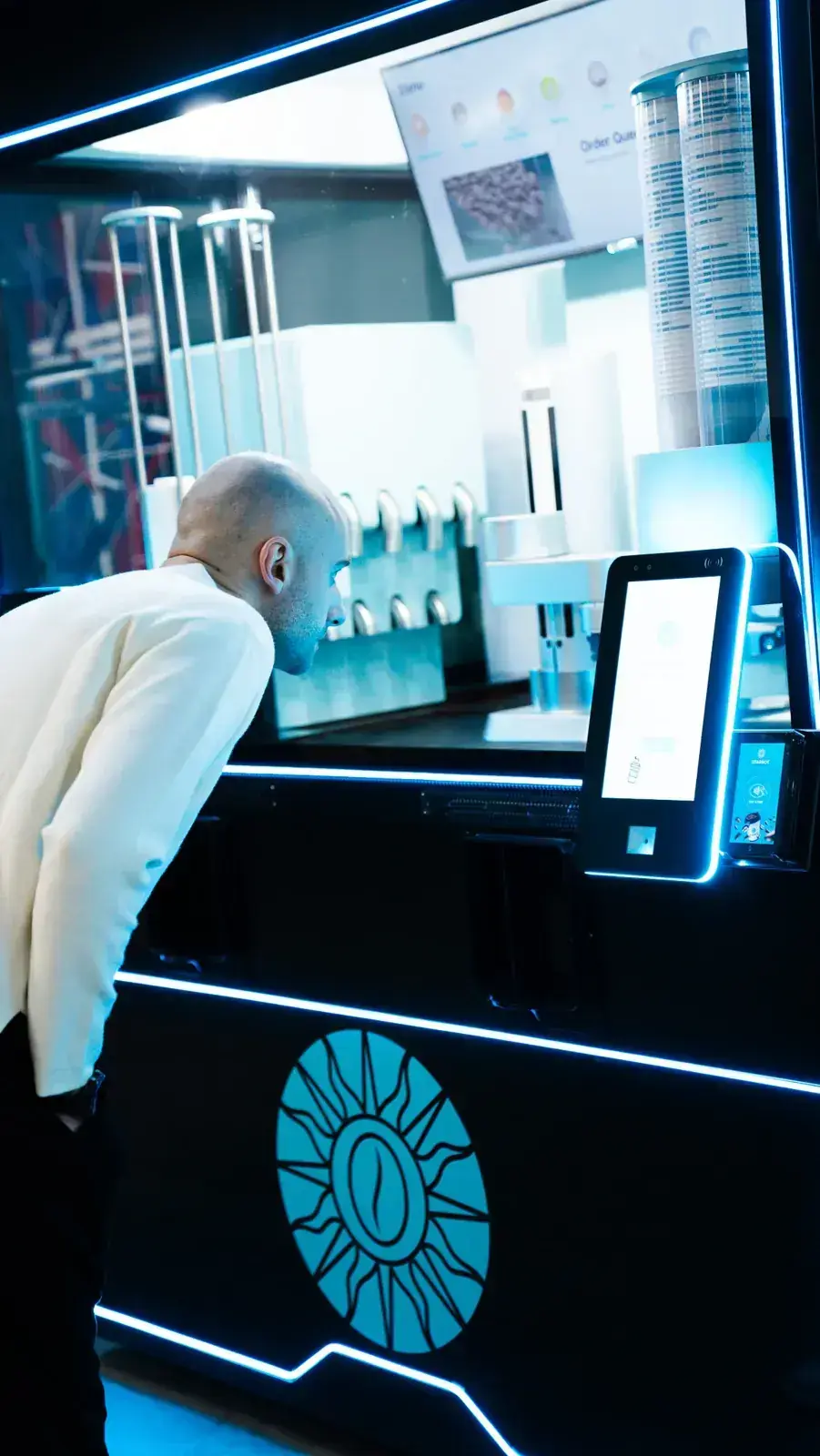
Guests holding STARBOT coffees beside the kiosk at the London launch
The case

Why a kiosk, in this kind of building.

Steady all day with a 10:00 and 14:00 lift — the most even demand curve of any venue we serve.

Coworking has the best demand curve of any venue we serve, and it is worth saying why: members arrive across a two-hour window rather than at a bell, they stay all day, and they get up from a desk roughly when they need a reason to. The result is a lift at 10:00 and another at 14:00 on top of a base load that never really stops. For a machine with no wage bill that is close to the ideal shape, because there is no dead middle to pay for.

The problem the kiosk actually solves in a coworking space is not thirst, it is job description. Coffee is included in most memberships, which means somebody is making it, and that somebody is the community manager who was hired to run the tours, fix the printer, chase the renewals and keep members from leaving. A measurable slice of their day goes into milk. Handing that to a machine is the cheapest headcount decision an operator can make.

The third thing is the tour. Every operator on earth walks a prospect past the coffee point and says something about it, and the honest truth is that a bean to cup on a counter is not a reason anybody signs. A robot arm pouring a flat white in under 60 seconds is a stop on the tour rather than a sentence in it, and in a market where three buildings within a mile are quoting the same desk rate, the tour is what is actually being sold.

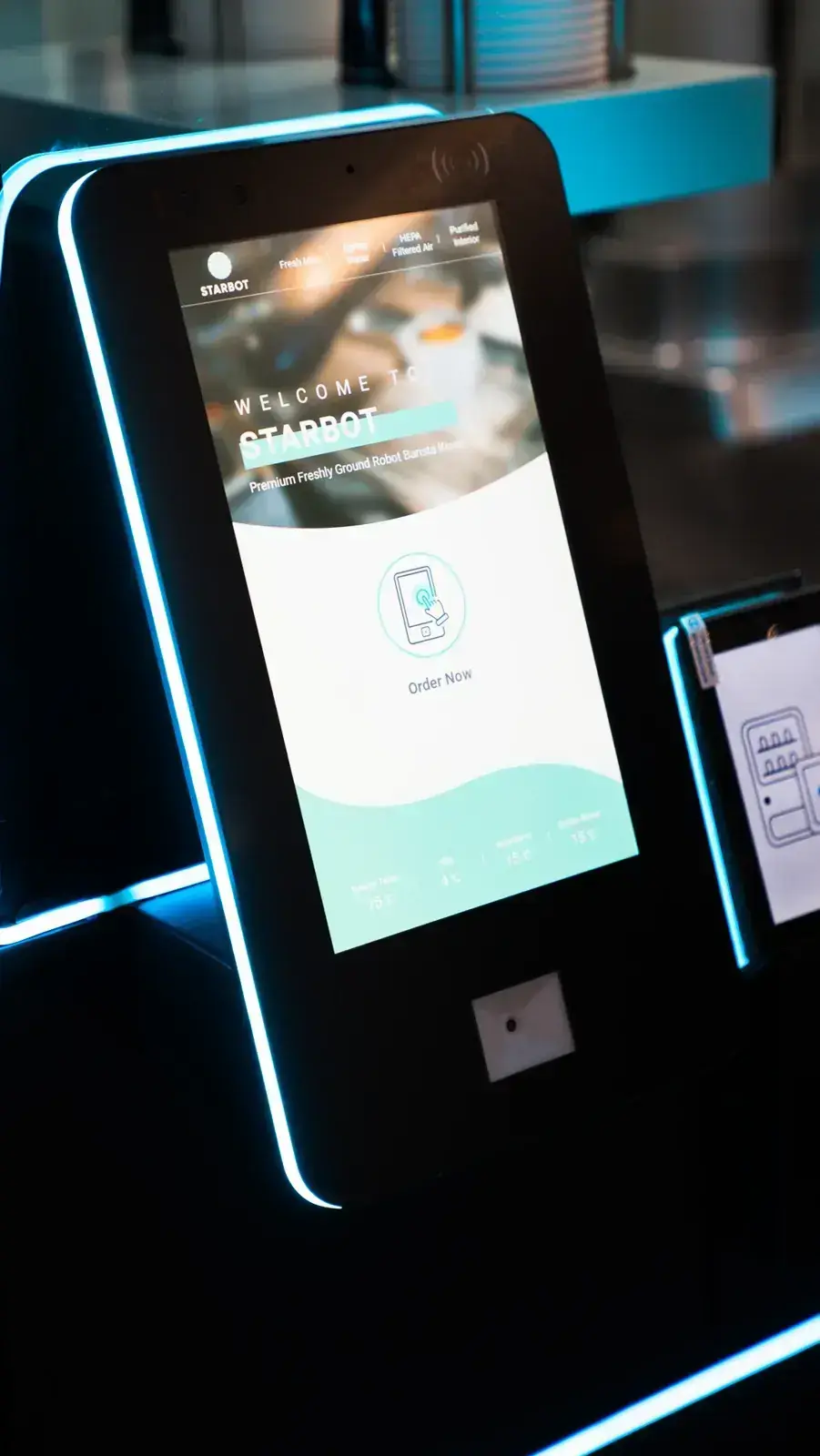
The STARBOT ordering touchscreen taking a contactless card payment
Tap, choose, pay
A customer ordering coffee at the STARBOT touchscreen
Ordering, mid-morning
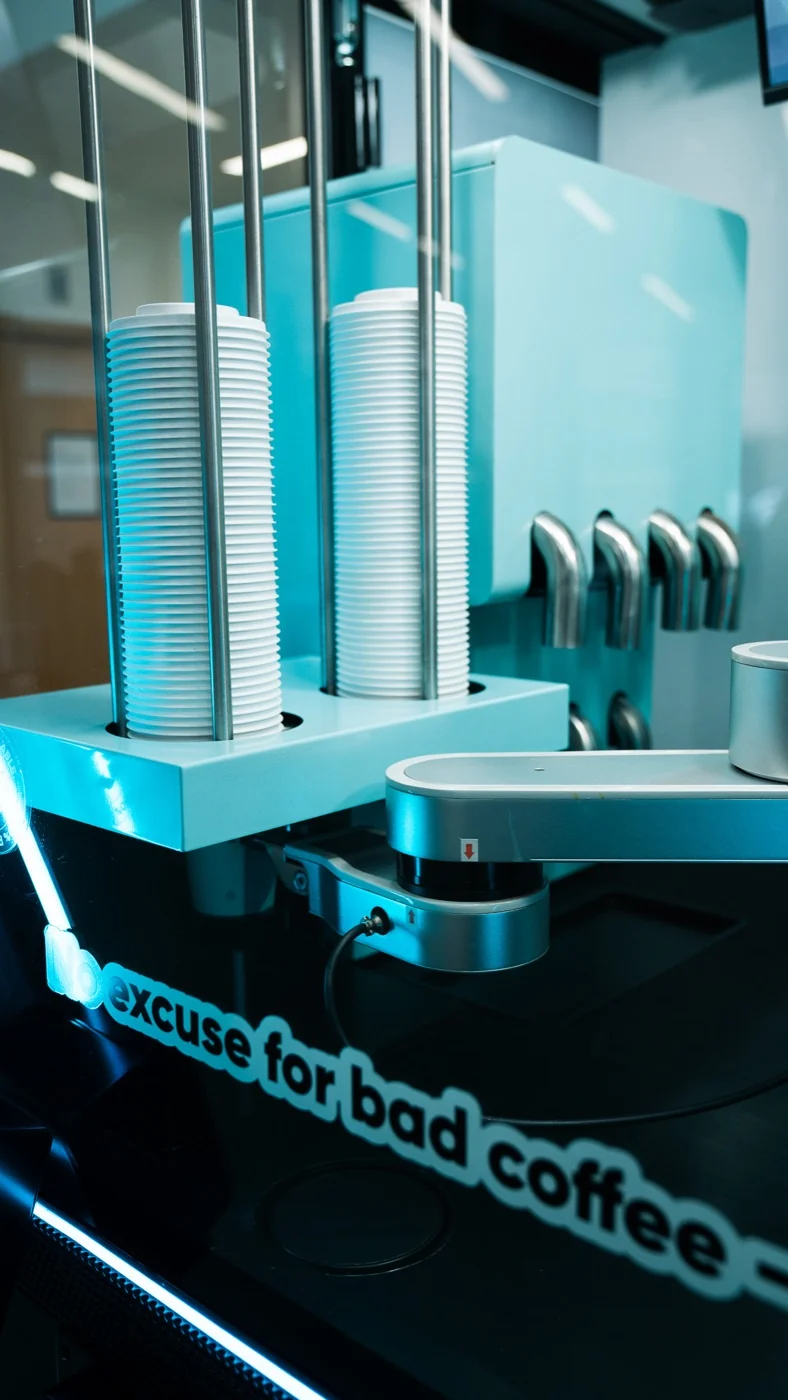
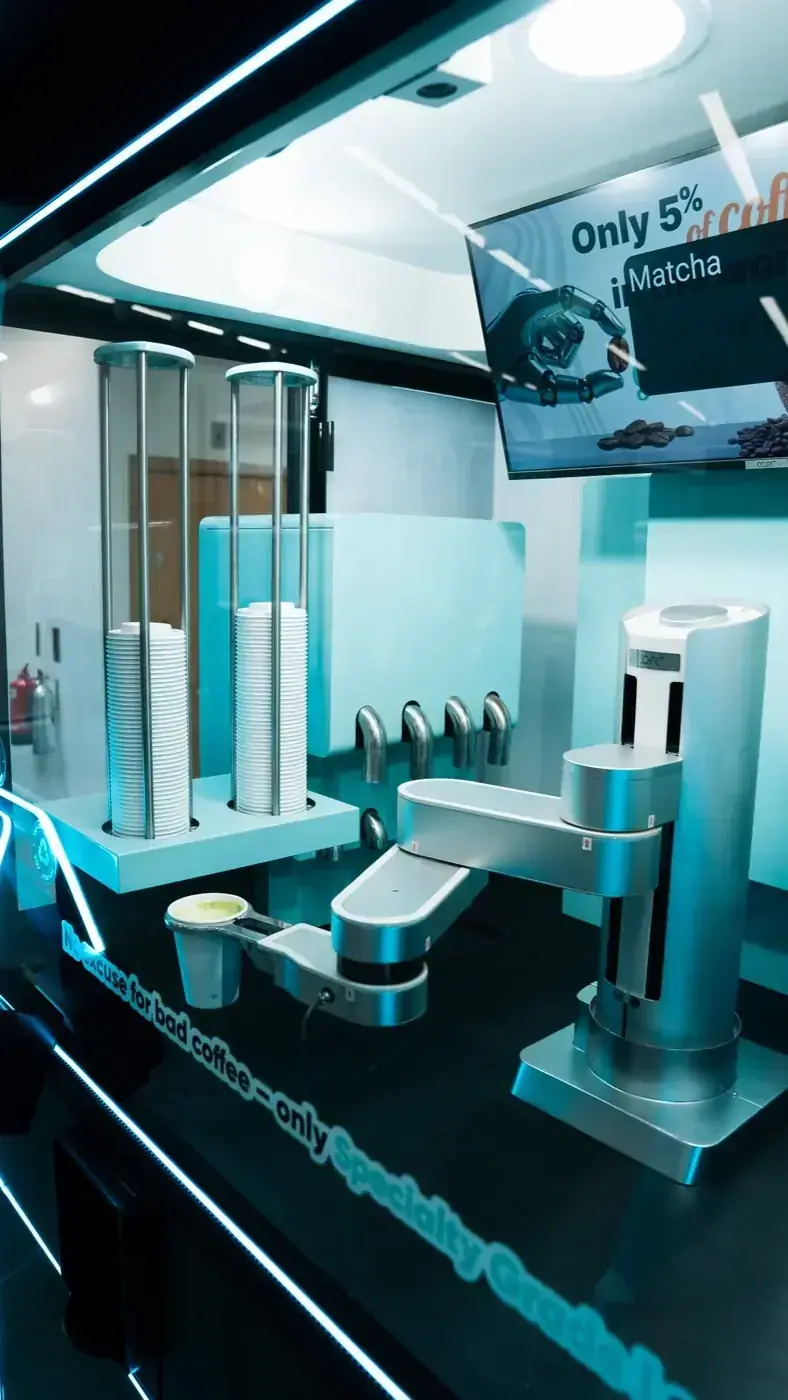
The robotic arm inside the STARBOT kiosk placing a cup
The arm, mid-cycle

Photographed at City St George’s, University of London — our live site. Real photography, no renders.

The first objection

“Coffee is included in our membership.”

What actually happens

Where the incumbent gives up

Community managers spend a measurable slice of the day making flat whites instead of selling desks.

This is the part nobody puts in the business case, because it is nobody’s job to write it down.

Our answer

What the kiosk does instead

Then the kiosk runs on a member tariff and you stop paying someone to pour it. The cost per cup is known and fixed.

Same drink at 06:00 and at 22:00, without a wait, from 2.5 m² of floor.

The trading day

A day in coworking spaces, hour by hour.

Not a generic day. This is how the demand actually arrives in this kind of building — including the hours a staffed counter is paid for and nobody comes.

Trading pattern · coworking spaces

Early members and the 24/7 keyholders. Thin, but it is the group most likely to be paying for a private office rather than a hot desk, and they notice what is available before the team arrives.

The main arrival window, spread across an hour rather than a bell. Members are settling in, and the first coffee of the day is bundled into that routine.

The morning lift, and the first of two genuine peaks. Meeting-room bookings start on the hour, which means guests arriving at reception who are also being offered a drink.

Steady. This is the stretch that makes coworking unusual — most venues are dead here, and a coworking floor simply is not, because people are working through and getting up when they need to.

The afternoon lift, the larger of the two. It is the post-lunch slump made visible, and it is the single busiest hour on most coworking sites.

Members working late, plus community events with a drinks reception. Event nights are the exception to the pattern and they are the nights the coffee point is most visibly not staffed.

Near zero in most buildings, and genuinely busy in the few with a strong 24/7 membership. Worth measuring rather than assuming, because operators are usually wrong about their own weekend in both directions.

Why it holds up here
Takes coffee duty off the community team entirely
Even demand all day, which is the best case for an unattended unit
A visible amenity on the tour that closes desk sales
Where it stands

The position decides the numbers.

Two spots forty metres apart in the same building can differ by half the sales. These are the positions that work in coworking spaces — and the one that does not.

The members' lounge or breakout, on the main circulation route

The position that matches the actual demand curve. Members pass it every time they get up from a desk, which is what turns a coffee into a habit rather than a trip, and it puts the machine in the room the operator already photographs for the website.

On the tour route, in sight of reception

If the prospect does not walk past it, it is not doing half its job. A position visible from the front desk means every viewing includes it without the community manager having to detour, and meeting-room guests can be offered a drink without anyone leaving the desk.

The floor with the most private offices, in a multi-floor building

Private-office members are the highest-value and the least likely to walk two floors for a coffee. In a building with several floors the second position goes where the retention risk is, not where the hot desks are.

Not inside the members' kitchen

In a kitchen the kiosk competes with a free filter jug and a fridge, disappears from the tour entirely, and inherits the queue that forms around a microwave at lunch. Immediately outside it keeps the break-time association and loses all three problems.

Getting it approved

How a yes actually happens here.

Coworking is the fastest sign-off of any venue on this site, because the person who runs the building is usually the person who can decide. The community manager or general manager sponsors it, the operator's head of operations approves the arrangement, and on a single-site independent that can be one conversation. The complication is ownership: many operators occupy under a management agreement with a landlord rather than a lease, and it is worth knowing which before agreeing a position in a shared lobby.

The second question is always the membership promise. If coffee is advertised as included, changing it to a paid tariff is a member-communications decision rather than an operational one, and it is the part operators get wrong by doing it quietly. The kiosk supports either — free at the point of use on a member tariff the operator covers, or paid — and the operators who handle it best decide that before the machine arrives, not after the first complaint.

Who has to say yes

What estates and compliance ask · answered

Our membership includes coffee. How does that work?

It runs on a member tariff: the drink is free at the point of use and the operator covers it, so the promise is unchanged and the cost per cup becomes a known fixed number instead of an unpredictable one. Alternatively members pay and you take an agreed share, which some operators prefer once they see what included coffee actually costs them.

Do we need our landlord's permission?

Inside your own demise, normally not. If the position is in a shared lobby or common parts under a management agreement, the building owner decides. Because nothing is plumbed and nothing is fixed to the fabric, it is usually a permission rather than a licence for alterations, which is a far shorter conversation.

Can we take it to our other sites?

Yes, and a multi-site operator is the easiest kind of rollout to service — one arrangement, one point of contact, and a servicing round that covers several buildings in a morning. The tariff can differ between sites if the memberships do.

What happens to the coffee budget we already have?

It stops being unpredictable. Today it is beans, milk, a service contract, someone's time and whatever the machine broke last month; on a member tariff it becomes a cost per cup you can put in a model. That is usually the number that decides it, rather than the machine itself.

Is there anything for our team to do?

No. Restocking, cleaning the milk path and repairs are ours, and the kiosk reports its own stock and fault state. The community team stops being responsible for the one amenity every member notices when it fails, which is the actual point of the exercise.

Can meeting-room guests use it?

Yes, and that is one of the better arguments for a position in sight of reception. A guest arriving for an 11:00 booking can be pointed at it rather than waiting while somebody goes to make a cafetiere, and the operator can cover guest drinks on the same tariff.

Nothing here needs plumbing, drainage or a fixing to the fabric of the building. The kiosk stands on the floor and plugs into a 16A socket.

What the site has to be able to offer
2.5 m² of clear floor on the main circulation route, off the escape routeA standard 16A socket within reach of the positionLift or level access to bring the kiosk inClarity on whether the position sits inside your demise or in common partsA named contact for restocking access, including any out-of-hours arrangement
Operations

Who does what, once it is in.

A vending contract creates work for your facilities team. This one does not: restocking, cleaning, faults and reporting are ours.

Restocking is driven by the machine, not by the community team

The kiosk reports what it has left, so replenishment follows consumption. In coworking that is the difference between a full building on a Tuesday and a half-empty one on a Friday being handled automatically, rather than by a community manager noticing the milk has run out at 14:10.

The tariff is a setting, so the membership promise can change without the machine changing

Free at the point of use for members, paid for day-pass users, covered for meeting-room guests — these are configuration decisions rather than different equipment. Operators do change their minds about this once they can see the per-cup number, and doing so does not involve an installation.

Nothing for the front desk to clean or restock

The milk path, drip tray and interior are on our schedule. There is no jug to rinse, no grounds to knock out and no fridge to restock behind the desk, which removes the specific job that was quietly eating the community manager's morning.

Faults are ours to notice

The kiosk reports its own fault state, so we usually know before the building does. That matters more in coworking than elsewhere: broken coffee is the complaint that reaches a member forum fastest, and the operator finding out from us rather than from a member is the difference.

Someone working on a laptop with a STARBOT coffee beside them
Dwell time, on site
Specialty Grade 1 coffee beans held in a hand before loading the hopper
Specialty Grade 1 beans
The interior mechanism of the STARBOT kiosk with cups and hoppers
Inside the unit

Photographed at our live site in London. Real photography, no renders.

What gets signed

A site licence, not a lease.

An operator signs a site licence rather than a lease. It is permission to place and operate the kiosk in an agreed position, with no exclusive possession of any part of the floor and no tenancy created. In coworking that distinction is unusually relevant, because many operators are themselves occupying under a lease or a management agreement with terms about who else may occupy space in the building.

The commercial terms come in two shapes here rather than one. On revenue share the members pay, drinks start at £2.00 and the operator takes an agreed share of every cup as site commission. On a member tariff the operator covers the drinks and buys a known cost per cup instead of a variable coffee budget. Operators with an included-coffee membership almost always start on the second and some move to the first once they have seen the volume.

Where an operator would rather run the machine itself, the same kiosk is available on a five-year lease at £1,790 a month — which for a multi-site operator amortising a fit-out is sometimes the more natural line in the model than a placement agreement.

Exit is straightforward and it should be, in a sector where buildings open, close and change operator regularly. Notice on either side, we collect the kiosk, and there is no reinstatement because nothing was altered. If the operator moves rather than stops, the usual answer is that it moves with them and we survey the new floor.

The commercial shape — a share of every cup, or a fixed monthly fee for the space — is set out before anything is installed. See how hosting works.

Versus the alternatives

Every other option, including where we lose.

If one of the rows above ours fits your building better, take it. We would rather not install a kiosk than install one into a position that cannot carry it.

The optionHow it plays out hereWhere it falls down
The community manager making it

Included in membership, personal, and the thing the operator currently tells prospects about on the tour.

It is the most expensive coffee in the building once you price the hour, and it happens instead of tours, renewals and the things that actually keep the desks full. It also stops entirely the moment that person is on holiday, at lunch, or showing someone round.

A filter jug and a bean to cup on the counter

Self-service, free to members, no labour, and it is what most of the market does.

Cleaning and refilling still land on the community team, and the drink is not something a member would choose to buy. As a differentiator on a tour it is worth nothing, because the building down the road has exactly the same machine on exactly the same counter.

A staffed café in the ground-floor lobby

The best experience, a genuine amenity, and in a large flagship building it works commercially on non-member trade too.

It needs the volume of a large building and it closes in the evening, which is when your 24/7 members are still there. Below flagship scale you are paying wages through hours that a coworking floor does not generate the cups to justify.

A deal with the café next door

Costs nothing, supports a neighbour, and members get a proper coffee.

Every coffee is a member leaving the building for twenty minutes, and it makes your amenity somebody else's opening hours. It also cannot be shown on a tour, which removes the only part of the coffee question that affects desk sales.

A STARBOT kiosk

Barista-grade drinks without a wait, no staff, an even all-day demand curve, that footprint, and no capital cost on revenue share.

If your brand promise is a barista making a member's coffee and knowing their name, a machine is a downgrade of exactly the thing you sell, and some members will say so. A small single-floor operator with a modest member count will not generate the volume to make it worthwhile, and the menu is fixed — there is no off-menu drink for the member who wants it a particular way.

The last row is ours, with its real downside written in. Revenue share and unit pricing are agreed per site and are not published.

When to say no

Where this is the wrong answer.

Four cases in this venue type where we would tell you not to bother. They cost us installs; printing them costs less than a kiosk that never earns.

Siting mistakes

Four ways to put it in the wrong place.

Each of these has happened somewhere, and each shows up as the same thing on the report: a position that takes half of what the footfall said it would.

Putting it behind the front desk

The community manager is now the barista again, only with an extra step. Everything the operator was buying — the hour back, the amenity that runs while the team is on a tour — is undone by a position that requires a member of staff to be standing next to it.

Siting it in the members' kitchen

It ends up competing with free filter coffee a metre away, invisible to every prospect on a tour, in the room that is most congested at lunch. The kitchen feels like the obvious home for a coffee machine and it is the position that reliably underperforms.

Putting it in the event space

Event rooms get booked out privately, and when they are, the building's coffee is behind a closed door for the afternoon. Members find a locked amenity far more annoying than no amenity, and they say so in the renewal conversation.

Next to the quiet zone or the phone booths

The grinder is audible, and a coworking floor is the one workplace where the quiet zone is an advertised product rather than an accident. The complaint that follows is about noise rather than coffee, and noise complaints in coworking end in refunds.

Where these cluster

The cities this venue type is thickest in.

Density matters to us as much as footfall: several sites inside one servicing round is what keeps a kiosk free to host.

Manchester

Spinningfields and the surrounding centre hold one of the densest independent and branded coworking clusters outside London, several within one servicing round.

London

The deepest coworking market in the country, and the one where three operators within a mile are quoting the same desk rate — which is what makes the tour, and what is on it, decisive.

Bristol

A strong tech and creative operator base in the centre, with out-of-town parks at Aztec West and Filton where there is no café to walk to at all.

Edinburgh

A financial and tech centre with year-round operators and one extreme August, when the city fills and the buildings do not empty.

Questions from this kind of building

The ones worth asking before you sign.

Coffee is included in our membership. Does that make this pointless?

No — it changes which model you use. The kiosk runs on a member tariff, so the drink stays free at the point of use and the operator covers it. What changes is that your coffee cost becomes a known figure per cup instead of beans, milk, a service contract and somebody's time, and your community manager stops being the person who makes it.

How much of a community manager's day does coffee actually take?

More than operators expect, because it is not the pouring — it is the restocking, the milk run, the cleaning, the machine that is broken again, and the interruption during a tour. It is also the least substitutable part: nobody else on a small site can do it, so it happens instead of renewals rather than alongside them.

Can day-pass users and meeting-room guests use it too?

Yes, and the tariff can treat them differently from members. A common arrangement is free at the point of use for members, covered by the operator for meeting-room guests, and paid by card for day-pass users — the same machine, three settings, and nothing for the front desk to administer.

We have four buildings. Can we do all of them?

Multi-site is the easiest version of this. One arrangement covers the group, the servicing round can take several buildings in a morning, and the member experience is the same wherever they drop in — which for an operator selling a network rather than a room is usually the point.

What does it need from the building?

A corner of clear floor, a standard socket and a way to get the kiosk in — a lift or a level entrance. There is no plumbing and no drainage because it runs from a refillable water supply, so it can go in a lounge or on a landing rather than only near a sink.

Will it be loud on an open floor?

There is a grinder and it is audible. In a lounge or a breakout area that reads as activity; outside a phone booth or in an advertised quiet zone it does not, and that is a siting decision we make on the walk-round. Coworking is the venue where getting this wrong costs the most, because quiet is something your members are paying for.

What happens if members do not like it?

Then it is the wrong site and we would rather find out in the first month than the twelfth. A kiosk in a building that does not want it costs us more than it costs you, which is why the siting conversation is ours to get right and why moving or removing it is a visit rather than a negotiation.

Does it work for a 24/7 membership?

That is one of the stronger arguments for it. A member with a key fob at 21:00 has no community team, no café and no reason to expect a proper coffee, and the kiosk trades those hours at no extra cost because there is no shift attached to them.

How does it compare to putting a café in the lobby?

A staffed café is better if the building generates the volume, and in a flagship it also earns from people who are not members. Below that scale you are paying wages through hours a coworking floor does not fill, and the café shuts in the evening — which is precisely when your highest-value members are still at their desks.

Not what you were after? All sixteen venue types · Host a kiosk at your site · Own a STARBOT franchise · Lease a unit · Own one · £1,790/mo

Tell us about your building.

Postcode, venue type and rough daily footfall is enough to start. We come back with a footfall-based model for your site — usually within a day.

Or go direct — WhatsApp hello@starbot.co.uk

Tell us about your site.
We reply the same day.

No obligation, no credit search, no spam — one reply from the team with the exact numbers for your venue.

Prefer to talk? WhatsApp us — or ask Richard, bottom right.