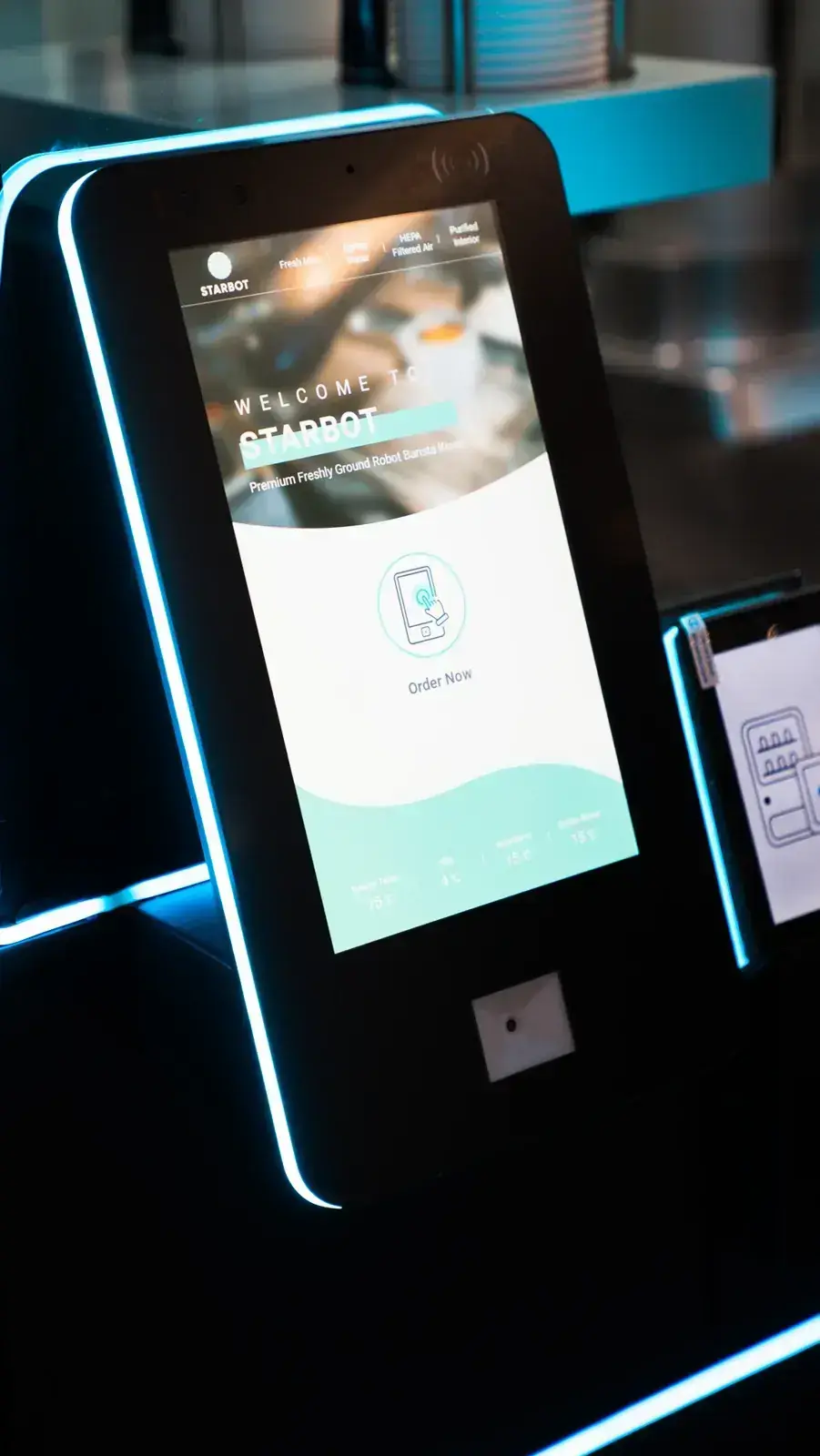
Shared amenity coffee for a park where no single tenant is big enough to justify a café. Free to host — we install, stock and service it; your site takes a share of
Aggregated from many small tenants — no single peak, but a reliable all-day base load.
A business park is a coffee problem of arithmetic rather than appetite. Ten firms of thirty people want the same drink at the same time of the morning, but no one of them is large enough to install anything, and none of them will pay for something their neighbours use. The park as a whole is a perfectly good coffee site; it just has no single occupier who can act on that, which is why the amenity never appears.
The landlord or managing agent is the only party that sees the whole estate, and a kiosk is one of the very few amenities they can add without operating anything or increasing the service charge. It stands in shared reception on 2.5 m², we stock and service it, and the park takes a share of every cup — an income line attached to common parts that were previously pure cost.
The other thing a park buys is a letting argument. Out-of-town estates compete for tenants against town-centre buildings that have a coffee shop on the ground floor, and the agent showing a unit has to answer the same question every viewing. A kiosk in the shared entrance turns that question into a demonstration, and it is the cheapest thing on the estate that does.
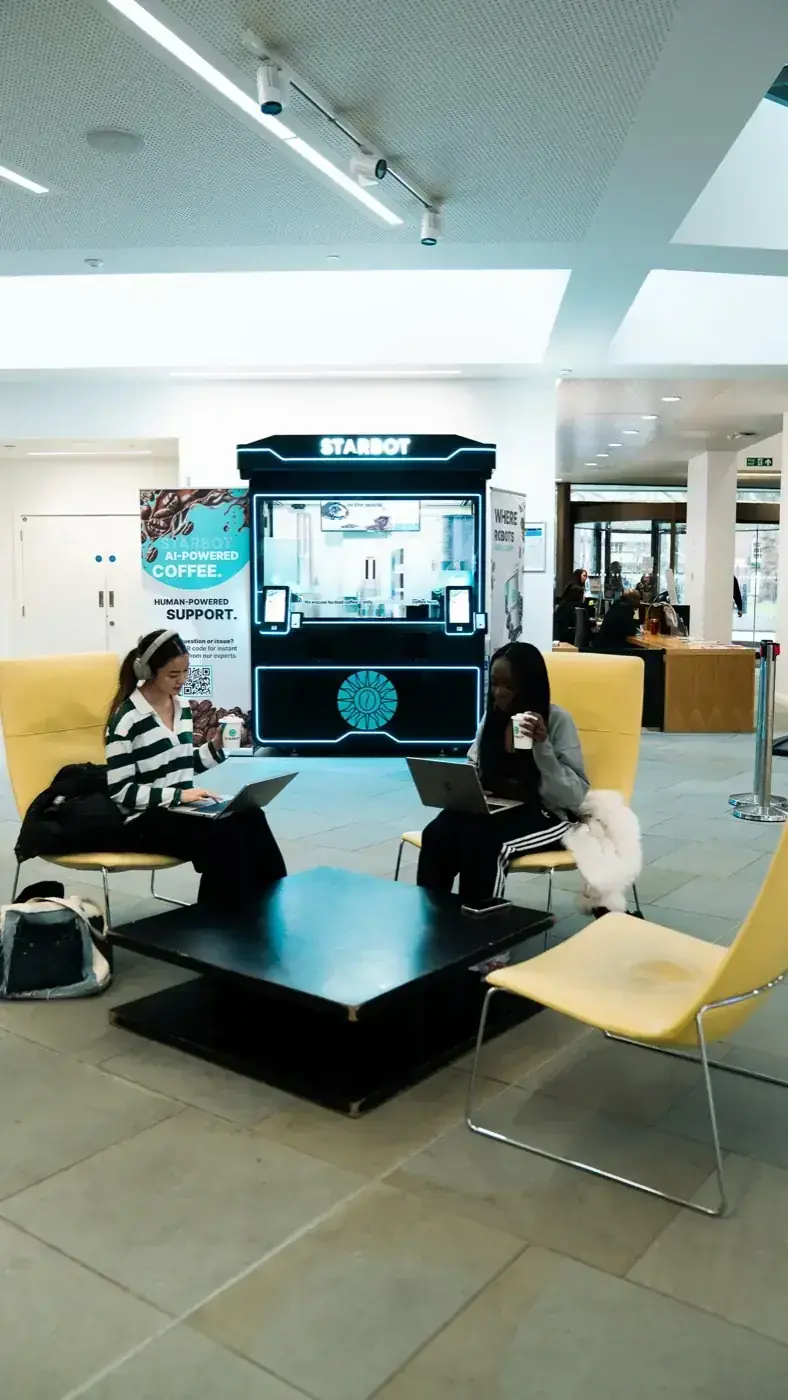
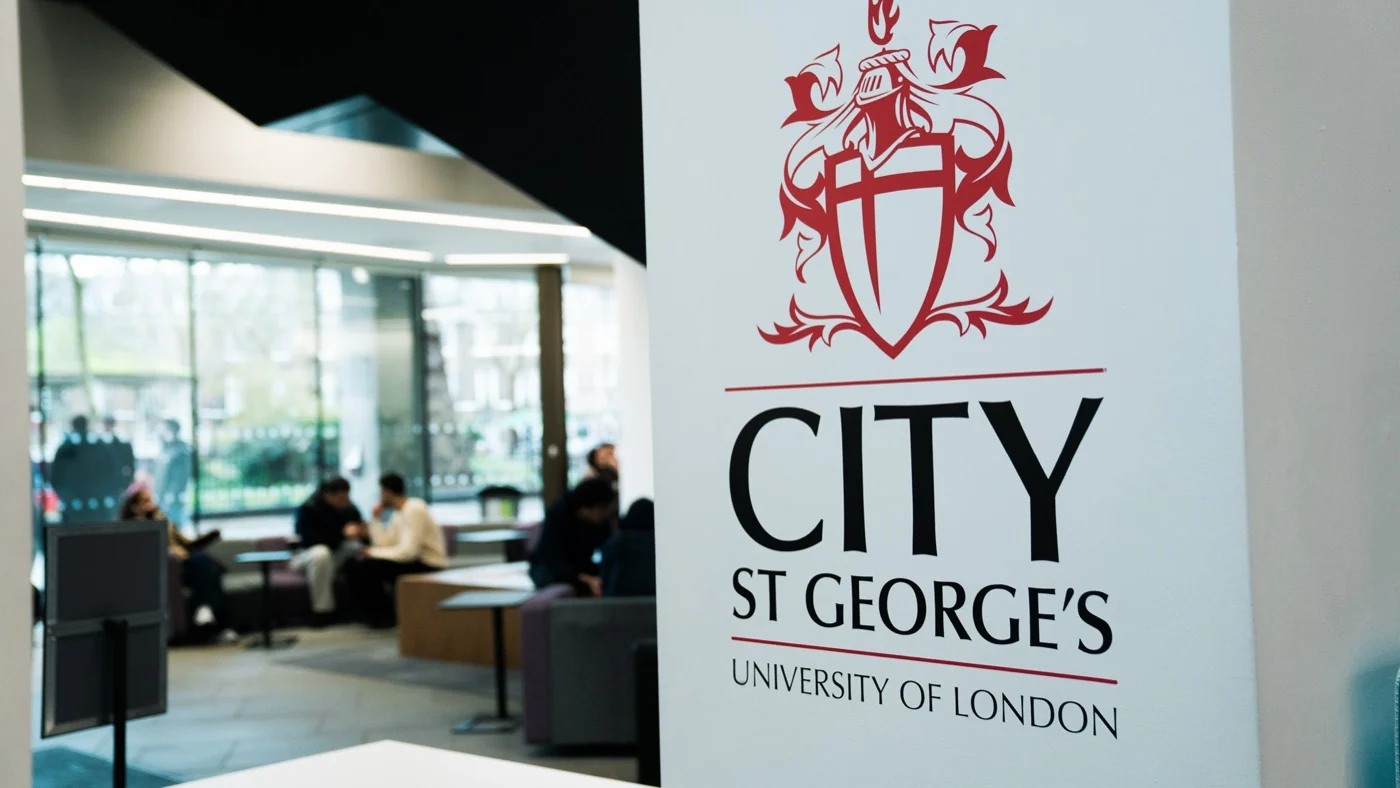
Photographed at City St George’s, University of London — our live site. Real photography, no renders.
A café needs a single tenant large enough to carry it on its own; a park of ten small firms never has one, however many people are on the estate in total.
This is the part nobody puts in the business case, because it is nobody’s job to write it down.
No one has to. It goes in the shared reception on a revenue share, and the park keeps a cut of every cup.
Same drink at 06:00 and at 22:00, in under 60 seconds, from a corner of floor.
Not a generic day. This is how the demand actually arrives in this kind of building — including the hours a staffed counter is paid for and nobody comes.
Arrivals stagger across the whole park rather than arriving together, because tenants keep different hours and everybody parks and walks in from a different corner of the site.
The closest thing to a peak, but flatter than an office tower's — thirty firms starting within ninety minutes of each other produces a long ramp, not a wall.
Meeting traffic. Parks host suppliers, interviews and client visits in tenant reception areas, and the visitor coffee problem lands on whichever tenant is hosting.
The out-of-town lunch problem. There is nowhere to walk to, so people either drive off site for forty minutes or stay in — and staying in is what the kiosk sells.
The steadiest stretch of the day on an estate. Base load from many small tenants at once is more reliable here than a single occupier's afternoon lull.
Thinning by unit rather than all at once. The two or three tenants with later hours keep a trickle going long after the earliest firm has locked up.
Close to zero on most parks, and that is fine — a kiosk with no wage attached to it costs nothing to be shut, which is precisely the reason a staffed unit never worked here.
Two spots forty metres apart in the same building can differ by half the sales. These are the positions that work in business parks — and the one that does not.
The only position that serves every tenant equally, which matters politically as much as commercially. It is also the space the landlord controls outright, so the decision belongs to one party rather than to a negotiation between occupiers.
Where a park has one building holding several tenants, its lobby is the highest concentration of people passing a fixed point on the estate. It beats a hub building that people drive past but rarely enter.
Parks that added a shared facility already proved people will cross the estate for it. Putting the kiosk on that route borrows a journey that is already happening rather than asking for a new one.
The moment the kiosk sits inside a demise, it belongs to that tenant in everybody else's mind and the aggregation argument collapses. The whole point is that it is nobody's and everybody's, and the position has to say so.
On a multi-let estate the decision sits with whoever controls common parts — normally the landlord, exercised through a managing agent. That is a simpler chain than an office tenancy, because there is no occupier's lease to work around and no third party whose demise is affected. What the agent needs to know is that this is an income line, not a service charge item, and that they are not adopting an operational responsibility.
The second question on a park is always fairness. Agents are careful about anything that looks like it favours one tenant, and about anything that could be read as a change to the service charge budget. A kiosk avoids both: it is placed in shared space, funded by us, available to everybody, and the estate's share comes from cups sold rather than from a levy anybody pays.
No, and that is the point. We fund, install, stock and service the kiosk; nothing is recharged to the tenants and no budget line is created. On revenue share the estate receives a share of the cups sold, so it is income against common parts rather than a cost to allocate.
There is no advantage to give — it stands in shared space and everyone reaches it on the same terms. Fairness is exactly why it belongs in the estate hub rather than in the reception of the largest occupier, and it is worth saying that in the tenant notice.
Nothing. The kiosk is licensed by the landlord in common parts, so a tenant leaving does not affect the agreement. If the estate's occupier mix changes enough that the trade changes with it, that is a conversation about position, not a contractual problem.
We are. It is our equipment, tested and insured as ours, and the estate is not adopting an asset or an inspection duty. Your building manager keeps doing exactly what they did before it arrived.
None. It stands on the floor, plugs into a standard 16A socket and runs from a refillable water supply, so there is no drainage, no fixed pipework and nothing fastened to the fabric. It leaves the reception exactly as it found it.
The estate, as part of the common parts supply it already pays for — a standard socket load rather than a metered service. Everything that goes into a cup, and everything that maintains the machine, is ours.
Nothing here needs plumbing, drainage or a fixing to the fabric of the building. The kiosk stands on the floor and plugs into a standard socket.
A vending contract creates work for your facilities team. This one does not: restocking, cleaning, faults and reporting are ours.
The kiosk reports what it has left, so refills follow what the park actually drank. That matters on a multi-let estate where the mix changes — a new sixty-person tenant moving into an empty unit changes the consumption curve before anyone thinks to tell us.
Cleaning inside the machine, the milk path and the drip tray are ours. Your cleaning contractor keeps cleaning the floor of a reception they were already cleaning, and no one on the estate has to open the machine or order anything for it.
The kiosk reports its own fault state, so the usual sequence is that an engineer is already scheduled when a tenant mentions it. On an estate this matters more than elsewhere: a managing agent's least favourite thing is fielding complaints about an amenity they introduced.
Card and contactless only means every cup is a record. For a park, the useful part is knowing which hours the estate actually trades — the data answers whether a second position at the far end of the site is worth having, rather than leaving it to opinion.
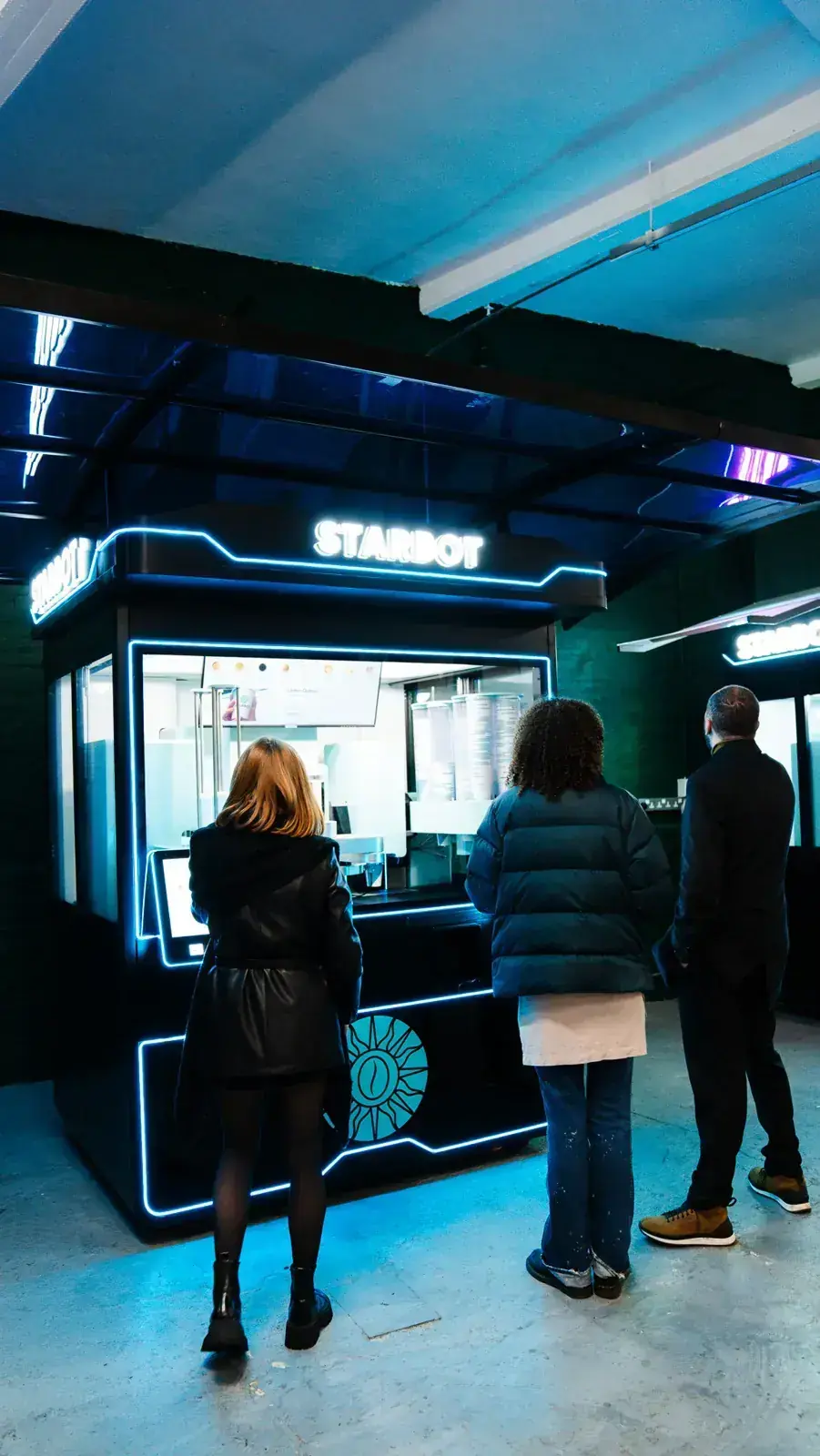
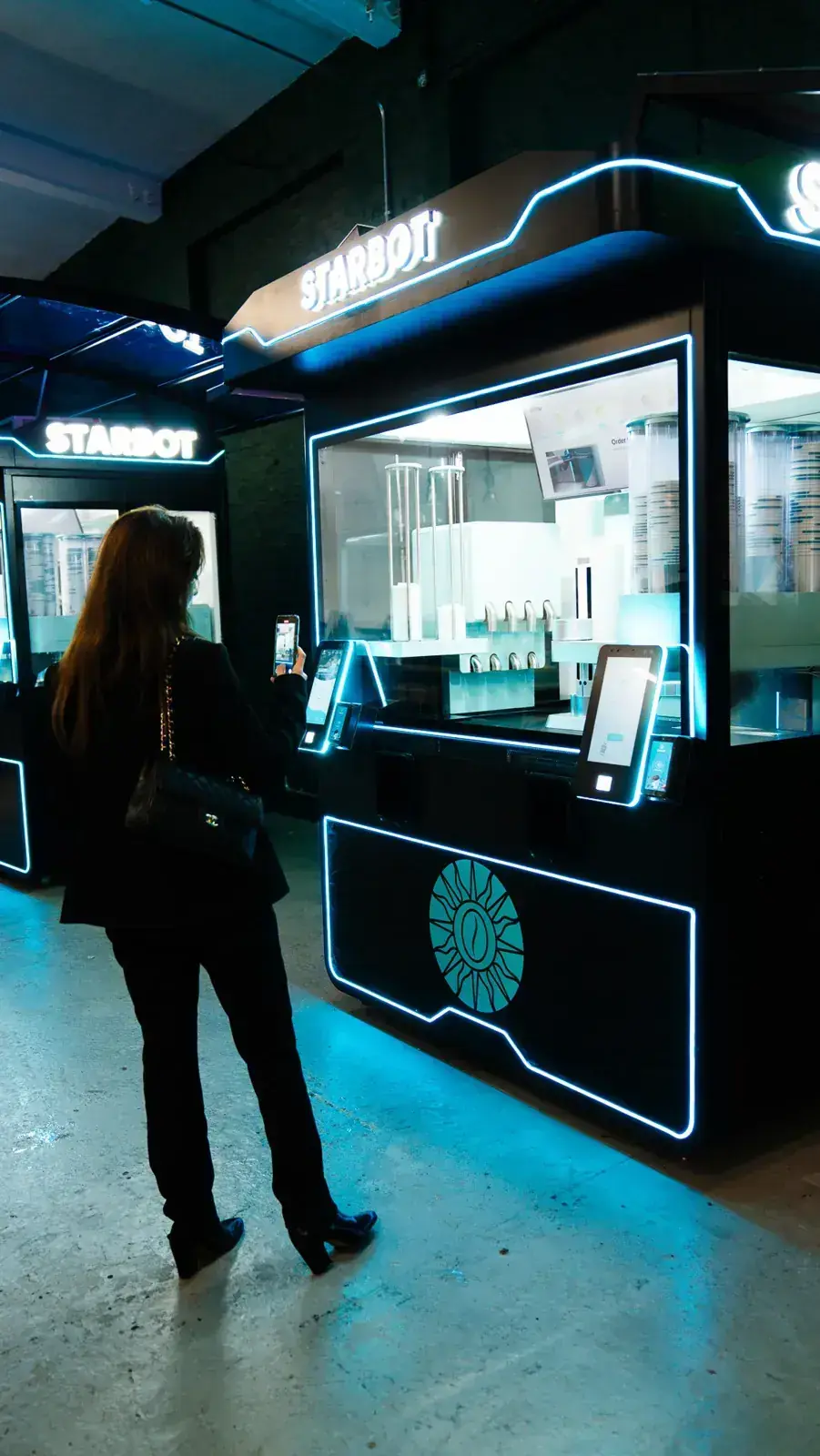
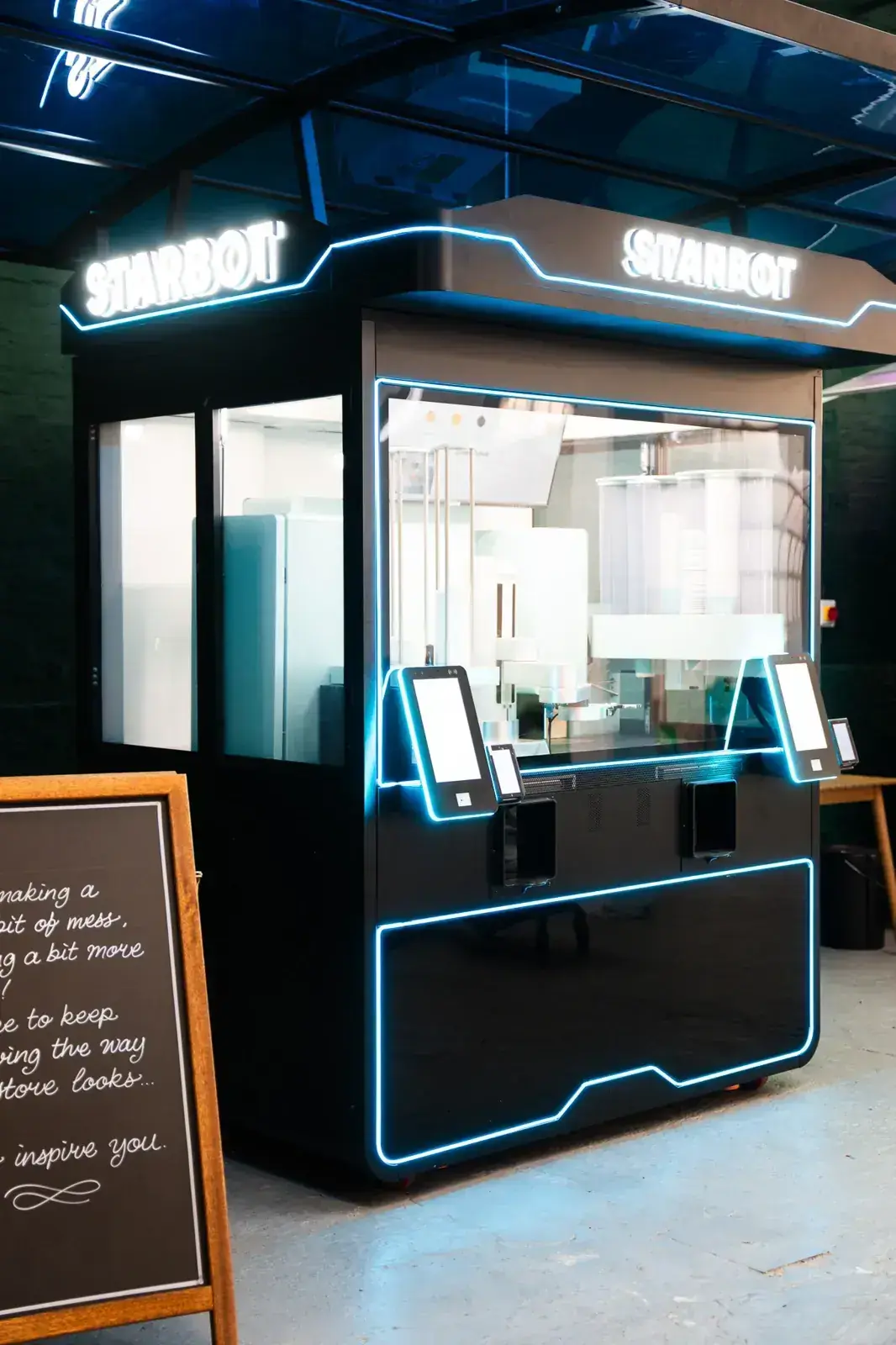
Photographed at our live site in London. Real photography, no renders.
The estate signs a site licence, not a lease. It is permission for us to place and operate a machine in a defined spot in common parts; it grants no exclusive possession of any part of the estate and creates no tenancy. For a landlord that distinction is the whole reason this is a five-minute decision rather than a legal one — there is nothing here that touches the estate's letting position.
The commercial term is an agreed share of every cup sold, paid to the estate. It is agreed per site rather than published, because a park of ten small units and a park with a two-thousand-person anchor are not the same offer, and a single published rate would be wrong for one of them. Nothing is charged to tenants and nothing enters the service charge.
Exit is by notice on either side, and there is nothing to reinstate because nothing was altered. Estates change hands, refurbish and re-let, and an agreement that made any of those awkward would be an agreement an agent declines on principle. If the estate is sold, the licence is simply a matter for the incoming manager to keep or end.
If a park would rather run the machine itself — because it wants the full margin, or because an operator on site wants to run it — the same kiosk is available on a five-year lease at £1,790 a month. It is the same equipment and the same servicing, on a different commercial footing.
The commercial shape — a share of every cup, or a fixed monthly fee for the space — is set out before anything is installed. See how hosting works.
If one of the rows above ours fits your building better, take it. We would rather not install a kiosk than install one into a position that cannot carry it.
The amenity every park wants on the letting particulars, and on a large estate with an anchor tenant it genuinely works.
It needs one occupier of real scale to underwrite it. A park of ten thirty-person firms cannot produce the covers to pay a wage through a long flat afternoon, which is why so many estate cafés open, struggle and close within a couple of years.
Cheap, already common on estates, and it covers the base need for something hot at 15:00.
It sells the drink people settle for. On a park where the alternative is a fifteen-minute drive, that is tolerated rather than chosen, and it does nothing at all for the letting argument — no agent ever won a viewing on a vending machine.
The default outcome. Ten firms each end up with a bean to cup or a pod machine in their own kitchen.
Ten machines, ten sets of consumables, ten descaling arguments and no shared amenity at all. It is the most expensive way for an estate to solve coffee, and the cost is invisible because it is spread across ten service charge-free budgets.
Zero cost to the landlord, and there is usually a retail park or a drive-through within a few miles.
It removes people from the estate for forty minutes in the middle of the day and gives every viewing agent the same awkward answer. The cost falls on tenants rather than the landlord, which is why it persists for years.
Barista-grade drinks without a wait in shared reception, that footprint, no capital cost on revenue share, and a share of every cup to the estate.
It depends on people passing one point, and a park where everyone drives to their own unit door and never enters a shared building is a park where the aggregation does not happen. On a low-density estate with no hub, we are the wrong answer and would rather say so at the survey than install into an empty lobby.
The last row is ours, with its real downside written in. Revenue share and unit pricing are agreed per site and are not published.
Four cases in this venue type where we would tell you not to bother. They cost us installs; printing them costs less than a kiosk that never earns.
Each of these has happened somewhere, and each shows up as the same thing on the report: a position that takes half of what the footfall said it would.
It becomes that tenant's machine in everybody's mind, and the other nine firms stop thinking of it as available to them. The aggregation that made the estate a viable site quietly disappears, and the sales figures blame the machine rather than the politics of the position.
Plenty of parks have a management or meeting building that people drive past daily and walk into twice a year. Footfall on the estate is irrelevant if it does not pass the door, and this is the single most common way a park position underperforms.
On an out-of-town estate everybody arrives by car and walks a fixed path from a space to a door. A kiosk off that path asks people to make a separate trip across an estate, and on a wet Tuesday in February they simply will not.
A park with a night-shift occupier, a nursery or a gym trades at hours the estate manager may not have mentioned. Fixing the position around the 09:00 arrival alone leaves the most defensible trade of the day — the hours nothing else on the estate is open — unserved.
Density matters to us as much as footfall: several sites inside one servicing round is what keeps a kiosk free to host.
The M42 corridor holds the largest concentration of business parks outside the South East, where individual tenants are too small to justify a café but the estate as a whole is not.
Aztec West and the Filton parks are out-of-town estates where the nearest coffee is a drive, so the shared hub is the only realistic position and there is nothing competing with it.
The science park estates run late lab and office hours on sites with no retail at all, which turns a shared reception into the only place on the estate anything is open.
Outer London and the M25 fringe behave like the rest of the country — multi-let estates with no walkable coffee — while sitting inside the densest servicing round we run.
None of them has to. The estate is the customer, not the tenants: the kiosk goes into shared reception under a licence from the landlord, we fund and run it, and the park takes a share of every cup that is sold. Ten firms of thirty people are one coffee site even though they are ten unviable ones, and the only party who can act on that is whoever controls common parts.
No. There is no capital cost, no maintenance contract and no consumables budget to allocate, so nothing is recharged to tenants. On revenue share it works the other way around — the estate receives income against common parts that previously only ever generated cost.
Normally the managing agent, referring an income decision to the landlord or asset manager if that is how the estate is run. Because the position is in common parts and nothing is fixed to the building, no tenant's demise is affected and no consent has to be collected from occupiers.
The agreement is unaffected — it is licensed by the landlord in shared space rather than tied to any occupier. If the estate loses a large tenant and the trade drops with it, that is a conversation about whether the position still works, and we carry the risk of that rather than the estate.
It can, but you should know what changes. In a single tenant's lobby it becomes that tenant's machine in everyone else's mind, and the estate-wide argument goes away. If there is genuinely no shared building, the honest answer is often that the park is not a kiosk site yet.
Good, and it is one of the strongest signals on an out-of-town site. Where the nearest coffee is a fifteen-minute drive, the kiosk is not competing with a café at all — it is competing with people leaving the estate for forty minutes, which tenants like even less than the landlord does.
That is what most estates actually buy. An agent showing a unit gets asked about food and drink on every viewing, and a working kiosk in the entrance answers it in a way that a plan for a future café never has. It is the cheapest amenity on the estate that a prospective tenant can see working.
We do. It reports its own faults, so an engineer is usually scheduled before a tenant has mentioned it to your building manager. There is no number for your estate team to ring, no spares to hold and no maintenance line to add to the budget.
It depends on how many people pass the position and stop, which is why we survey rather than quote an estate average. As a scale reference, the kiosk at our first London site served 150 cups a day in its first two months — a much busier through-route than a park hub, which is exactly why an estate figure has to come from your own numbers.
Not what you were after? All sixteen venue types · Host a kiosk at your site · Own a STARBOT franchise · Lease a unit · Own one · £1,790/mo
Postcode, venue type and rough daily footfall is enough to start. We come back with a footfall-based model for your site — usually within a day.
No obligation, no credit search, no spam — one reply from the team with the exact numbers for your venue.
Prefer to talk? WhatsApp us — or ask Richard, bottom right.
Ask me anything on this page — the kiosk, the numbers, your site. Voice or chat, any hour.