Live · City St George’s, University of London

Coffee machines for warehouses and logistics sites

Shift-change coffee at 06:00 and 22:00 on a site where the nearest café is a fifteen-minute drive. Free to host — we install, stock and service it; your site takes

150cups a day, first London site
2.5 m²and one 16A socket
£0to install and to run
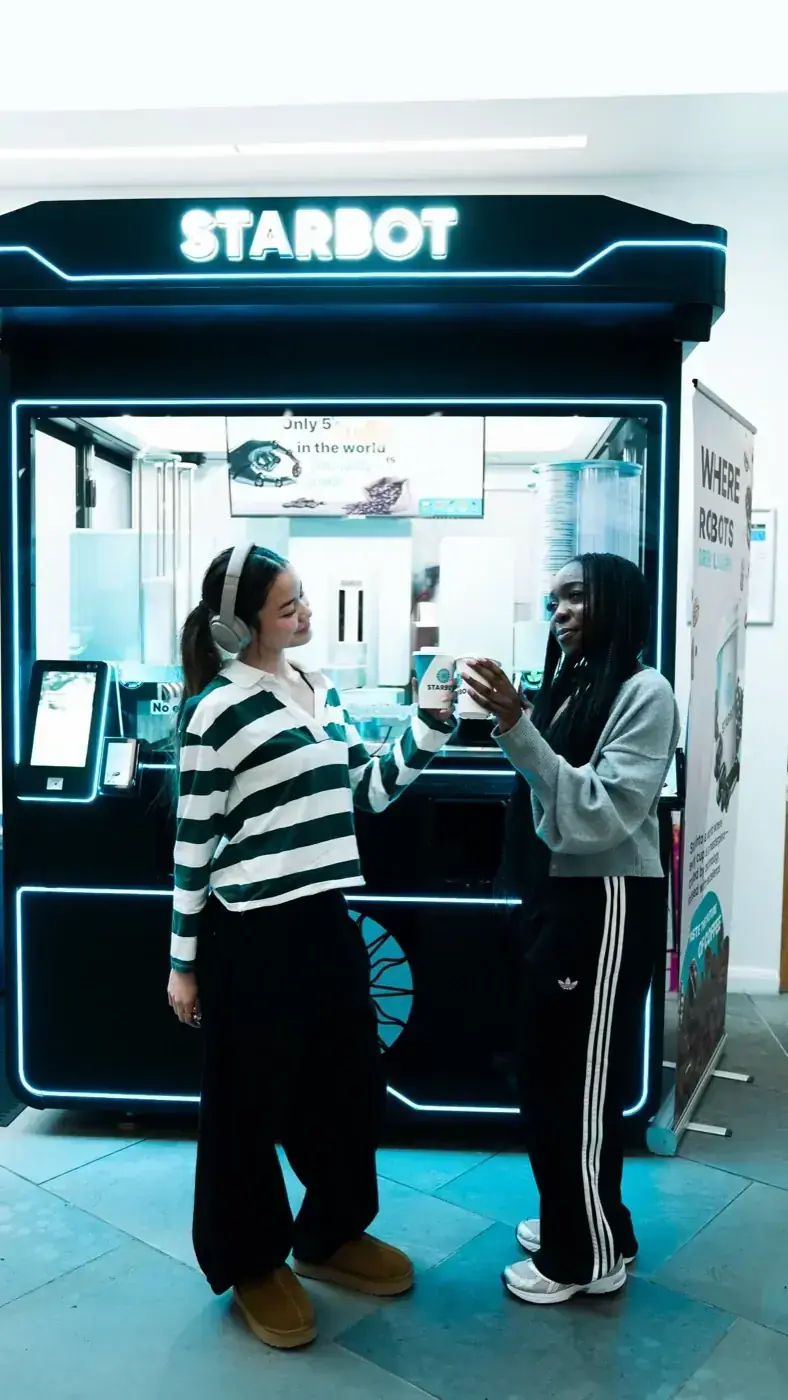
Guests holding STARBOT coffees beside the kiosk at the London launch
The case

Why a kiosk, in this kind of building.

Shift changes, sharp and predictable — three a day on a 24-hour site, each one a wall of people at once.

A distribution site does not have a coffee problem in the way an office does. It has a break problem. Two hundred people come off a shift inside the same ten minutes, and everything they can do in a twenty-minute break has to happen in a room with a kettle, a vending bank and a queue. There is nowhere to walk to, because the nearest anything is fifteen minutes away by car and the car is in a locked yard.

That makes the drink itself unusually load-bearing. On a site competing for pickers and drivers against three other sheds within a few miles, the break room is one of the very few things a site manager can visibly improve without a headcount case. A machine that makes a proper flat white in under 60 seconds is a small thing, and on a hard-to-staff site small visible things are what the exit interviews are actually about.

The other half of the argument is the hours. A 24-hour operation has a shift change at times when nothing within reach is open at all, and no staffed option has ever existed for 02:00. A kiosk trades those hours at the same cost as it trades the day ones, which is nothing, because there is no wage attached to it standing there.

Specialty Grade 1 coffee beans held in a hand before loading the hopper
Specialty Grade 1 beans
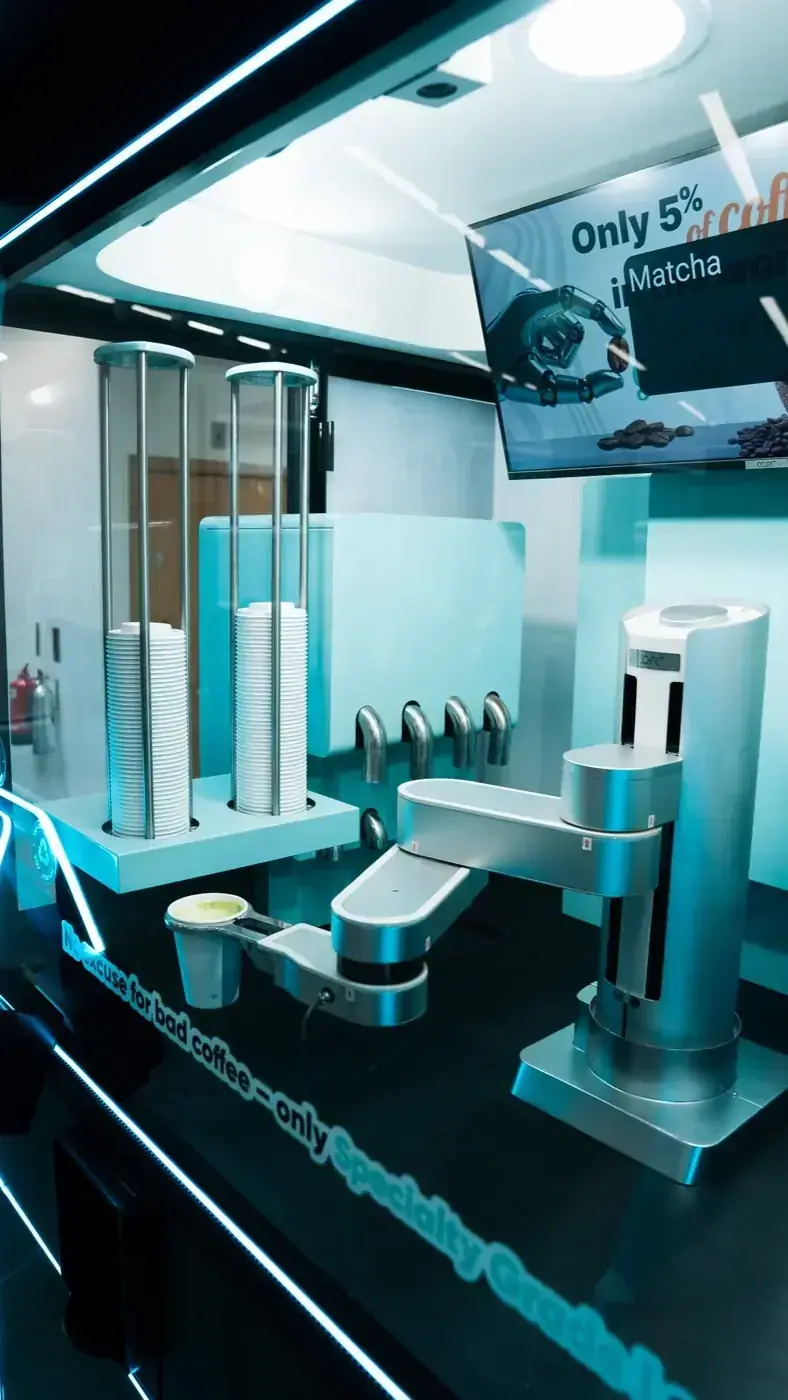
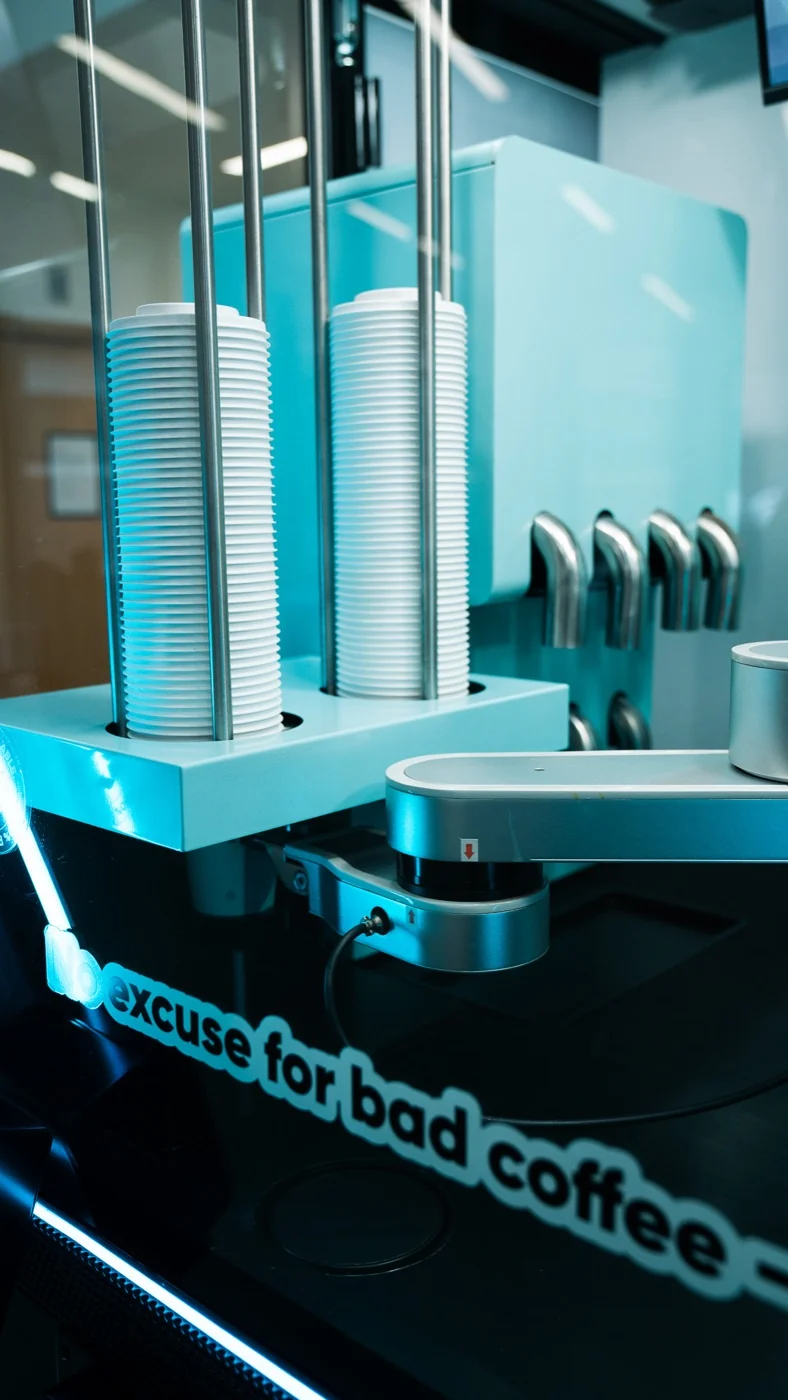
The interior mechanism of the STARBOT kiosk with cups and hoppers
Inside the unit
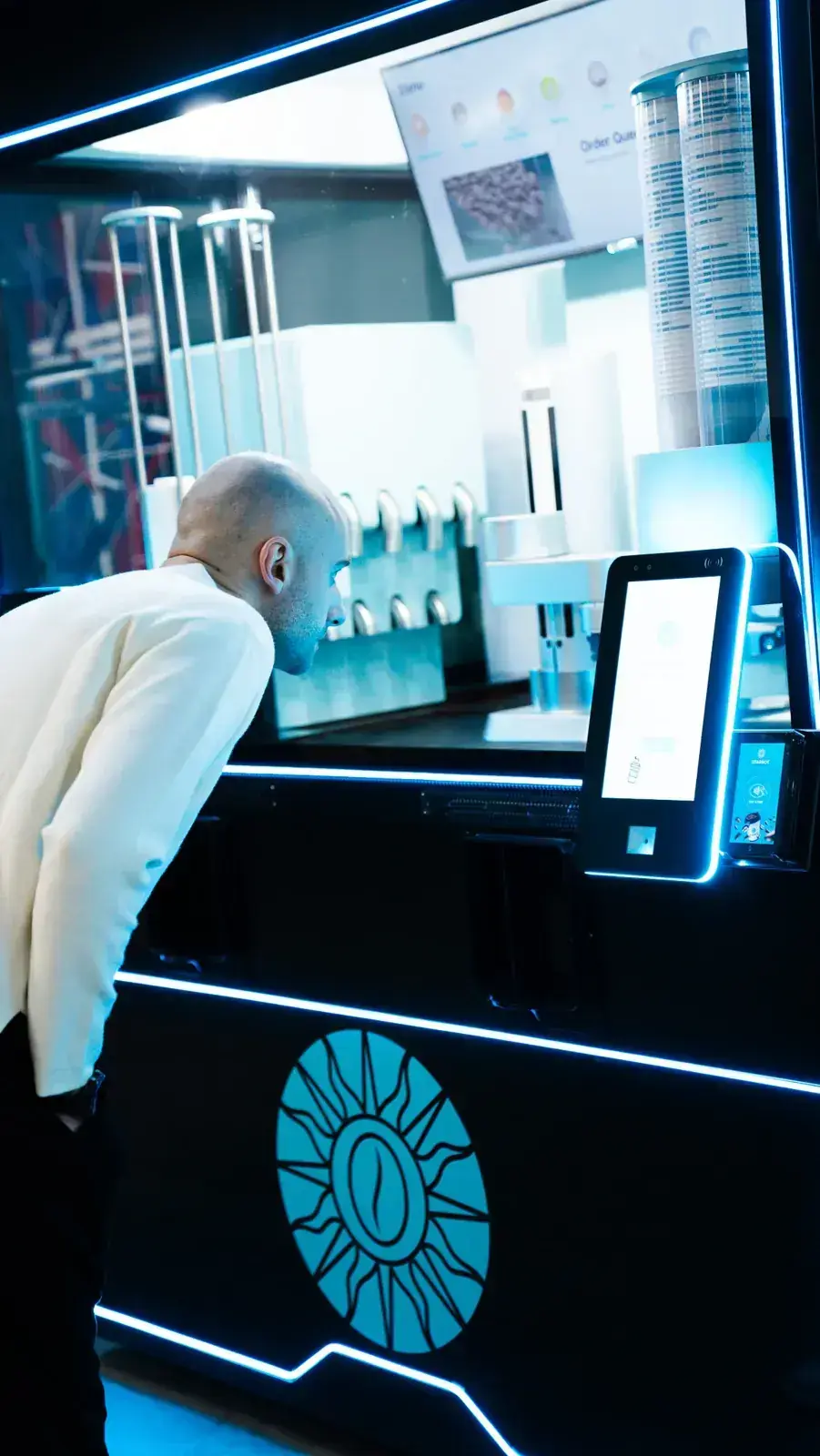
Two people choosing drinks at the STARBOT ordering screen
Two at the screen

Photographed at City St George’s, University of London — our live site. Real photography, no renders.

The first objection

“Our break rooms already have vending.”

What actually happens

Where the incumbent gives up

Distribution parks have no coffee within walking distance, so the break room machine is the only option and everyone knows it.

This is the part nobody puts in the business case, because it is nobody’s job to write it down.

Our answer

What the kiosk does instead

Vending sells the drink people settle for. The retention argument on a hard-to-staff site is the drink they actually want.

Same drink at 06:00 and at 22:00, without a wait, from 2.5 m² of floor.

The trading day

A day in warehouses and logistics sites, hour by hour.

Not a generic day. This is how the demand actually arrives in this kind of building — including the hours a staffed counter is paid for and nobody comes.

Trading pattern · warehouses

The morning shift change. Outgoing nights and incoming days pass each other in the same corridor, and the whole demand for the next four hours happens inside about twenty minutes.

Drivers cycling through on their own clock rather than the shift's. They arrive individually, they cannot leave the site, and they have a fixed window before the next run.

First break. Fixed, short and simultaneous — the break room fills and empties on a timer, which is the single most demanding pattern any venue on this site produces.

Lunch, staggered across departments on a large shed but still compressed. Nobody is leaving site, so everything consumed in this hour is consumed in the break room.

The afternoon shift change, and the second wall of people. On a three-shift site this repeats a third time in the evening with the same shape.

The night shift comes on. Nothing else within reach is open, which makes this the least contested trade of the entire day and the one no staffed option has ever served.

The middle of nights. Low volume, high value to the people buying, and the hour that decides whether the machine is seen as a genuine improvement or as another vending box.

Why it holds up here
Absorbs a whole shift change without a queue
Runs at 02:00 on a 24-hour site, where nothing else is open
A cheap retention lever where staffing is the hardest problem on site
Where it stands

The position decides the numbers.

Two spots forty metres apart in the same building can differ by half the sales. These are the positions that work in warehouses — and the one that does not.

Inside the main break room, on the route in

The break room is where the twenty minutes is actually spent, and the position that works is the one people reach before they sit down. A machine at the far wall past the tables gets used by whoever is already up; one by the door gets used by everyone entering.

Beside the clocking-in point or turnstile

Shift change is the biggest single moment of the day, and the clock is the one place every person on the site passes at a fixed time. It catches the outgoing shift as well as the incoming one, which no break room position does.

The driver reception or transport office

Drivers are a separate population with their own dwell time and no access to the main facilities. A position in driver reception serves people who are held on site by their loading slot, and who currently have nothing at all.

Not on the warehouse floor itself

Anywhere inside the operation means forklift routes, dust, temperature and a food and drink rule that exists for good reasons. The kiosk belongs in the welfare side of the building, behind the line where PPE stops being required.

Getting it approved

How a yes actually happens here.

Warehouse decisions are made on site far more often than head office people expect. The general manager or site manager can normally say yes to something in the welfare area, with HSE checking it and the operations manager confirming it does not affect the break schedule. The complication is not seniority, it is that a site is judged on throughput, so anything perceived as slowing a shift change gets refused quickly.

The second party is often not the occupier at all. Many sheds are run by a third-party logistics operator on a contract with a retailer or manufacturer, and that contract has a term. The practical effect is that the licence has to be easy to transfer or end, and that a site manager will ask what happens at contract renewal before they ask anything about coffee.

Who has to say yes

What estates and compliance ask · answered

Does it affect our shift-change timings?

Only if it is sited badly. Each drink is served without a wait and there is nobody to talk to, so a queue moves at machine pace, but a position that puts that queue across the route from the clock to the floor is a genuine problem. That is a siting decision made on the walk-round, not afterwards.

Where does it sit relative to PPE and forklift routes?

On the welfare side of the line, never on the operational floor. It needs to be somewhere people have already taken off the high-vis, away from any MHE route, which in practice means the break room, the corridor to it, or the clocking area.

Who is responsible for it under our health and safety arrangements?

We are. It is our equipment, tested and insured as ours, and your HSE manager is not adopting an asset or an inspection duty. What they are approving is a position, which is the part that genuinely belongs to them.

Our site runs on a 3PL contract that is up for renewal. What happens then?

The licence ends by notice on either side and we collect the kiosk. Nothing is fixed to the building and there is no reinstatement, so a change of operator is a phone call rather than a dilapidation. If the incoming operator wants it, it stays exactly where it is.

Does it need plumbing or a drain in the welfare area?

No. It runs from a refillable water supply and a standard 16A socket, which is why it can go into an existing break room rather than needing the welfare block altered. Nothing is fastened to the fabric of the building.

How does servicing work on a secure site with an induction requirement?

The same way any contractor attends: our engineer is inducted and booked in like anyone else. Because the kiosk reports its own fault and stock state, the visits are scheduled rather than reactive, which makes them much easier to fit around a site that controls access tightly.

Nothing here needs plumbing, drainage or a fixing to the fabric of the building. The kiosk stands on the floor and plugs into a standard socket.

What the site has to be able to offer
2.5 m² in the welfare area, off the operational floor and off any MHE routeA standard 16A socket within reach of the positionA goods route in — a level door or dock, not a stair to a mezzanine canteenContractor access arrangements, including induction, for restocking and servicingA named site contact who can be reached across shifts, not only on days
Operations

Who does what, once it is in.

A vending contract creates work for your facilities team. This one does not: restocking, cleaning, faults and reporting are ours.

Restocking is set by shift pattern, not by a weekly round

The kiosk reports its own stock, which on a shed matters because consumption is decided by the shift roster. A site adding a night shift for peak season empties it at a completely different rate, and the refill follows the sales rather than a calendar somebody set in January.

Peak season is the test and it is planned for

Logistics sites double their headcount for a few weeks a year and the break room feels it first. Because replenishment is driven by what the machine has actually sold, a seasonal ramp shows up in the data as it starts rather than as an empty hopper at 02:00 in December.

Nothing is added to the site team's list

The milk path, drip tray and interior are ours. There is no open jug, no hot plate and no grounds bin for a break-room cleaner to deal with, which matters in a welfare area that is cleaned to a schedule by people who have plenty to do already.

Faults are reported by the machine, on nights as well as days

The kiosk reports its own fault state, so a failure at 01:00 does not depend on a night shift manager finding a number for it. On a site where the alternative is nothing at all for eight hours, that is the difference between a machine people trust and one they stop walking to.

A customer ordering coffee at the STARBOT touchscreen
Ordering, mid-morning
The robotic arm inside the STARBOT kiosk placing a cup
The arm, mid-cycle
Espresso extracting into a cup inside the STARBOT kiosk
Extraction, per cup

Photographed at our live site in London. Real photography, no renders.

What gets signed

A site licence, not a lease.

A logistics site signs a site licence rather than a lease: permission to place and operate a machine in a defined position in the welfare area. It gives no exclusive possession of any part of the building and creates no tenancy, which is what makes it a site-level decision rather than something that has to go through a property team.

The commercial side has two common shapes here. On revenue share the staff pay by card, drinks start at £2.00, and the site takes an agreed share of every cup. On sites where the coffee is being used as a retention lever, the operator would rather it were free at the point of use and covers it themselves — the same kiosk, a different tariff setting, and a decision the site can revisit later.

Exit is deliberately simple because logistics contracts are not. Notice on either side, we collect the kiosk, nothing to reinstate. Where a shed changes 3PL operator, the machine either transfers to the incoming operator on the same terms or comes out, and neither outcome requires anybody to involve a solicitor at a moment when they are already busy.

If a site or an operator would rather run the machine itself — some do, particularly where coffee is being provided free as part of a retention package — it is available on a five-year lease at £1,790 a month. Same kiosk, same servicing, different commercial footing.

The commercial shape — a share of every cup, or a fixed monthly fee for the space — is set out before anything is installed. See how hosting works.

Versus the alternatives

Every other option, including where we lose.

If one of the rows above ours fits your building better, take it. We would rather not install a kiosk than install one into a position that cannot carry it.

The optionHow it plays out hereWhere it falls down
The vending bank already in the break room

Installed, familiar, cheap per cup, and it covers the basic need for something hot at 02:00.

It sells the drink people settle for, and everyone on site knows it. On a shed where the alternative is a fifteen-minute drive, it is tolerated rather than chosen, and it contributes nothing to the one problem the site actually has, which is holding on to staff.

A kettle, an urn and instant coffee

The default in most welfare rooms, effectively free, and nobody has to approve anything.

It cannot absorb a shift change. Two hundred people on a twenty-minute break do not queue for a kettle; they give up, and the break gets spent on a phone instead. It is also the item most likely to be left on, which is why some sites have removed them entirely.

A staffed canteen counter

The traditional answer on a large site, and on the biggest sheds with a real catering contract it works.

It is paid for the whole shift to serve three ten-minute walls of people, and it is never open on nights — which is exactly when the site has least to offer. Catering contracts on distribution sites are among the first things cut when a 3PL contract is repriced.

Nothing — people bring their own or drive out

Zero cost to the site, and there is usually a services or a drive-through within a few miles.

Nobody can leave a secure yard inside a twenty-minute break, so 'drive out' is not real. What actually happens is people bring a flask, the break room feels like an afterthought, and the site keeps losing the recruitment argument to the shed down the road.

A STARBOT kiosk

Barista-grade drinks without a wait in the welfare area, trading at 02:00 as readily as at 10:00, that footprint, no capital cost on revenue share.

It is a machine in a room where the pressure is a fixed twenty-minute break, so a genuine two-hundred-person simultaneous wall wants a second position rather than heroic throughput from one. It also has to be paid for by somebody: on a site where the workforce will not spend on coffee, the honest model is the operator covering it, not revenue share.

The last row is ours, with its real downside written in. Revenue share and unit pricing are agreed per site and are not published.

When to say no

Where this is the wrong answer.

Four cases in this venue type where we would tell you not to bother. They cost us installs; printing them costs less than a kiosk that never earns.

Siting mistakes

Four ways to put it in the wrong place.

Each of these has happened somewhere, and each shows up as the same thing on the report: a position that takes half of what the footfall said it would.

Siting it across the shift-change route

A queue between the clock and the floor turns coffee into a throughput problem, and the moment an operations manager sees that happen the machine is finished regardless of how good it is. The same kiosk a few metres off the flow serves the same people without ever appearing in a shift-change conversation.

Putting it on the operational floor

Dust, temperature swings, MHE routes and a food and drink rule that exists for real reasons. Beyond the compliance argument it simply gets used less, because people will not stop for a drink while they are still in PPE and on the clock.

Choosing the position for the day shift only

The most defensible trade on a 24-hour site is 22:00 and 02:00, when nothing within reach is open. A position inside a part of the building that is locked or unlit on nights throws away the hours that had no competition at all.

Ignoring the drivers

Drivers are held on site by a loading slot, cannot leave the yard and have no access to the main welfare area. Siting purely for warehouse staff misses a captive population with genuine dwell time, and on some sheds that is the steadier half of the trade.

Where these cluster

The cities this venue type is thickest in.

Density matters to us as much as footfall: several sites inside one servicing round is what keeps a kiosk free to host.

Birmingham

The M42 corridor is the middle of the country's distribution network, where sites are surrounded by other sites and by nothing else at all.

Leeds

The M62 and M1 sheds around the city run three shifts on estates where the nearest coffee is a motorway services rather than a high street.

Manchester

Regional distribution around the motorway box operates around the clock, and the night trade there has never had any staffed option to compete with.

Sheffield

Logistics sites on the M1 corridor sit outside a walkable centre, which makes the break room the whole of the offer rather than one option among several.

Questions from this kind of building

The ones worth asking before you sign.

Our break rooms already have vending. Why change anything?

Because vending and this are answering different questions. Vending covers the need for something hot; it has never been a reason anybody stayed in a job. On a site where the nearest coffee is a fifteen-minute drive and the yard is locked, the break room is one of the few things a site manager can visibly improve, and a proper flat white without a wait is a bigger lever there than it would be anywhere with a café across the road.

Will it hold up a shift change?

Not if it is sited off the route from the clock to the floor. Drinks are served without a wait with nobody to talk to, so the queue moves at machine pace, but a position that puts that queue across the flow is a genuine operational problem and we treat it as a siting decision rather than something to argue about afterwards.

Can it go on the warehouse floor?

No, and it should not. It belongs on the welfare side of the PPE line, away from MHE routes, dust and temperature swings. Beyond the compliance point, people do not stop for a coffee while they are still on the clock and in high-vis, so a floor position would be used far less anyway.

We run this site under a 3PL contract that is up in two years. Is that a problem?

No. It is a site licence with notice on either side and nothing fixed to the building, so a change of operator is a phone call. If the incoming operator wants the kiosk, it stays where it is on the same terms; if not, we collect it and there is nothing to reinstate.

Does it work on nights?

Nights are the strongest argument on the whole site. At 22:00 and 02:00 nothing within reach is open, there has never been a staffed option for those hours, and the kiosk costs exactly the same to run then as at midday because there is no wage attached to it standing there.

What about our drivers — they cannot get into the main building.

They are often the better half of the trade, and driver reception is a position in its own right. Drivers are held on site by a loading slot, they have dwell time they cannot spend anywhere else, and at the moment most sheds offer them nothing at all.

Who pays — the site or the staff?

Either. On revenue share the staff pay by card, drinks start at the entry price and the site takes a share of every cup. Where the coffee is being used as a retention lever, most operators would rather cover it and hand it out free — the same machine on a different tariff, and a decision that can be changed later.

How does an engineer get on site with our induction rules?

Inducted and booked in like any other contractor. Because the kiosk reports its own stock and fault state, visits are planned rather than reactive, which is much easier to fit around a secure site than a supplier turning up unannounced when something has broken.

Our headcount doubles for peak. Will it keep up?

Replenishment follows what the machine has actually sold rather than a fixed round, so a seasonal ramp shows up as it starts. The honest limit is that one machine on a two-hundred-person simultaneous break is one machine — if your peak break is genuinely that compressed, the answer is a second position rather than a bigger promise.


Not what you were after? All sixteen venue types · Host a kiosk at your site · Own a STARBOT franchise · Lease a unit · Own one · £1,790/mo

Tell us about your building.

Postcode, venue type and rough daily footfall is enough to start. We come back with a footfall-based model for your site — usually within a day.

Or go direct — WhatsApp hello@starbot.co.uk

Tell us about your site.
We reply the same day.

No obligation, no credit search, no spam — one reply from the team with the exact numbers for your venue.

Prefer to talk? WhatsApp us — or ask Richard, bottom right.