Live · City St George’s, University of London

Coffee machines for care homes

Proper coffee for visiting families and night staff, without taking a carer off the floor to make it. Free to host — we install, stock and service it; your site

150cups a day, first London site
2.5 m²and one 16A socket
£0to install and to run
Guests holding STARBOT coffees beside the kiosk at the London launch
The case

Why a kiosk, in this kind of building.

Visiting hours in the afternoon, plus night staff on a twelve-hour shift with nowhere to go.

In a care home the coffee question is really a staffing question. Every drink made for a visiting family is made by a carer who has stepped away from the floor to make it, and carer time is the one resource a home genuinely cannot create more of. A kiosk in the visitors' area does not improve on a carer's hospitality — it removes the need to choose between hospitality and the resident who needed help at the same moment.

The second audience is the night team. A twelve-hour shift from evening to morning, in a building with no shop, no café and nowhere to go, currently runs on instant from a kettle in a staff room. It is a small thing and it is not a small thing: on a site where recruitment and retention are the hardest problem in the sector, a decent coffee at 03:00 is one of the few improvements a home can make without a rota change.

The third reason homes look at this is the show-round. A family choosing a home for a parent decides on the feel of the building in the first fifteen minutes, and increasingly the newer homes are built with a bistro or coffee corner for exactly that reason. A kiosk gives an older building the same moment without converting a room or employing anybody to stand in it.

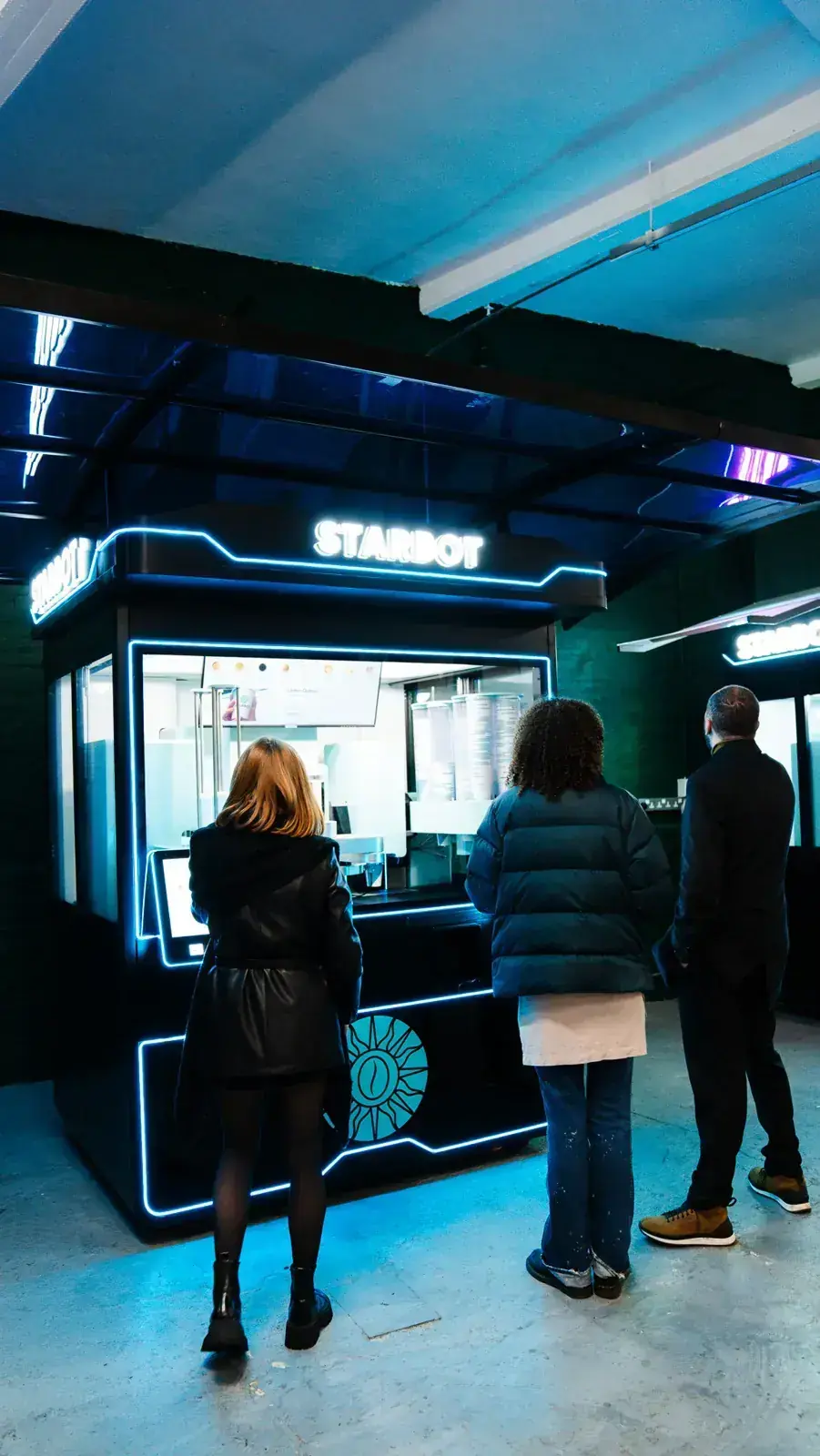
People queueing at the STARBOT kiosk during a busy period
A queue that clears
Someone working on a laptop with a STARBOT coffee beside them
Dwell time, on site
Specialty Grade 1 coffee beans held in a hand before loading the hopper
Specialty Grade 1 beans

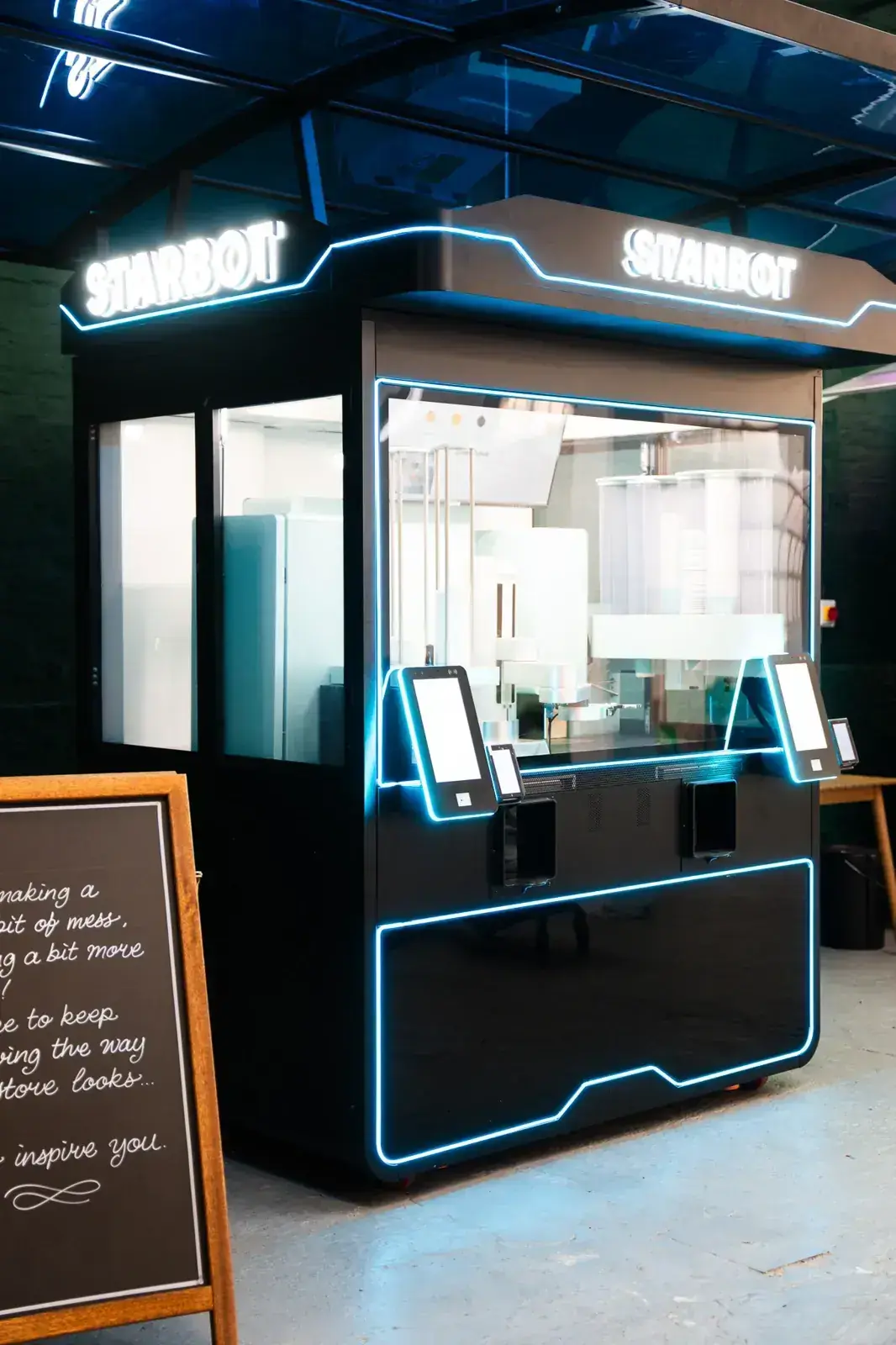
Photographed at City St George’s, University of London — our live site. Real photography, no renders.

The first objection

“Our residents cannot use a touchscreen.”

What actually happens

Where the incumbent gives up

Making a visitor a coffee currently costs you a carer's time, which is the one thing a home cannot spare.

This is the part nobody puts in the business case, because it is nobody’s job to write it down.

Our answer

What the kiosk does instead

The buyers here are visitors and staff, not residents — and a large-target screen with three taps is easier than the kettle in the staff room.

Same drink at 06:00 and at 22:00, in under 60 seconds, from 2.5 m² of floor.

The trading day

A day in care homes, hour by hour.

Not a generic day. This is how the demand actually arrives in this kind of building — including the hours a staffed counter is paid for and nobody comes.

Trading pattern · care homes

Handover. The night team finishes a twelve-hour shift and the day team arrives, and for twenty minutes the building has twice as many staff in it as usual.

The morning routine. Almost nobody is buying coffee — this is the part of the day when carers are least able to stop and most likely to be asked to.

Visiting professionals: the GP round, district nurses, the chiropodist, the hairdresser, physiotherapists. A steady weekday population nobody counts as footfall.

The visiting peak. Families after school and after work, the activities session, and the show-round with a prospective family — the highest-stakes coffee in the building.

Evening visitors, then handover again at around 20:00 as the night team takes over for another twelve hours.

Nights. A small team, no shop within reach, no café open, and a kettle in the staff room as the only option for eleven hours.

The busiest visiting day of the week, and the day with the fewest staff available to make anybody a drink.

Why it holds up here
Frees carers from making drinks for visitors
Night staff on twelve-hour shifts get something better than instant
No open jugs or hot plates left unattended in a residential setting
Where it stands

The position decides the numbers.

Two spots forty metres apart in the same building can differ by half the sales. These are the positions that work in care homes — and the one that does not.

The visitors' lounge or reception coffee corner

This is the position that serves the audience that actually pays: families, visiting professionals and prospective residents' relatives on a show-round. It works because it is off the residents' living areas but immediately visible from the front of the building.

Near the family room, not inside it

Homes keep a quiet room for private conversations with relatives, and a machine inside it would be intrusive. Immediately outside, families can get a drink before or after without a member of staff having to leave the floor to offer one.

The staff area, in larger homes taking a second position

Most homes take one kiosk and put it where visitors are. Where a home is large enough for a second, the staff area is the one that changes the night shift, and it is the position with the clearest retention argument behind it.

Not on a residents' walking route

Corridors in a care home are circulation for people with frames, wheelchairs and hoists, and they are also wayfinding for residents living with dementia. A new object in a familiar corridor is both an obstruction and a source of confusion, and neither is worth a coffee.

Getting it approved

How a yes actually happens here.

Nothing enters a care home without the registered manager. They are the named, accountable person on the home's registration, and a decision that touches residents, visitors, hot drinks or corridors is theirs regardless of who owns the building. In a group, the regional or operations director signs the commercial side and the group's estates or health and safety lead does the practical check, but the registered manager is the one who can stop it.

What they are weighing is not price. It is risk assessment: hot drinks in a residential setting, infection prevention, obstruction of circulation, and what a resident living with dementia might do with an unfamiliar machine. Those are legitimate questions with real answers, and the honest position is that siting is the control — this is a conversation about where it goes, not about whether the machine is safe in the abstract.

Who has to say yes

What estates and compliance ask · answered

It dispenses a hot drink. How is that safe here?

It dispenses hot drinks and that has to be risk assessed by you, not asserted by us. What we can say is that the control is siting: in the visitors' area, off resident circulation, in sight of the desk. There is no open jug, no hot plate and no urn standing unattended, which is more than can be said for the current arrangement in most lounges.

What does infection prevention make of it?

The cup path is sealed, there is no open milk jug and no exposed grounds, the exterior is a wipe-down surface, and the interior is cleaned and serviced by us on a logged schedule rather than by care staff between rounds. Your IPC lead is reviewing a sealed machine, not a shared kitchen appliance.

Will it obstruct a corridor used with hoists and frames?

It must not, and that rules out most corridor positions in a care home before we start. The footprint is tiny, which usually means the visitors' area or a reception corner rather than anywhere residents circulate — and we would rather rule a position out at survey than have it moved after an incident.

Could it confuse a resident living with dementia?

It is an unfamiliar object, and in a building where wayfinding is deliberately consistent that is a real consideration. It is one more reason the position is the visitors' side of the home rather than a residential corridor, and it is a question we expect the registered manager to answer for their own residents rather than one we would answer for them.

Does it add anything to our maintenance or cleaning schedule?

No. Restocking, cleaning, servicing, repair and insurance are ours, and the servicing is logged, so the home has a record to point at rather than a piece of equipment with no paperwork behind it.

Who is responsible for it at 03:00?

We are. It reports its own fault state, so an engineer is normally scheduled before the night team has noticed, and there is nothing on it for a member of staff to open, reset or clean during a shift.

Nothing here needs plumbing, drainage or a fixing to the fabric of the building. The kiosk stands on the floor and plugs into a 16A socket.

What the site has to be able to offer
2.5 m² off the residents' circulation routes, normally in the visitors' areaA standard 16A socket at the positionA wipe-down floor rather than a lounge carpetA position visible from reception or the deskDelivery access that does not cross resident areas during personal care or mealtimes
Operations

Who does what, once it is in.

A vending contract creates work for your facilities team. This one does not: restocking, cleaning, faults and reporting are ours.

Deliveries are timed around the home, not around us

Restocking is scheduled away from mealtimes, medication rounds and personal care, because a delivery trolley in a corridor at the wrong hour is a genuine disruption in a care setting. The kiosk reports what it has sold, so visits follow real consumption rather than arriving weekly regardless.

The servicing is logged, and the log is yours to show

Cleaning of the milk path, drip tray and interior is on our schedule and recorded. Homes live with inspection, and a piece of equipment that comes with a maintenance record attached is a very different proposition from a machine somebody donated to the staff room three years ago.

No carer is taken off the floor

This is the operational point the whole page rests on. A visitor who wants a coffee gets one without anybody being asked, which means the carer who would have made it stays with the resident who needed them. It is a small reallocation repeated many times a day.

Faults come to us, not to the manager on duty

The kiosk reports its own fault state and an engineer is dispatched on that signal. There is no supplier for a senior carer to ring at 22:00 and no line in the home's maintenance budget for a coffee machine.

The STARBOT kiosk from the side, showing its footprint against a wall
The unit, side on
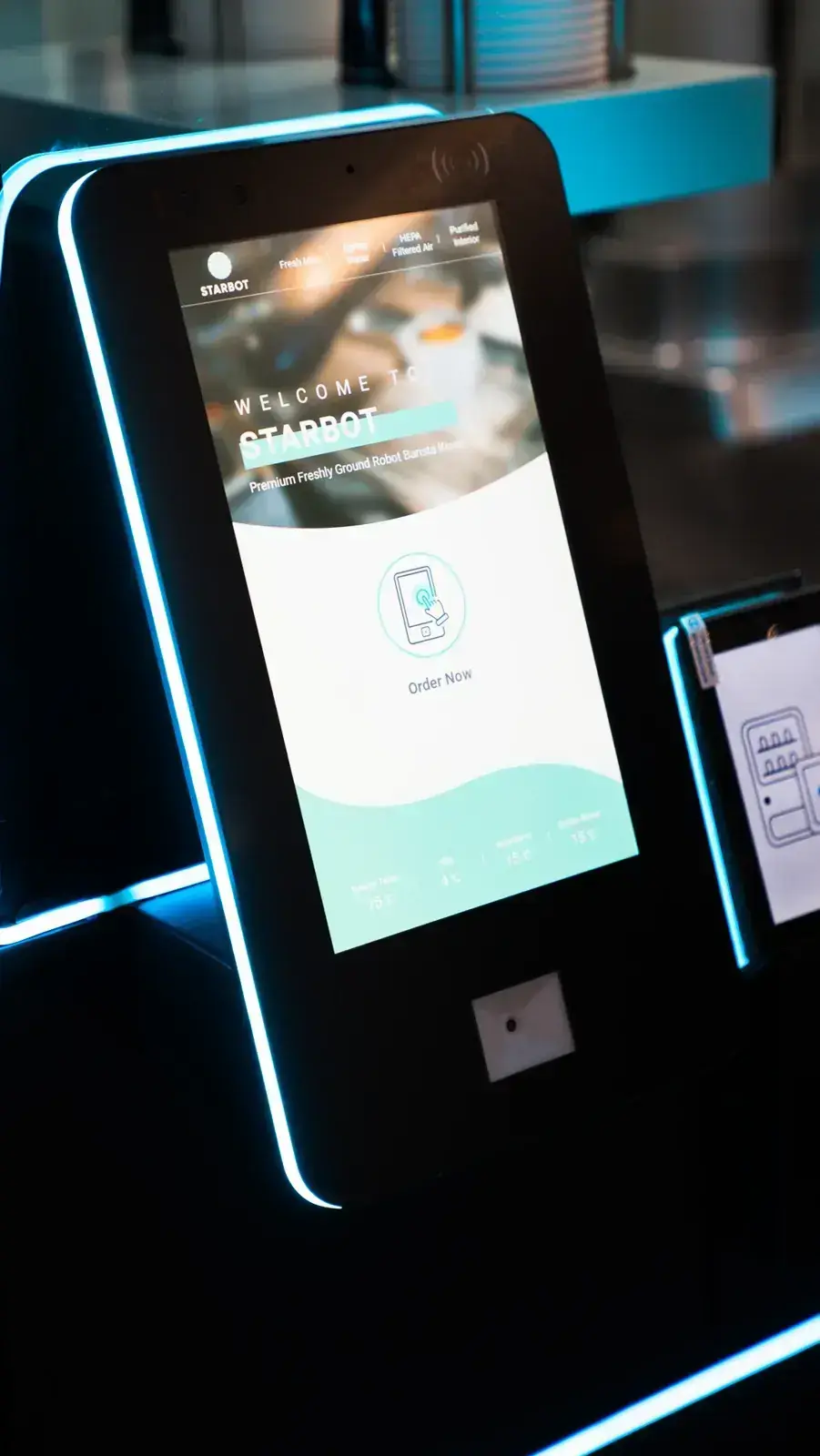
The STARBOT ordering touchscreen taking a contactless card payment
Tap, choose, pay
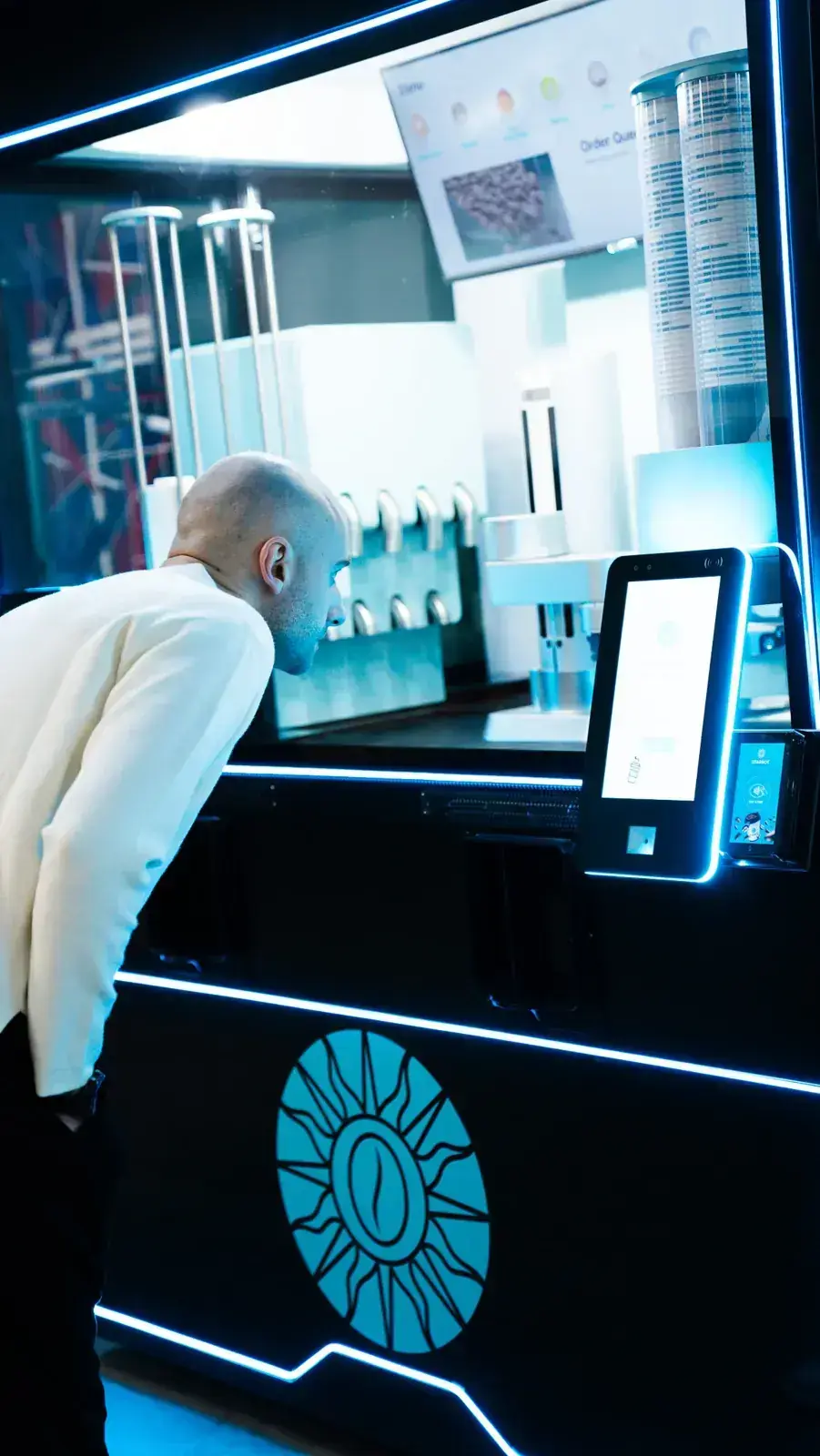
A customer ordering coffee at the STARBOT touchscreen
Ordering, mid-morning

Photographed at our live site in London. Real photography, no renders.

What gets signed

A site licence, not a lease.

The home signs a site licence: permission to place and operate the kiosk in an agreed position. It is not a lease and creates no tenancy, which matters in a sector where the building is frequently owned by one entity and the care operated by another — the licence is signed by whoever controls the space, which is normally the operating company rather than the property owner.

Commercially most homes choose between two shapes. On revenue share, visitors and staff pay by card, drinks start at £2.00, and the home takes an agreed share of every cup with no capital cost. In host mode the home covers the cups and the coffee is free to families, which is the choice homes make when they are treating it as part of the welcome rather than as an income line.

Because the position is decided by a risk assessment that belongs to the registered manager, the licence should provide for moving it. If the home's assessment changes — a new resident, a change of layout, a refurbishment — relocating the kiosk is a visit, not a negotiation, because nothing is plumbed or fixed to the building.

Exit is notice on either side with nothing to reinstate. For a group rolling out across several homes, the same kiosk is also available on a five-year lease at £1,790 a month if the operator would rather run the equipment itself than license it.

The commercial shape — a share of every cup, or a fixed monthly fee for the space — is set out before anything is installed. See how hosting works.

Versus the alternatives

Every other option, including where we lose.

If one of the rows above ours fits your building better, take it. We would rather not install a kiosk than install one into a position that cannot carry it.

The optionHow it plays out hereWhere it falls down
A carer makes it

The current answer in most homes, and it is warm, personal and exactly the hospitality a family remembers.

It costs the one thing the home cannot buy more of. Every coffee made for a visitor is a carer away from the floor, and on a Sunday afternoon with a full visiting room and a thin rota, the hospitality either does not happen or something else does not.

A filter jug or urn in the lounge

Cheap, requires no decision, and covers a visiting afternoon without anybody being asked.

An unattended hot vessel in a residential setting is its own risk assessment, the coffee is poor by the second hour, and somebody still has to make it, refill it and clear it away — which is a carer again.

A vending machine

Unstaffed, cheap, reliable, and it has been the default in institutional buildings for decades.

It looks institutional, which is the precise impression a home selling itself to a family is trying to avoid. A daughter deciding where her mother will live notices a vending machine in a corridor, and not favourably.

A bean to cup machine in the visitors' lounge

Better coffee than an urn, no cash, and the home owns it outright.

Somebody has to descale it, refill the milk, empty the grounds and clean it — and in a care home that somebody is a carer or a housekeeper. It also becomes the home's asset, its maintenance cost and its problem when it fails on a Sunday.

A STARBOT kiosk

Specialty coffee for visitors, professionals and the night team, serviced and insured by us, in a corner of floor with no capital cost on revenue share.

Residents are largely not the customer, so a home that wants something for residents specifically is being sold the wrong thing. The volume in a small home is genuinely low and we will say so rather than install and remove. And it is a machine, in a building whose entire proposition is human care — some registered managers will assess the hot-drink risk and conclude no, and that is a legitimate answer we are not going to argue with.

The last row is ours, with its real downside written in. Revenue share and unit pricing are agreed per site and are not published.

When to say no

Where this is the wrong answer.

Four cases in this venue type where we would tell you not to bother. They cost us installs; printing them costs less than a kiosk that never earns.

Siting mistakes

Four ways to put it in the wrong place.

Each of these has happened somewhere, and each shows up as the same thing on the report: a position that takes half of what the footfall said it would.

Siting it on a residents' corridor

It obstructs circulation used with frames, wheelchairs and hoists, and it changes a route that residents living with dementia navigate by familiarity. The consequence is not a slow month of sales, it is an incident, and it is entirely avoidable by staying on the visitors' side of the building.

Putting it beside the main entrance

Main doors in many homes are managed carefully because of residents who are inclined to leave, and adding a machine that draws people to stand near the entrance makes that harder for the staff who manage it every day.

Hiding it in the staff room only

It becomes a staff benefit with no visitor trade behind it, which halves the argument for having it and removes the show-round moment entirely. In most homes the visitors' area comes first and the staff position is a second machine, not an alternative to the first.

Standing it on a lounge carpet

Care home lounges are carpeted and spills happen, especially where the person carrying the cup is also carrying a bag, a coat and a conversation. A wipe-down floor near reception avoids a year of marks in the room families are shown into.

Where these cluster

The cities this venue type is thickest in.

Density matters to us as much as footfall: several sites inside one servicing round is what keeps a kiosk free to host.

Leeds

A large health and care workforce clustered around one of the biggest teaching hospitals in Europe, with residential care sites shift-changing on the same 07:00 and 19:00 pattern.

Newcastle

A compact centre and its surrounds mean one engineer can cover several homes in a morning, which is what makes single-machine sites viable here earlier than elsewhere.

Bristol

Care sites in the out-of-town belt around the city have no café within walking distance, so the staff room kettle really is the only option on a night shift.

Birmingham

The West Midlands has a dense residential care estate spread across suburbs and the M42 corridor, which suits a servicing round built around clusters rather than single visits.

Questions from this kind of building

The ones worth asking before you sign.

Our residents could not use a touchscreen. Does that not make it pointless?

The customers here are visitors, visiting professionals and staff, not residents — families arriving on a Sunday afternoon and a night team on a twelve-hour shift. Where residents do use it, the screen is large-target and the order is three taps, which is considerably easier than the kettle in the staff room. But we would not sell this to a home as a residents' amenity, because it is not one.

How do you handle the risk of a resident scalding themselves?

By siting, and by leaving the assessment where it belongs — with your registered manager. The position we recommend is the visitors' area, off resident circulation, in sight of the desk. What we can say is that a sealed machine with no open jug and no hot plate compares favourably with an urn standing on a lounge sideboard, which is what it usually replaces.

What will our infection prevention lead need to know?

That the cup path is sealed, there is no open milk jug or exposed grounds, the exterior is a wipe-down surface, and the interior is cleaned and serviced by us on a logged schedule rather than by care staff. The servicing record is available to the home, which is normally the part that matters when someone asks how it is maintained.

Will an inspector ask us about it?

We are not going to tell you what your inspector will focus on. What we would say is that the things usually asked about a piece of equipment in a home — who maintains it, on what schedule, what the risk assessment says, and where it sits in relation to residents — all have documented answers here, and the risk assessment is the registered manager's rather than a supplier's assurance.

Who pays for the coffee — visitors or the home?

Either. On revenue share, visitors and staff pay by card, drinks start at the entry price and the home takes an agreed share of every cup. In host mode the home covers the cups and coffee is free to families, which is what homes choose when they see it as part of the welcome rather than as income. Homes change their minds about this, and it is a setting rather than a different machine.

Does it create work for our maintenance or housekeeping team?

No. Restocking, cleaning, servicing, repair and insurance are all ours, and the machine reports its own faults so an engineer is usually scheduled before your team has noticed. Your housekeeper keeps cleaning the floor it stands on, and nothing else about it is yours.

Our home is small. Is it worth it?

Sometimes not, and we would rather look at your visiting pattern first than install something that stands idle. What decides it is how many visitors and visiting professionals pass the position on a normal week — not bed numbers — which is why the survey looks at the visitors' area and the Sunday pattern rather than at the size of the home.

Can we use it on show-rounds with prospective families?

That is one of the main reasons homes ask for it. A coffee handed to a daughter looking round for her mother is a fifteen-minute impression that costs no carer time, and it gives an older building the coffee-corner moment that new-build homes are designed with. The activities team tends to find its own uses for it after that.

What does the night team get out of it?

A proper drink at 03:00 in a building with nothing open and nowhere to go, instead of instant from the staff room kettle. It is a small thing to write down and a noticeable one to work with, in a sector where retention on nights is the hardest staffing problem there is.

Not what you were after? All sixteen venue types · Host a kiosk at your site · Own a STARBOT franchise · Lease a unit · Own one · £1,790/mo

Tell us about your building.

Postcode, venue type and rough daily footfall is enough to start. We come back with a footfall-based model for your site — usually within a day.

Or go direct — WhatsApp hello@starbot.co.uk

Tell us about your site.
We reply the same day.

No obligation, no credit search, no spam — one reply from the team with the exact numbers for your venue.

Prefer to talk? WhatsApp us — or ask Richard, bottom right.